
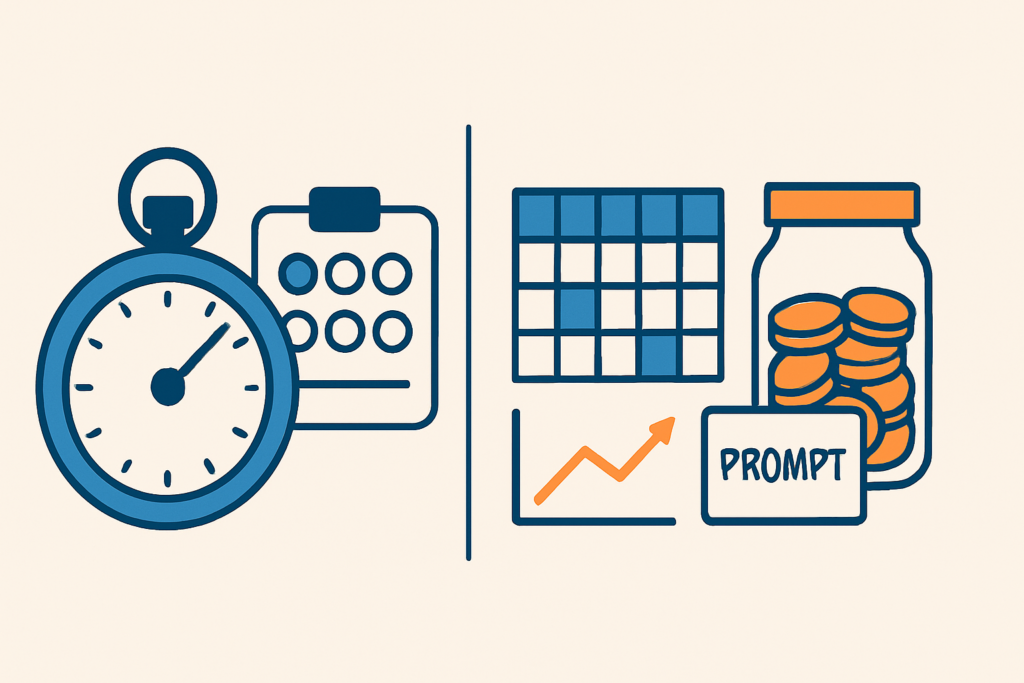
What is Partial Interval Recording?
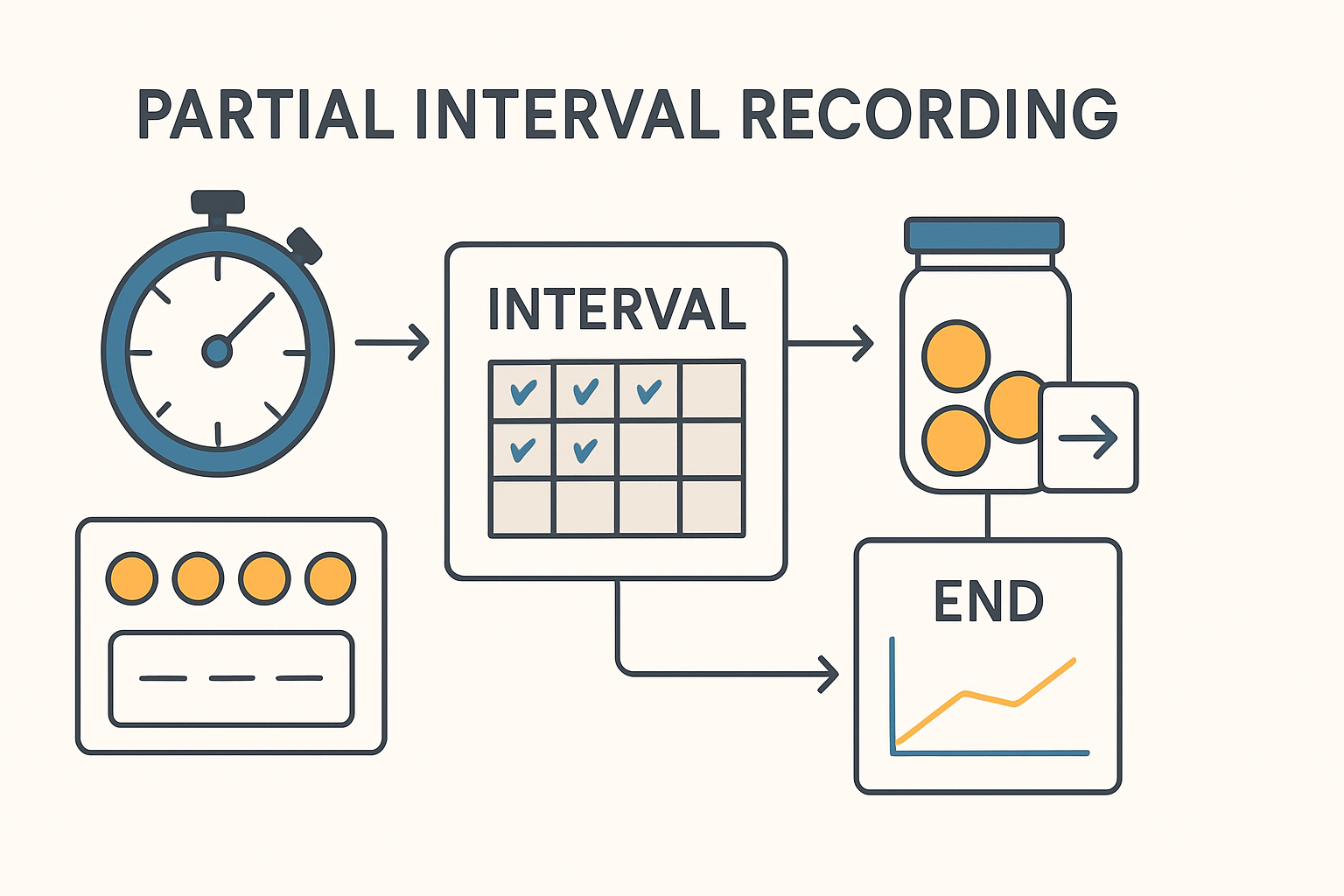
Partial interval recording is a discontinuous measurement method where you record whether a target behavior occurred at any point during predetermined time intervals. You mark an interval as ‘yes’ if the behavior happens at least once within that period, regardless of duration or frequency within the interval.
Table of Contents
- What is Partial Interval Recording?
- Applying Partial Interval Recording: ABA Examples
- Partial Interval Recording and the BCBA Exam
- Quick-Reference Implementation Checklist
- Summary and Next Steps for Mastery
This approach provides an estimate of occurrence rather than precise duration or count data.
Definition and Core Procedure
The core procedure involves dividing observation periods into equal intervals (typically 10-30 seconds). At the end of each interval, you record whether the target behavior occurred at any point during that interval. This differs from whole interval recording, which requires the behavior to persist throughout the entire interval, and momentary time sampling, which only records behavior at specific moment endpoints.
When to Use Partial Interval Recording
This method works best for behaviors that occur at high frequency or have unclear start/stop points. It’s particularly useful when you need a practical estimate of occurrence without continuous observation demands.
- High-frequency behaviors: Vocal stereotypy, hand flapping, or other rapid movements
- Behaviors with unclear boundaries: Off-task behavior, social engagement, or attention
- When continuous measurement isn’t feasible: During group instruction or when observing multiple clients
- For occurrence estimates: When you need to know if behavior is happening, not exact duration
The main advantage is its practicality for long observation periods, while the primary limitation is that it overestimates occurrence compared to duration measurement.

Applying Partial Interval Recording: ABA Examples
Understanding the theory is essential, but practical application solidifies mastery. These examples demonstrate how to implement partial interval recording in real clinical scenarios.
Example 1: Vocal Stereotypy During Group Instruction
Scenario: A student emits vocal stereotypy (humming) during 15-minute group work sessions. You’re using 10-second intervals with a total of 90 intervals per session.
ABC data: Antecedent (teacher gives group worksheet), Behavior (continuous humming), Consequence (peers look at student). The hypothesized function is automatic reinforcement from the sensory stimulation.
Data collection: Mark intervals where humming occurs at any point. If humming happens in 45 of 90 intervals, the occurrence percentage is 50%.
Example 2: Hand Flapping During Transitions
Scenario: A client engages in hand flapping during hallway transitions between activities. You’re using 15-second intervals during 5-minute transition periods.
ABC data: Antecedent (teacher says ‘line up’), Behavior (hand flapping), Consequence (transition delayed). The hypothesized function is escape from demands of the transition.
Data collection: Record intervals where flapping occurs at any moment. If flapping appears in 12 of 20 intervals, the occurrence is 60%.
Example 3: Calculating and Interpreting Your Data
After collecting data, you calculate occurrence percentage using this formula: (Intervals with Behavior ÷ Total Intervals) × 100. This percentage represents an estimate of occurrence, not duration.
For accurate measurement procedures, ensure consistent interval timing and clear operational definitions. Review our guide on data collection methods for comprehensive measurement strategies.
Partial Interval Recording and the BCBA Exam
This measurement method appears frequently on the BCBA exam, particularly in questions about selecting appropriate measurement procedures.
Key Exam Links and Task List Alignment
Partial interval recording aligns with Task List Section C-4: Measurement. You must distinguish it from other measurement methods:
- Continuous measurement: Frequency, duration, latency, interresponse time
- Whole interval recording: Behavior must occur throughout entire interval
- Momentary time sampling: Records behavior only at interval endpoints
- PLACHECK: Measures group behavior at specific moments
Understanding these distinctions is crucial for exam success. For more on measurement concepts, see our 7 dimensions guide.
Common Exam Traps and How to Avoid Them
Several predictable traps appear in measurement questions. Recognizing these patterns improves your exam performance.
- Confusing with duration measurement: Remember partial interval estimates occurrence, not duration
- Misinterpreting percentages: A 60% occurrence doesn’t mean 60% of time engaged
- Selecting for low-frequency behaviors: Use event recording instead for behaviors with clear start/stop
- Forgetting the overestimation bias: Partial interval overestimates compared to duration
- Mixing up interval types: Know when to use partial vs. whole vs. momentary
For additional exam strategies, explore our study framework guide.
Quick-Reference Implementation Checklist
Use this checklist when implementing partial interval recording in practice or studying for the exam.
- Define target behavior operationally with clear examples and non-examples
- Select appropriate interval length (typically 10-30 seconds based on behavior)
- Prepare data sheet with clear columns for intervals and scoring
- Establish observation schedule and ensure consistent timing
- Train observers to criterion for reliable data collection
- Score intervals consistently: Mark ‘yes’ if behavior occurs at any point
- Calculate occurrence percentage using the standard formula
- Interpret data appropriately as occurrence estimate, not duration
- Consider measurement limitations and potential overestimation
- Document procedures for treatment integrity and replication
Summary and Next Steps for Mastery
Partial interval recording serves as a practical discontinuous measurement method for estimating behavior occurrence. Its primary strengths include efficiency for long observation periods and applicability to high-frequency behaviors with unclear boundaries.
For BCBA exam preparation, focus on distinguishing partial interval from other measurement methods, recognizing appropriate application scenarios, and avoiding common interpretation errors. Practice with mock exam questions that test your ability to select measurement procedures based on behavior characteristics.
Continue your measurement mastery by exploring the BACB Task List and reviewing additional measurement procedures. Consistent practice with varied scenarios will solidify your understanding and prepare you for exam success.


