
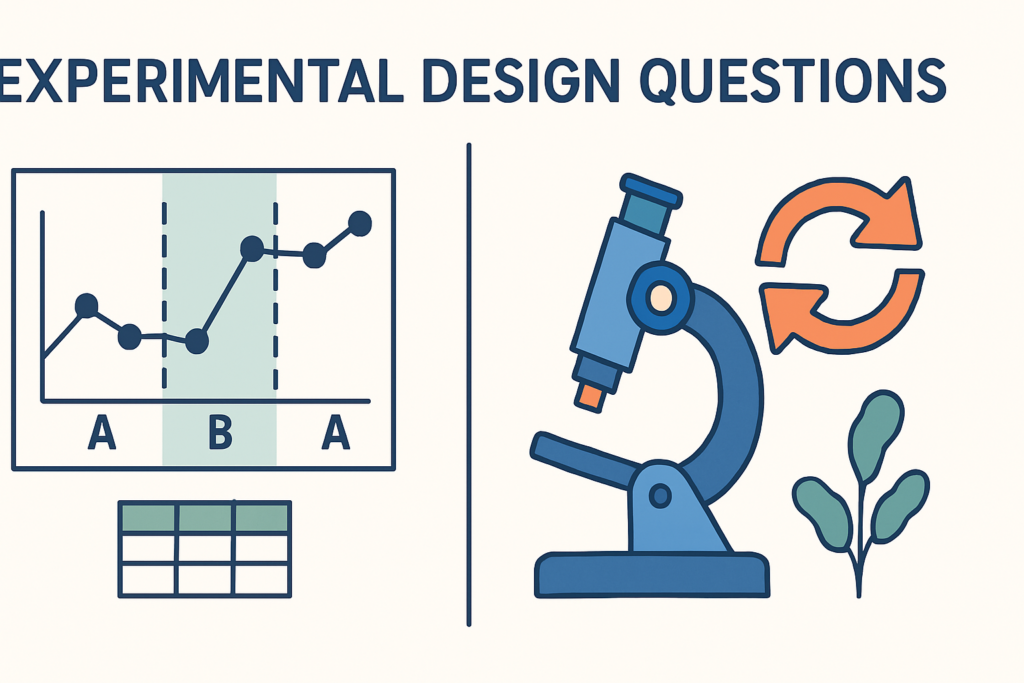
What Are Section 3 Experimental Design Questions Really Testing?
Many candidates approach experimental design questions as simple memorization tasks, but the exam tests deeper analytical skills. These questions assess your ability to evaluate whether a functional relationship has been demonstrated between variables.
Table of Contents
- What Are Section 3 Experimental Design Questions Really Testing?
- A Framework for Analyzing Any Experimental Design Question
- Common Exam Traps and How to Avoid Them
- Your Pre-Test Checklist for Experimental Design
The real challenge lies in applying baseline logic to determine if experimental control has been established.
The Core Skills Behind the Questions
Section 3 questions test three essential analytical abilities that correspond directly to Task List items B-01 through B-03. First, you must accurately identify the independent variable (intervention) and dependent variable (target behavior). Second, you need to discern whether the design follows proper baseline logic principles. Finally, you must evaluate whether sufficient replication has occurred to demonstrate experimental control.
These skills go beyond naming designs—they require understanding why certain designs provide stronger evidence than others.
From Scenario to Design: The Mental Checklist
Develop a systematic approach for every experimental design question. Start by identifying the target behavior (DV) being measured. Next, determine what intervention (IV) is being implemented. Then analyze how the intervention is introduced, withdrawn, or replicated across conditions. Finally, examine what the data paths reveal about the relationship between variables.
This mental checklist transforms complex scenarios into manageable analytical steps.
A Framework for Analyzing Any Experimental Design Question
Apply this concrete, repeatable strategy to deconstruct any experimental design question you encounter. The framework focuses on visual analysis and design logic rather than rote memorization.

Worked Example 1: The Reversal Design (A-B-A-B)
Consider a scenario where a BCBA implements token reinforcement to increase on-task behavior, collects baseline data, implements the intervention, returns to baseline, then re-implements the intervention. The key exam clue is the return to baseline conditions. When you see this pattern, you’re looking at a reversal design.
This design demonstrates experimental control through prediction, verification, and replication of effect. The data should show behavior changing predictably with each condition change.
Worked Example 2: The Multiple Baseline Across Behaviors
Imagine a practitioner teaching three different social skills sequentially, with the intervention introduced at different times for each skill. The critical feature is the staggered introduction of the IV across tiers. This design replicates the effect across different behaviors, settings, or participants without withdrawing treatment.
For the BCBA exam, look for scenarios where the intervention is applied to multiple baseline tiers in a sequential fashion. The design demonstrates control through replication across units rather than reversal.
Worked Example 3: The Changing Criterion Design
Picture a weight reduction program where reinforcement is provided for meeting progressively stricter weight loss criteria. This design features stepwise changes in the criterion for reinforcement, with the dependent variable following each criterion change. It’s often confused with other designs on the exam.
The distinguishing feature is that the intervention remains constant while the performance criterion changes incrementally. The behavior should track these criterion changes closely to demonstrate experimental control.
Common Exam Traps and How to Avoid Them
Understanding common pitfalls can save you valuable points on the exam. Many candidates lose marks not because they don’t know the material, but because they fall into predictable traps.
Mistaking Replication for Demonstration
The most frequent error involves confusing an A-B design with a true experimental design. An A-B design shows a demonstration of effect but lacks replication, making it weaker evidence for a functional relationship. The exam may present an A-B graph and ask for the design type—the correct answer is often ‘not a true experimental design.’
Remember that true experimental designs require either reversal, multiple baseline, or changing criterion elements to establish experimental control.
Graph Reading Pitfalls: Variability vs. Trend
Many questions hinge on your ability to perform visual analysis of provided graphs. High variability or opposing trends can undermine experimental control even in technically sound designs. Learn to distinguish between acceptable variability and problematic patterns that question the intervention’s effectiveness.
Pay attention to level, trend, and variability across phases. A design with clear experimental control should show predictable changes in these visual patterns when conditions change.
The ‘Best Design’ vs. ‘Design Used’ Question
Candidates often misread questions asking about the best design versus questions asking about the design used. The first requires considering ethical and practical constraints, while the second requires factual identification of what’s depicted. Always read carefully to determine which type of question you’re answering.
For ‘best design’ questions, consider factors like irreversibility of behavior, ethical concerns about withdrawing treatment, and practical implementation constraints.
Your Pre-Test Checklist for Experimental Design
Use this concise checklist for last-minute review before your exam. Focus on the analytical skills rather than memorizing definitions.
- Identify the independent variable and dependent variable in every scenario
- Determine if the design demonstrates prediction, verification, and replication
- Look for key features: return to baseline (reversal), staggered introduction (multiple baseline), or stepwise criterion changes (changing criterion)
- Distinguish between A-B designs (demonstration only) and true experimental designs
- Practice visual analysis of level, trend, and variability in graphed data
- Read questions carefully to determine if they ask for the design used or the best design for the situation
- Consider single-subject experimental designs in context of ethical and practical constraints
Mastering experimental design questions requires moving beyond memorization to genuine analytical thinking. By applying this framework systematically, you’ll approach these questions with confidence and precision. Remember that the BACB’s Task List emphasizes these analytical skills for good reason—they’re fundamental to evidence-based practice in applied behavior analysis.
For additional practice with data interpretation, explore our guide on graphing and visual analysis, which complements the skills needed for experimental design questions.


