
Respondent behavior represents a fundamental concept in behavior analysis that every BCBA candidate must master. Unlike operant behavior, which is shaped by consequences, respondent behavior is elicited by specific antecedent stimuli through classical conditioning processes. This distinction forms a critical exam area where many students stumble.
Table of Contents
- What is Respondent Behavior? A Foundational Definition
- Respondent Behavior in Practice: ABA Examples and Analysis
- Respondent Behavior on the BCBA Exam: What to Expect
- Quick-Study Checklist and Summary
What is Respondent Behavior? A Foundational Definition
Respondent behavior refers to responses that are automatically elicited by specific stimuli. These behaviors are involuntary and reflexive, meaning they occur without conscious control or learning in their initial form. The classic model comes from Pavlov’s work with dogs, where a neutral stimulus (bell) becomes a conditioned stimulus through pairing with an unconditioned stimulus (food).
The Core Mechanism: Elicited, Not Emitted
The key distinction lies in how behavior is produced. Respondent behaviors are elicited by antecedent stimuli, while operant behaviors are emitted and selected by their consequences. In the Pavlovian model, the unconditioned stimulus (US) naturally produces an unconditioned response (UR). Through repeated pairing, a previously neutral stimulus becomes a conditioned stimulus (CS) that elicits a conditioned response (CR).
This mechanism explains many autonomic responses in human behavior, including emotional reactions, physiological changes, and reflexive actions that form through associative learning.

Respondent vs. Operant: The Critical Distinction
Understanding this contrast is essential for BCBA exam success. Here are the key differences:
- Antecedent-driven vs. consequence-driven: Respondent behavior is elicited by specific stimuli that precede it, while operant behavior is influenced by consequences that follow it.
- Involuntary vs. voluntary: Respondent responses are typically reflexive and automatic, whereas operant behaviors are voluntary and purposeful.
- Classical vs. operant conditioning: Respondent behavior develops through classical (Pavlovian) conditioning, while operant behavior develops through operant (Skinnerian) conditioning.
- Focus on elicitation vs. reinforcement: Respondent conditioning focuses on stimulus pairing, while operant conditioning focuses on reinforcement and punishment contingencies.
For a deeper understanding of how consequences affect behavior, see our guide on how consequence affects behavior in ABA.
Respondent Behavior in Practice: ABA Examples and Analysis
Moving from theory to application, let’s examine realistic scenarios where respondent behavior appears in ABA practice. These examples demonstrate how conditioned emotional responses and physiological reactions can impact intervention planning.
Example 1: Medical Setting Anxiety (CS-CR)
Consider a child who develops intense anxiety when entering a medical clinic. The sight of the clinic (CS) elicits crying, clinging, and physiological arousal (CR) because it has been repeatedly paired with painful injections (US). In ABC terms:
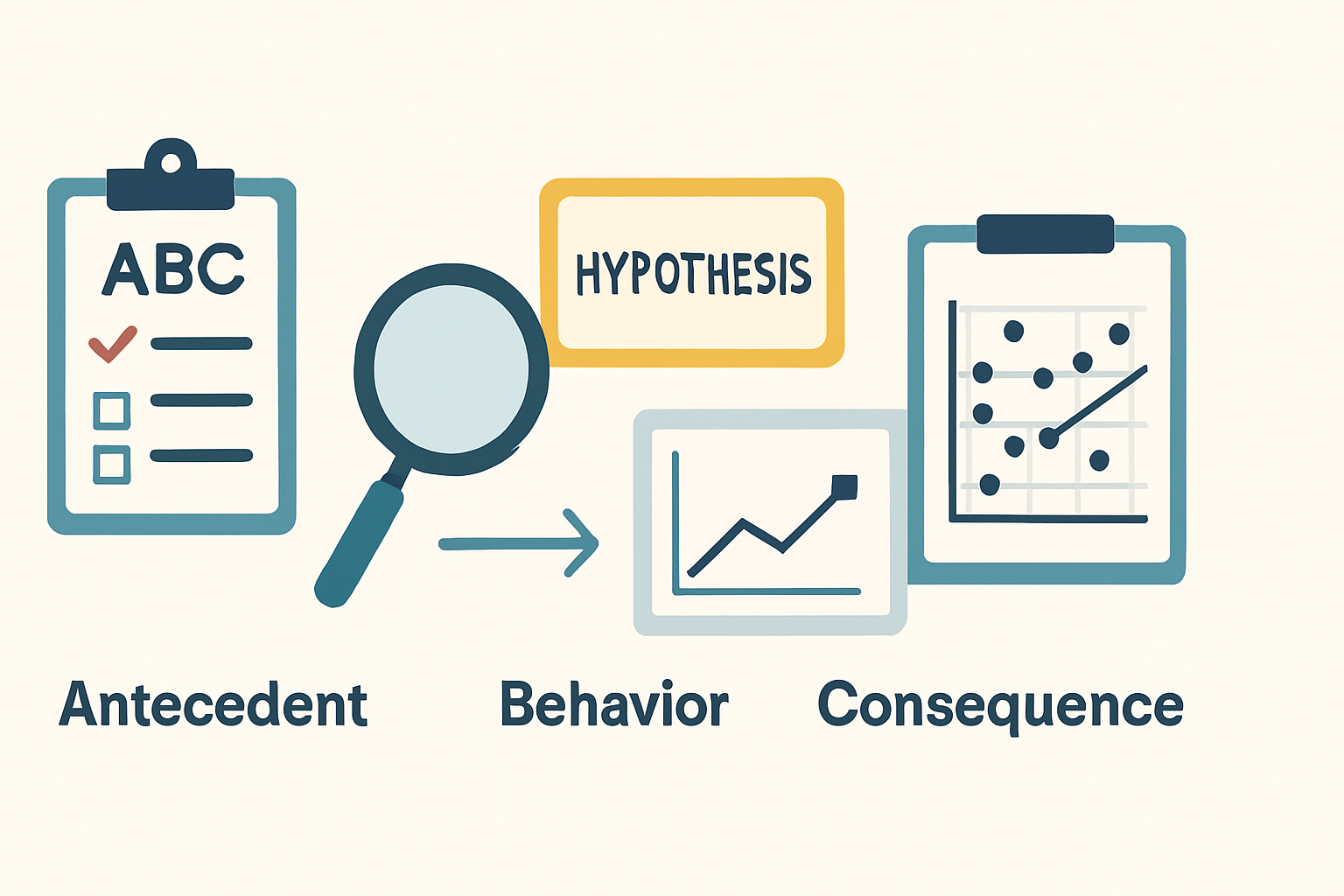
- Antecedent: Sight of medical clinic or medical personnel
- Behavior: Crying, clinging, increased heart rate, sweating
- Consequence: Not the focus (this is respondent, not operant)
The function here is an autonomic conditioned emotional response rather than an operant function like escape or attention. This distinction is crucial for selecting appropriate interventions.
Example 2: Food Aversion After Illness
A specific food (CS) becomes aversive after being consumed just before a stomach virus (US). The child now exhibits gagging, refusal, and disgust responses (CR) when presented with that food, even though the food itself didn’t cause the illness.
This taste aversion learning demonstrates respondent conditioning’s power and explains why some feeding interventions must address conditioned aversions rather than just operant refusal behaviors.
Example 3: Salivation to a Lunch Bell
In a school setting, a bell (CS) rings consistently before lunch is served (US). After repeated pairings, students begin to salivate (CR) when they hear the bell, even before seeing or smelling food.
This classic example reinforces the basic Pavlovian model and shows how neutral stimuli can acquire eliciting properties through association with biologically significant events.
Respondent Behavior on the BCBA Exam: What to Expect
This topic appears in multiple exam formats, and understanding the common traps is essential for success. Many questions test your ability to distinguish respondent from operant processes in applied scenarios.
Common Question Formats and Traps
Exam questions typically fall into these categories:
- Definition identification: “Which of the following best describes respondent behavior?”
- Example recognition: “In the scenario above, the child’s crying when seeing the needle represents which type of conditioning?”
- Contrast questions: “How does respondent conditioning differ from operant conditioning?”
- Component identification: “In this example, what serves as the conditioned stimulus?”
The most common trap is confusing reinforcement and punishment (operant concepts) with elicitation (respondent concept). Remember that respondent behavior is about what comes BEFORE the behavior, not what comes after.
Key Terms You Must Know
Master these essential concepts:
- Unconditioned Stimulus (US): A stimulus that naturally and automatically triggers a response without prior learning
- Unconditioned Response (UR): The natural, unlearned reaction to an unconditioned stimulus
- Conditioned Stimulus (CS): A previously neutral stimulus that, after association with a US, comes to trigger a conditioned response
- Conditioned Response (CR): The learned reaction to a conditioned stimulus
- Respondent Extinction: The gradual weakening and disappearance of a conditioned response when the CS is repeatedly presented without the US
- Higher-Order Conditioning: When a neutral stimulus becomes a CS by being paired with an already established CS
For related concepts, explore our article on antecedent strategies and common exam traps.
Quick-Study Checklist and Summary
Use this checklist to test your understanding and identify areas needing review before your exam.
Respondent Behavior Self-Check
Ask yourself these questions when analyzing behavior:
- Is the behavior reflexive or autonomic? Does it involve emotional or physiological responses?
- Is it elicited by a specific antecedent stimulus? Does a particular stimulus reliably precede the behavior?
- Was it established through pairing? Did the stimulus gain its eliciting power through association with another stimulus?
- Is it involuntary? Does the individual have conscious control over the response?
- Does it follow the US-UR/CS-CR model? Can you identify the unconditioned and conditioned components?
Key Takeaways for Your Studies
Remember these critical points:
- Respondent behavior is antecedent-driven and involuntary, while operant behavior is consequence-driven and voluntary
- Conditioned emotional responses form through respondent conditioning and can significantly impact behavior
- Confusing respondent with operant conditioning is a major exam error – focus on what elicits vs. what reinforces
- Many physiological and emotional reactions in clinical settings have respondent components that require different intervention approaches
For comprehensive exam preparation, consider our BCBA exam prep guide that covers all essential domains. Additionally, the BACB Task List provides official guidance on required knowledge areas.


