

Antecedent interventions represent a proactive approach to behavior change in applied behavior analysis. These strategies focus on modifying environmental conditions before challenging behavior occurs, rather than reacting to it afterward. Understanding these interventions is essential for effective practice and BCBA exam preparation.
Table of Contents
- Antecedent Interventions ABA: What Are Antecedent Interventions in ABA?
- Key Types of Antecedent-Based Strategies
- Applied Examples: From ABC Data to Intervention
- Antecedent Interventions on the BCBA Exam
- Quick-Reference Checklist for Implementation
Antecedent Interventions ABA: What Are Antecedent Interventions in ABA?
Antecedent interventions involve environmental modifications that occur before a target behavior. The goal is to prevent or reduce the likelihood of challenging behavior by addressing its triggers.
Core Definition and Proactive Purpose
These interventions are fundamentally proactive rather than reactive. They work by altering the antecedent conditions that typically evoke problem behavior. This approach aligns with the principle that prevention is more effective than reaction.
How They Differ from Consequence Strategies
Consequence strategies like reinforcement and punishment occur after behavior. Antecedent interventions happen before behavior occurs, making them fundamentally different in timing and approach.
- Antecedent interventions: Modify environment before behavior
- Consequence strategies: Apply reinforcement/punishment after behavior
- Proactive vs reactive: Prevention vs. response
- Function-based: Both require understanding behavioral function
Key Types of Antecedent-Based Strategies

Several evidence-based antecedent interventions exist in ABA practice. Each targets different aspects of the antecedent environment to prevent challenging behavior.
Noncontingent Reinforcement (NCR) and High-P Sequences
Noncontingent reinforcement involves providing reinforcement freely and frequently regardless of behavior. This reduces the motivating operation for problem behavior. High-probability request sequences involve presenting several easy-to-follow requests before a difficult demand.
Functional Communication Training (FCT) as an Antecedent Strategy
While often considered a consequence strategy, FCT functions antecedently when taught before challenging behavior occurs. By establishing an alternative communication response, the individual has a functional replacement available when triggers occur.
Modifying Setting Events and Discriminative Stimuli
Setting events are environmental conditions that alter the value of consequences. Discriminative stimuli (Sds) signal that reinforcement is available. Modifying these elements changes the behavioral context before problems arise.
Applied Examples: From ABC Data to Intervention
Real-world application shows how ABC analysis leads to effective antecedent interventions. These examples demonstrate the practical translation of assessment to implementation.
Example 1: Escape-Maintained Task Refusal
ABC analysis reveals: Antecedent=Difficult math worksheet, Behavior=Tantrum/refusal, Function=Escape. The intervention combines task modification with a high-p sequence.
- Modify worksheet difficulty to 75% success rate
- Implement high-probability request sequence before math tasks
- Provide choice-making opportunities for task order
- Use visual timers to signal task duration
Example 2: Attention-Seeking Behavior During Transitions
ABC pattern: Antecedent=Unstructured transition time, Behavior=Yelling, Function=Attention. The intervention uses visual supports and noncontingent attention.
- Implement visual schedule showing transition sequence
- Provide noncontingent attention before transitions
- Use transition warnings (5-minute, 2-minute, 1-minute)
- Establish transition routines with consistent cues
Antecedent Interventions on the BCBA Exam
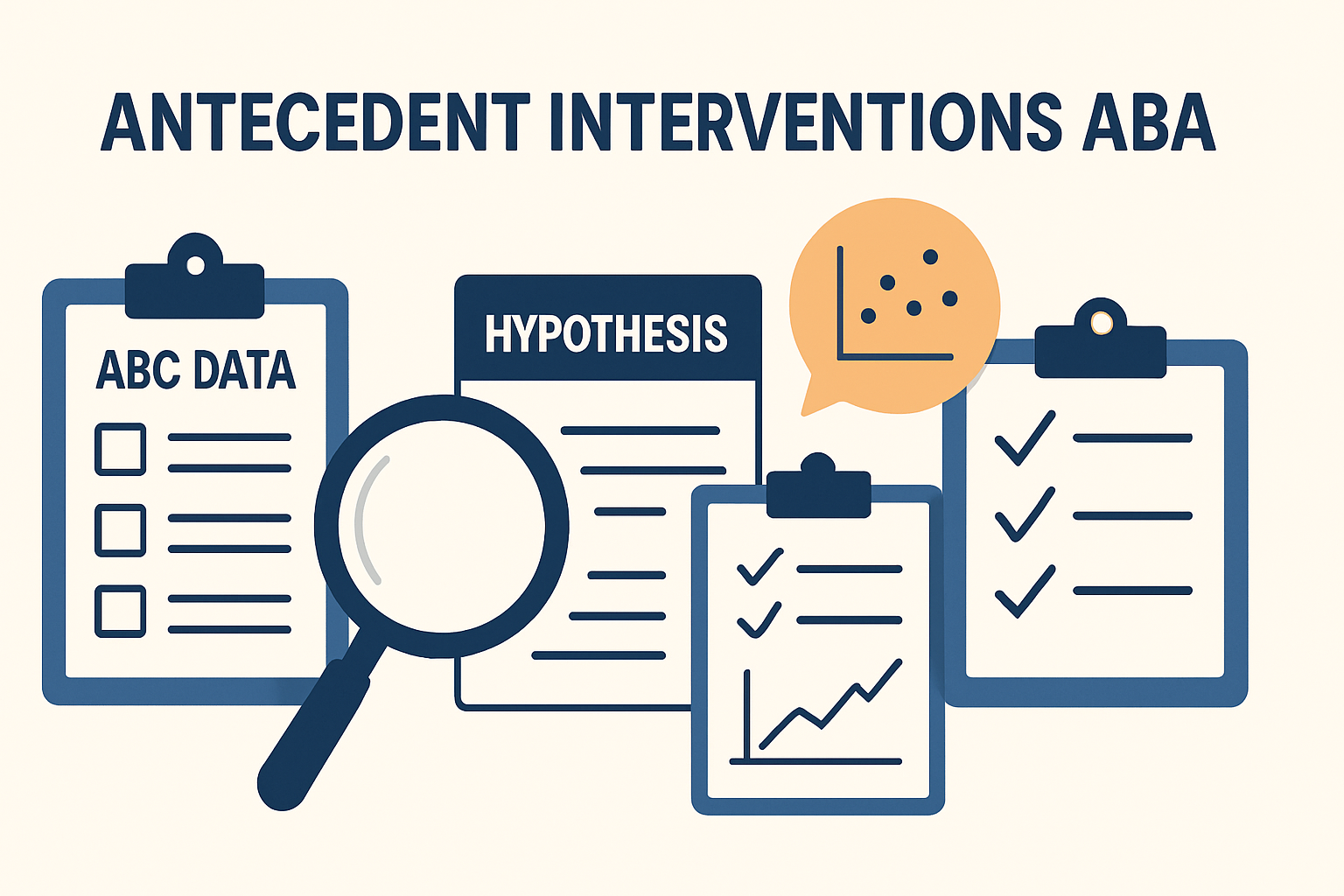
The BCBA exam tests your ability to select appropriate interventions based on assessment data. Understanding antecedent strategies requires recognizing their proactive nature and function-based design.
Common Exam Traps and How to Avoid Them
Several patterns trip up exam candidates. Recognizing these common mistakes improves your test performance.
- Confusing antecedent with consequence: Remember timing – antecedent comes before behavior
- Misidentifying the function: Always base intervention on functional assessment data
- Selecting reactive strategies: Choose interventions that prevent rather than respond
- Overlooking setting events: Consider broader environmental conditions beyond immediate triggers
Practice Scenario: Choosing the Right Intervention
A student engages in property destruction when asked to complete writing tasks. Functional analysis indicates escape-maintained behavior. The current worksheet requires copying 20 sentences. Which antecedent intervention is most appropriate?
The best choice involves modifying task difficulty by reducing the number of sentences and implementing a high-p sequence. This addresses the escape function proactively by making the demand less aversive while building behavioral momentum.
Quick-Reference Checklist for Implementation
This practical checklist helps ensure systematic implementation of antecedent interventions. Follow these steps for effective behavior support.
- Conduct functional assessment to identify behavior function
- Analyze ABC data for specific antecedent patterns
- Select intervention matching identified function
- Modify environment before behavior occurs
- Monitor implementation fidelity regularly
- Collect ongoing data to evaluate effectiveness
- Adjust intervention based on data trends
For more on behavioral assessment, see our guide to functional analysis vs descriptive assessment. Understanding the four functions of behavior is also essential for selecting appropriate interventions. The BACB Ethics Code provides guidance on ethical intervention selection, while research from the Journal of Applied Behavior Analysis supports evidence-based practices.
Antecedent interventions represent a powerful proactive approach in ABA. By modifying environmental conditions before challenging behavior occurs, practitioners can create more supportive contexts for behavior change. Mastery of these strategies enhances both clinical effectiveness and exam performance.


