
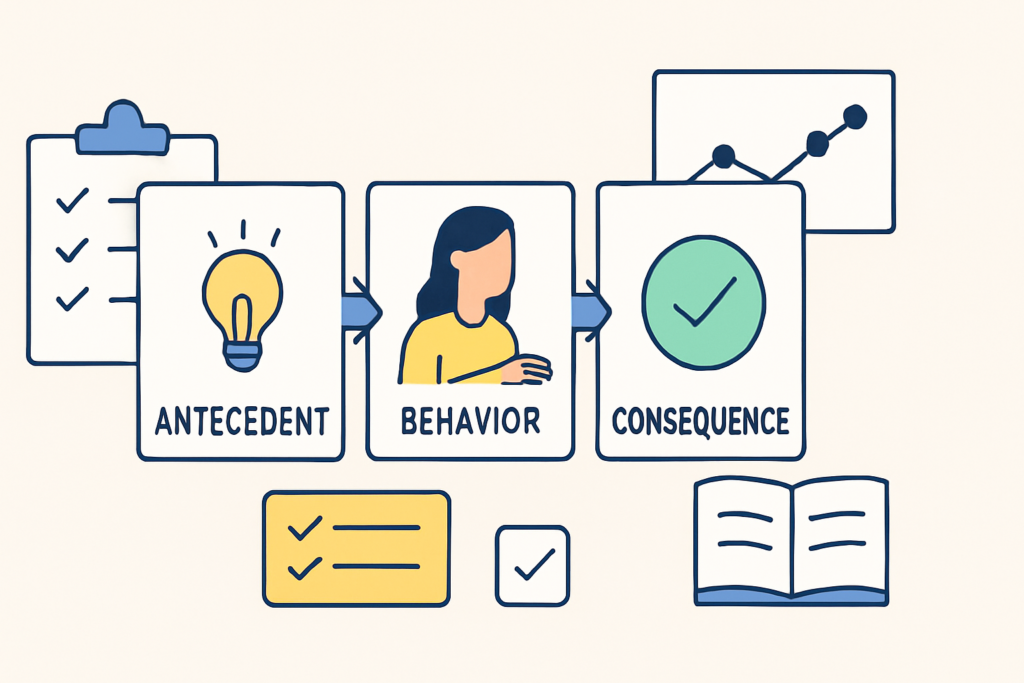
Three Term Contingency: What is the Three-Term Contingency?
The three-term contingency represents the fundamental unit of analysis in applied behavior analysis. This framework breaks down behavior into three essential components that form a predictable relationship.
Table of Contents
- Three Term Contingency: What is the Three-Term Contingency?
- Three-Term Contingency in Action: Worked Examples
- Three-Term Contingency on the BCBA Exam
- Quick-Reference Checklist and Summary
Understanding this model is crucial for both clinical practice and exam success.
Breaking Down the ABCs: Antecedent, Behavior, Consequence
The ABC acronym stands for antecedent, behavior, and consequence. Each component plays a specific role in understanding why behaviors occur.
- Antecedent: Environmental conditions or stimuli present immediately before a behavior occurs. This includes discriminative stimuli that signal the availability of reinforcement.
- Behavior: The observable and measurable act that follows the antecedent. It must be defined in objective terms that allow for reliable measurement.
- Consequence: The stimulus change following a behavior that affects its future probability. Consequences can be either reinforcing or punishing.
Why This Contingency is the Foundation of ABA
The three-term contingency embodies the principle of determinism in behavior analysis. It assumes behavior is lawful and predictable based on environmental variables.
This framework serves as the basis for functional behavior assessment, intervention design, and data-based decision making. Mastery of this concept is non-negotiable for effective practice.
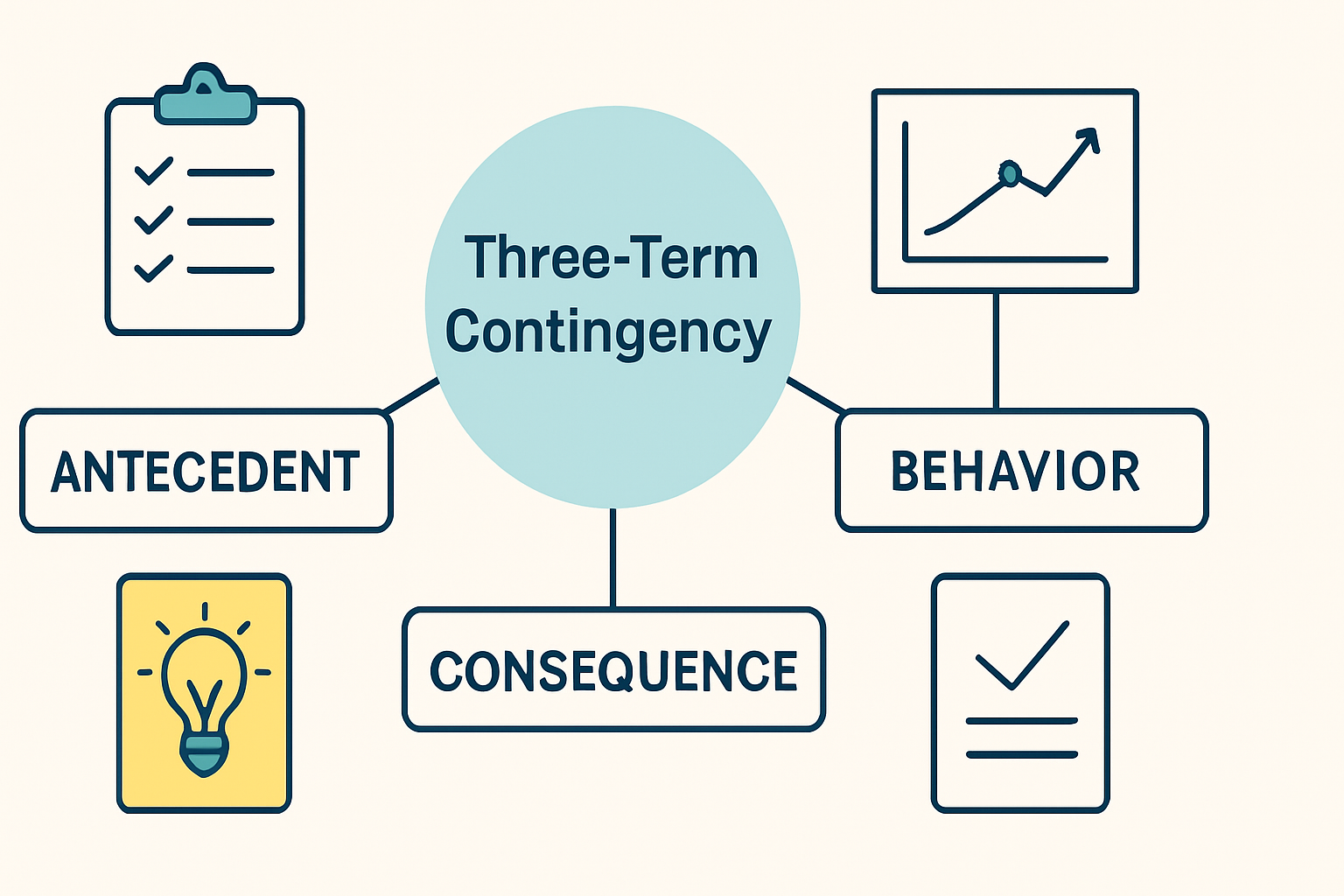
Three-Term Contingency in Action: Worked Examples
Moving from theory to application requires analyzing real-world scenarios. These examples demonstrate how to identify each component and hypothesize function.
Example 1: Escape-Maintained Behavior in a Classroom
A student puts their head down during difficult math work. The teacher removes the worksheet and tells the student to take a break.
- Antecedent: Presentation of challenging math worksheet
- Behavior: Student puts head down on desk
- Consequence: Teacher removes worksheet (escape from task)
- Hypothesized Function: Escape from academic demands
Example 2: Attention-Seeking Behavior at Home
A child whines while their parent is on the phone. The parent pauses the conversation and asks, “What’s wrong?”
- Antecedent: Parent engaged in phone conversation
- Behavior: Child whines audibly
- Consequence: Parent provides verbal attention
- Hypothesized Function: Access to social attention
Example 3: Tangible-Access Behavior in a Clinic
A client says “iPad please” during scheduled break time. The therapist delivers the iPad immediately.
- Antecedent: Therapist announces “Break time”
- Behavior: Client mands for iPad using complete sentence
- Consequence: Therapist delivers iPad (access to tangible)
- Hypothesized Function: Access to preferred items
This example demonstrates appropriate communication that serves the same function as potentially problematic behavior.
Three-Term Contingency on the BCBA Exam
Exam questions often test your ability to identify components and analyze relationships. Understanding common traps improves your accuracy.
Common Exam Traps and How to Avoid Them
Several patterns consistently challenge candidates. Recognizing these helps you select correct answers more reliably.
- Confusing setting events with immediate antecedents: Setting events are broader contextual factors, while antecedents are immediate triggers.
- Misidentifying the consequential effect: Focus on whether the consequence increases or decreases future behavior, not just what physically occurred.
- Over-interpreting private events: Stick to observable and measurable components unless the question specifically addresses private behavior.
- Missing conditional relationships: Remember that antecedents signal the availability of reinforcement, creating a conditional probability.
Practice Identifying the Components
During a session, a therapist presents a matching task. The client throws materials on the floor. The therapist removes the task and offers a sensory break.
- Antecedent: Presentation of matching task
- Behavior: Throwing materials on floor
- Consequence: Removal of task and access to sensory break
- Function: Escape from task demands
This analysis demonstrates the escape function maintained by negative reinforcement. For more on reinforcement principles, see our guide on negative reinforcement.
Quick-Reference Checklist and Summary
Use this checklist to systematically analyze behavior scenarios. This structured approach prevents common analysis errors.
Your ABC Analysis Checklist
- Is the behavior observable and measurable?
- What immediately preceded the behavior?
- What changed in the environment after the behavior?
- What is the likely function based on the consequence?
- Is this a true contingency or merely correlation?
- Are there any setting events influencing the relationship?
Key Takeaways for Your Studies
The three-term contingency serves as the basic unit of analysis in behavior analysis. Mastery of this concept is essential for both clinical practice and exam success.
Remember that this framework underlies all functional assessment and intervention design. For comprehensive exam preparation, explore our BCBA exam prep guide and additional resources on the four functions of behavior.
For authoritative reference, consult the Behavior Analyst Certification Board resources and peer-reviewed literature on operant conditioning principles.


