

Why the Four Functions of Behavior Are Foundational
Understanding the four functions of behavior represents a cornerstone of applied behavior analysis and is essential for BCBA certification. This framework moves beyond simply describing what behavior looks like to explaining why it occurs. The four functions – sensory/automatic, escape, attention, and tangible – provide the analytical structure for conducting effective functional behavior assessments.
Table of Contents
- Why the Four Functions of Behavior Are Foundational
- Defining and Distinguishing Each Function
- From Observation to Hypothesis: Analyzing ABC Data
- Exam Focus: Common Traps and How to Avoid Them
- Your Functional Analysis Quick-Check Guide
- Summary: From Function to Intervention
- References
Mastering these concepts transforms how you approach behavior change from reactive to proactive, evidence-based practice.
The Core of Functional Assessment
Functional assessment aims to identify the maintaining variables of behavior. Unlike topography-based approaches that focus on what behavior looks like, functional assessment examines the environmental conditions that evoke and maintain behavior. The four functions serve as the primary hypotheses tested during this process, guiding data collection and intervention design.
When you correctly identify function, you can develop function-based interventions that address the root cause rather than just suppressing symptoms. This approach aligns with ethical standards and produces more durable behavior change.
Mapping Functions to the BCBA Task List
The four functions directly correspond to several critical areas on the BCBA Task List. Key domains include:
- Section B-1: Define and provide examples of behavior, response, and response class
- Section B-4: Define and provide examples of positive and negative reinforcement contingencies
- Section B-9: Define and provide examples of operant extinction
- Section F-3: Identify and prioritize socially significant behavior-change goals
These task list items require you to apply functional analysis principles in assessment and intervention contexts.
Defining and Distinguishing Each Function
Each function represents a distinct type of reinforcement contingency that maintains behavior. Understanding the precise definitions and reinforcement mechanisms is crucial for accurate analysis.
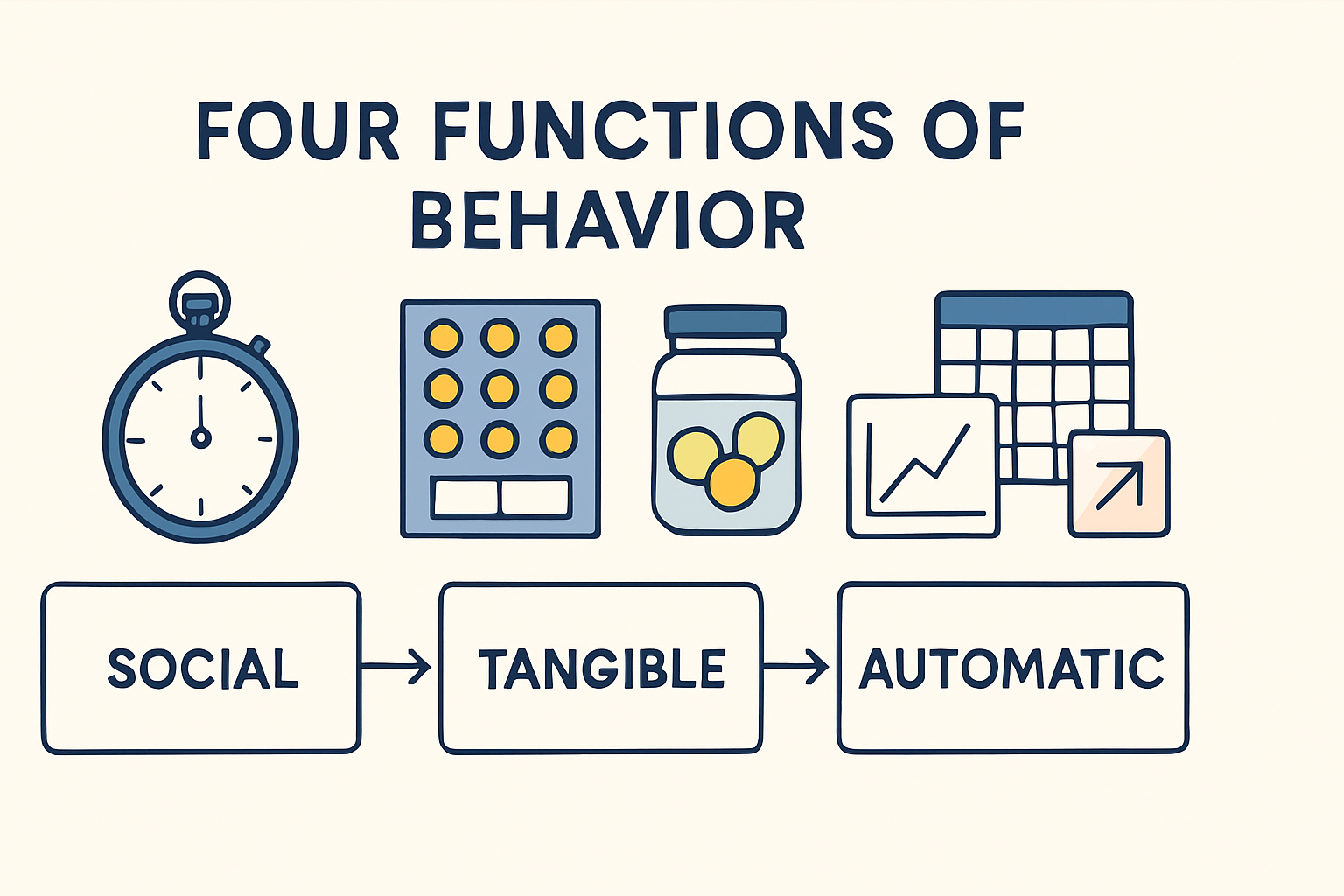
Sensory/Automatic (Automatic Reinforcement)
Automatic reinforcement occurs when the behavior itself produces the reinforcing consequence. The reinforcement is intrinsic to the behavior rather than mediated by others. This can involve either adding stimulation (positive automatic reinforcement) or removing aversive stimulation (negative automatic reinforcement).
Common examples include hand-flapping that produces visual stimulation, rocking that provides vestibular input, or scratching that relieves an itch. The key characteristic is that the reinforcement occurs regardless of social context.
Escape (Negative Reinforcement)
Escape behavior is maintained by negative reinforcement, where the behavior removes or avoids an aversive stimulus. The individual engages in the behavior to terminate or postpone something unpleasant. Motivating operations like task difficulty, demands, or aversive social situations establish the value of escape.
Examples include a student throwing materials to escape difficult academic work, or a child having a tantrum to avoid a non-preferred activity. The reinforcement is the removal of the aversive condition.
Attention (Social Positive Reinforcement)
Attention-maintained behavior occurs when behavior gains access to social interaction. This represents social positive reinforcement, where the consequence is the addition of attention. Importantly, the attention can be positive (praise, conversation) or negative (reprimands, corrections) – what matters is the access to social interaction.
Common scenarios include a child interrupting conversations to gain adult attention, or an individual engaging in disruptive behavior when ignored. The behavior is reinforced by obtaining social contact.
Tangible (Social Positive Reinforcement)
Tangible functions involve behavior that gains access to preferred items or activities. Like attention, this represents social positive reinforcement, but the consequence is a tangible object or activity rather than social interaction. Deprivation serves as a key motivating operation that establishes the value of the tangible.
Examples include tantrums in stores to obtain candy, or aggression when a preferred toy is removed. The behavior is reinforced by access to the desired item or activity.
From Observation to Hypothesis: Analyzing ABC Data
Moving from theoretical definitions to practical application requires analyzing antecedent-behavior-consequence sequences. Each function produces distinct patterns in ABC data that guide hypothesis development.
Worked Example 1: Escape vs. Attention
Consider aggression during table work. If the antecedent is “teacher presents math worksheet” and the consequence is “teacher removes worksheet and sends student to timeout,” the likely function is escape. The behavior successfully terminated the aversive task.
Contrast this with the same behavior where the antecedent is “teacher is talking to another student” and the consequence is “teacher stops conversation and addresses the aggression.” Here, the likely function is attention, as the behavior gained social interaction.
Worked Example 2: Automatic vs. Social
Analyze hand-flapping behavior. When it occurs in an empty room with no social consequences, the likely function is automatic reinforcement – the behavior produces its own sensory consequences.
However, if hand-flapping occurs specifically when a parent is on the phone and results in the parent ending the call to attend to the child, the function may shift to attention. The social context and consequences determine the function.
Worked Example 3: Tangible with an MO
Examine a tantrum in a grocery store. The antecedent includes seeing candy at checkout and previous deprivation of sweets (the motivating operation). The consequence is “parent gives candy to stop crying.”
This clear pattern indicates a tangible function. The behavior is reinforced by access to the preferred item, with deprivation establishing its reinforcing value. For more on how consequences affect behavior, see our guide on how consequence affects behavior in ABA.
Exam Focus: Common Traps and How to Avoid Them
BCBA exam questions often test your ability to distinguish between functions in complex scenarios. Recognizing common traps improves your accuracy.
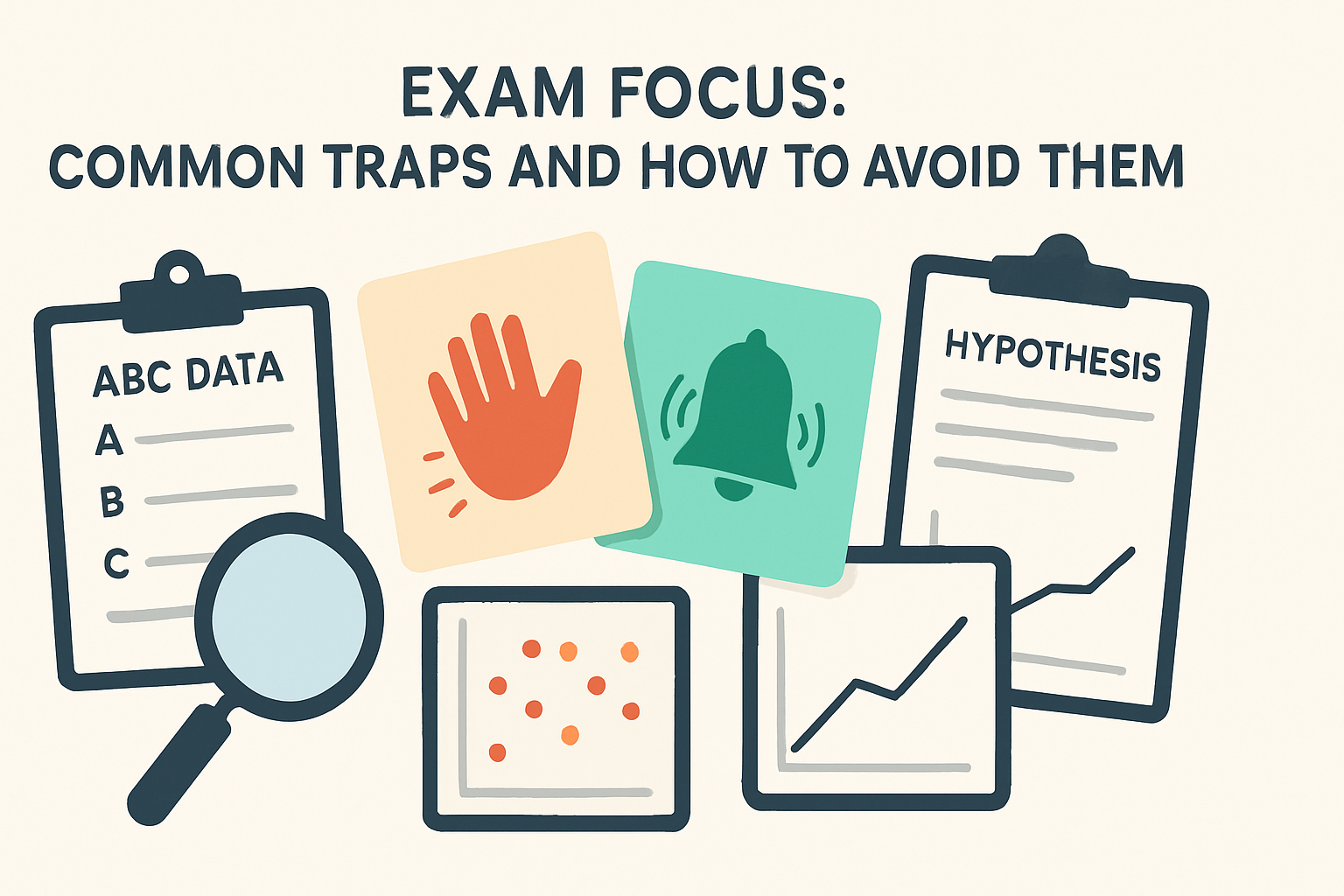
Trap 1: Confusing Topography for Function
The same behavior topography can serve multiple functions. Hitting might be for escape in one context and attention in another. The exam tests whether you look beyond what the behavior is to analyze why it occurs based on environmental variables.
Always examine the antecedents and consequences rather than making assumptions based on behavior form. This principle is fundamental to functional behavior assessment.
Trap 2: Misidentifying the Type of Reinforcement
Students often confuse positive and negative reinforcement within functions. Remember: escape is always negative reinforcement (removing something aversive), while attention and tangible are always positive reinforcement (adding something desirable).
Automatic reinforcement can be either positive (adding stimulation) or negative (removing aversive stimulation). Drill these definitions until they become automatic.
Trap 3: Overlooking Motivating Operations
Exam questions frequently include MOs as critical clues. Phrases like “after being alone for an hour,” “when preferred items are visible but out of reach,” or “following difficult task demands” establish the conditions for specific functions.
Develop a systematic approach: first identify potential MOs in the antecedent, then analyze the consequence pattern. This aligns with understanding motivating operations in ABA.
Your Functional Analysis Quick-Check Guide
Use this decision framework when analyzing behavior functions:
- Step 1: Examine the consequence – What immediately follows the behavior?
- Step 2: Identify reinforcement type – Is something added (positive) or removed (negative)?
- Step 3: Analyze social mediation – Does the consequence require another person?
- Step 4: Check for MOs – What establishing operations are present in antecedents?
- Step 5: Test your hypothesis – Would changing this consequence affect the behavior?
For sensory/automatic: Behavior produces own reinforcement, no social mediation needed.
For escape: Behavior removes aversive stimulus, negative reinforcement.
For attention: Behavior gains social interaction, positive reinforcement.
For tangible: Behavior gains items/activities, positive reinforcement.
Summary: From Function to Intervention
Accurate functional identification is the essential first step toward effective intervention. Once you determine the maintaining function, you can select function-based strategies that address the root cause.
For escape functions, consider antecedent modifications like task difficulty adjustments or choice-making opportunities. For attention functions, implement differential reinforcement of alternative behaviors. For tangible functions, establish clear contingency systems. For automatic reinforcement, provide competing stimuli or teach alternative responses.
Remember that the BACB emphasizes function-based interventions in their ethics codes and practice guidelines. Mastering the four functions not only prepares you for exam success but also for ethical, effective practice that produces meaningful behavior change. For comprehensive exam preparation, explore our BCBA exam prep guide.


