
What is Stimulus Control Transfer? A Definition for BCBAs
In applied behavior analysis, stimulus control transfer refers to the systematic process of shifting control of a behavior from an artificial prompt to the natural discriminative stimulus in the environment. This procedure ensures that learned behaviors occur under appropriate conditions without ongoing assistance.
Table of Contents
- What is Stimulus Control Transfer? A Definition for BCBAs
- Stimulus Control Transfer in Action: Worked ABA Examples
- Exam Relevance and Common Traps for BCBA Candidates
- Quick-Study Checklist for Stimulus Control Transfer
- Summary: Achieving Independence Through Systematic Transfer
The core objective involves moving from therapist-controlled cues to naturally occurring signals that should evoke the target response.
The Goal: From Prompt to Natural Cue
Imagine teaching someone to stop at a red traffic light. Initially, you might verbally say ‘stop’ when they approach the intersection. Through stimulus control transfer, you systematically fade your verbal prompt until the red light itself controls the stopping behavior.
This shift represents the essence of effective teaching in ABA—creating independent responding to relevant environmental cues.
Key Terminology You Must Know
- Discriminative Stimulus (SD): A stimulus in the presence of which a response has been reinforced
- Prompt: An additional stimulus that increases the likelihood of a correct response
- Fading: The gradual removal of prompts while maintaining correct responding
- Transfer of Stimulus Control: The process of shifting control from prompts to the natural SD
- Within-stimulus prompt: Altering the SD itself to make it more noticeable
- Extra-stimulus prompt: Adding a separate stimulus to evoke the response

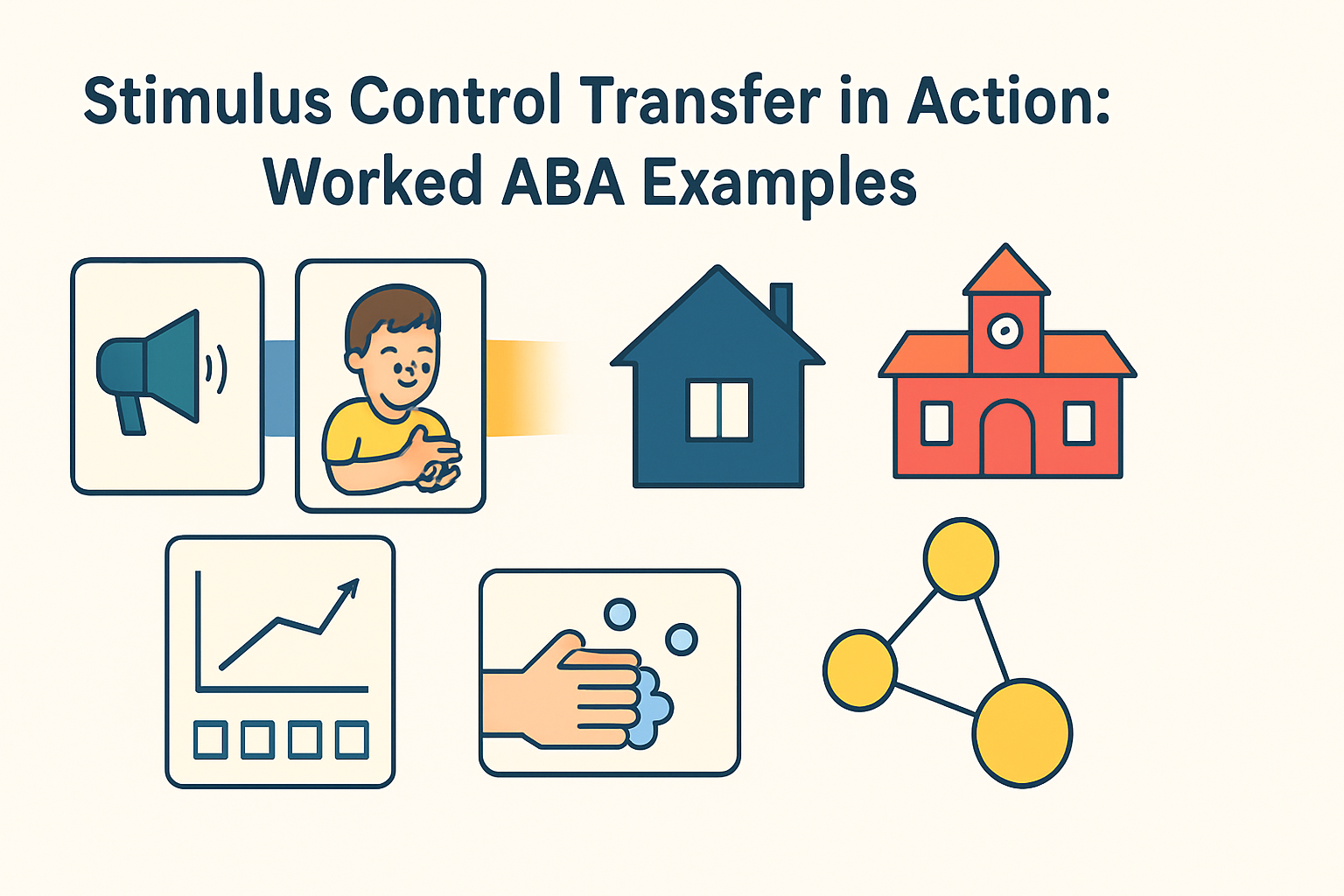
Stimulus Control Transfer in Action: Worked ABA Examples
Understanding the theory is essential, but seeing practical applications clarifies how these procedures work in real intervention settings.
Example 1: Teaching a Child to Wash Hands
Consider teaching hand washing to a child with limited self-care skills. The natural SD might be dirty hands or preparing for a meal.
Initial teaching uses a most-to-least prompting hierarchy:
- Week 1: Full physical guidance through all steps
- Week 2: Partial physical prompts at key transition points
- Week 3: Gestural prompts pointing to next step
- Week 4: Verbal prompts only when needed
- Week 5: Independent responding to dirty hands SD
Each step systematically fades support while maintaining correct performance, ensuring the sight of dirty hands eventually controls the washing chain.
Example 2: Transferring Control in a Social Script
A learner uses a script card to ask peers to play. The goal transfers control from the card to the natural SD of seeing peers engaged in preferred activities.
Using a time delay procedure:
- Initial: Present card immediately when peers are playing
- Phase 1: Wait 2 seconds before showing card
- Phase 2: Wait 5 seconds before prompting
- Phase 3: Fade to partial script (first word only)
- Final: Independent initiation when seeing peers play
The hypothesized function is access to social interaction, making the transfer particularly important for natural reinforcement.
Exam Relevance and Common Traps for BCBA Candidates
Stimulus control transfer questions frequently appear on the BCBA exam, testing both conceptual understanding and practical application skills.
Trap 1: Confusing Prompt Fading with Other Procedures
Candidates often mix stimulus control transfer with related but distinct concepts:
- Shaping: Differentially reinforcing successive approximations of a target behavior
- Chaining: Linking discrete behaviors into a complex sequence
- Generalization: Occurrence of behavior under novel conditions
Remember: Transfer specifically involves shifting control from prompts to natural SDs, not changing the behavior itself.
Trap 2: Selecting an Inefficient Transfer Method
Choosing inappropriate procedures can hinder learning. Consider this scenario: A learner consistently makes errors when transitioning from gestural to verbal prompts.
A better approach might involve errorless learning principles using a time delay rather than least-to-most prompting. This minimizes errors and maintains motivation.
For more on related concepts, see our guide on errorless learning procedures.
Quick-Study Checklist for Stimulus Control Transfer
Use this actionable summary for efficient review before your exam:
- Define stimulus control transfer in your own words
- Identify the natural SD in any teaching scenario
- Select appropriate prompt fading procedures based on learner needs
- Differentiate transfer from shaping, chaining, and generalization
- Recognize when to use time delay versus prompt fading hierarchies
- Plan for maintenance and generalization from the beginning
- Monitor for prompt dependency and adjust procedures accordingly
- Document prompt levels systematically across sessions
For additional study strategies, explore our BCBA exam study framework.
Summary: Achieving Independence Through Systematic Transfer
Effective stimulus control transfer represents a cornerstone of ethical ABA practice. By systematically shifting control from artificial prompts to natural environmental cues, practitioners promote genuine independence rather than prompt dependency.
This procedure embodies the applied dimension of ABA by creating socially significant behavior change that maintains in natural contexts. Mastery requires understanding both the theoretical foundations and practical implementation details.
For BCBA candidates, proficiency with stimulus control transfer procedures demonstrates competence in designing effective, ethical interventions that respect client autonomy while achieving meaningful outcomes.
Learn more about related concepts in our guide on stimulus control principles or explore the BACB Task List for complete exam coverage requirements.



