

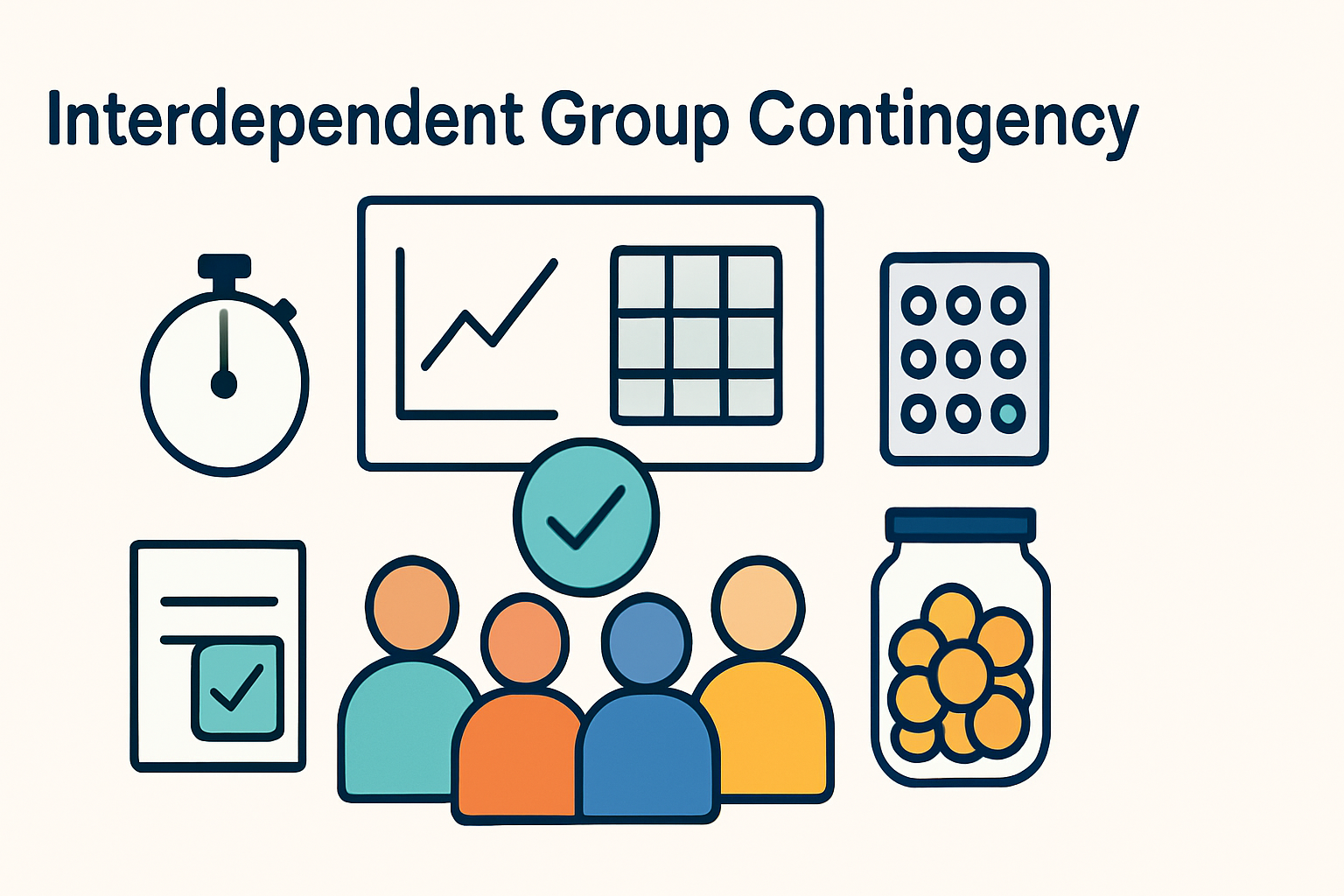
An interdependent group contingency is a behavior intervention strategy where reinforcement for every group member depends on the collective performance of the entire group meeting a specific criterion. This approach creates an ‘all-or-nothing’ dynamic that can effectively promote cooperation and shared responsibility in various settings.
Table of Contents
- What is an Interdependent Group Contingency?
- Applied Examples in ABA Settings
- Exam Relevance and Common Pitfalls
- Quick-Reference Implementation Checklist
- Summary and Key Takeaways
What is an Interdependent Group Contingency?
This behavioral arrangement establishes that reinforcement delivery for all individuals in a group is contingent upon the group as a whole achieving a predetermined standard. The collective criterion must be met for anyone to receive reinforcement, creating interdependence among participants.
The Core Definition and Mechanism
In technical terms, an interdependent group contingency occurs when access to reinforcement for each group member requires the entire group’s behavior to reach a specified performance level. This creates a shared contingency where individual outcomes are tied to group performance. The mechanism operates on the principle that group members will influence each other’s behavior to achieve the common goal.
Key Characteristics and Rationale
This approach offers several advantages in applied settings. It promotes teamwork and cooperation naturally, as members have a vested interest in each other’s success. The intervention is also efficient to implement, requiring fewer resources than individual contingencies for each participant.
However, practitioners must consider potential drawbacks. The arrangement may create peer pressure that could become coercive if not monitored carefully. Some individuals might become ‘free-riders’ who benefit from others’ efforts without contributing adequately. Understanding these dynamics helps in ethical implementation.
Applied Examples in ABA Settings
Real-world applications demonstrate how interdependent group contingencies function across different environments. These examples illustrate the practical implementation and behavioral mechanisms at work.
Example 1: The Classroom Quiet Challenge
In a special education resource room, the teacher implements a contingency where if the entire class’s average noise level remains below 60 decibels for 20 consecutive minutes, all students earn 5 minutes of free-choice time. The antecedent is the teacher’s announcement of the challenge. The behavior involves all students maintaining appropriate volume levels. The consequence is group access to preferred activities. The hypothesized function is access to tangible reinforcement and peer attention.
Example 2: The Social Skills Group Point Pool
An adolescent social skills group uses a point system where members earn points for initiating conversations with peers. If the group’s total points meet a weekly goal of 50 points, all members get to choose the activity for the next session’s final 15 minutes. This arrangement targets social initiation skills while promoting group cohesion. The function involves access to preferred activities and social reinforcement.
Example 3: Reducing Transition Time in a Clinic
In an early intervention clinic, if all clients in a therapy pod complete their transitions (materials put away, seated at next station) within 2 minutes of the transition prompt, the entire pod receives a special sticker for their collective chart. This intervention addresses transition difficulties common in young learners. The function combines escape from delayed transitions with access to tangible reinforcement. For more on reinforcement strategies, see our guide to positive reinforcement in ABA.
Exam Relevance and Common Pitfalls
Understanding interdependent group contingencies is crucial for BCBA exam success, as this concept appears in multiple exam domains. Candidates must recognize when this approach is appropriate and how to implement it ethically.
How the BCBA Exam Tests This Concept
This topic typically appears in sections covering behavior-change procedures (Task List item B-14) and ethical implementation considerations. Exam questions may present scenarios requiring identification of the appropriate group contingency type or evaluation of implementation procedures. Questions often test understanding of when to use interdependent versus other group contingencies.
Frequent Misconceptions and Exam Traps
Several common errors can trip up exam candidates. First, confusing interdependent contingencies with dependent group contingencies (where one individual’s performance determines reinforcement for all). Second, overlooking ethical concerns related to peer coercion and pressure. Third, failing to identify the collective criterion in scenario descriptions. Fourth, misapplying this approach when independent contingencies would be more appropriate for individual skill acquisition.
Quick-Reference Implementation Checklist
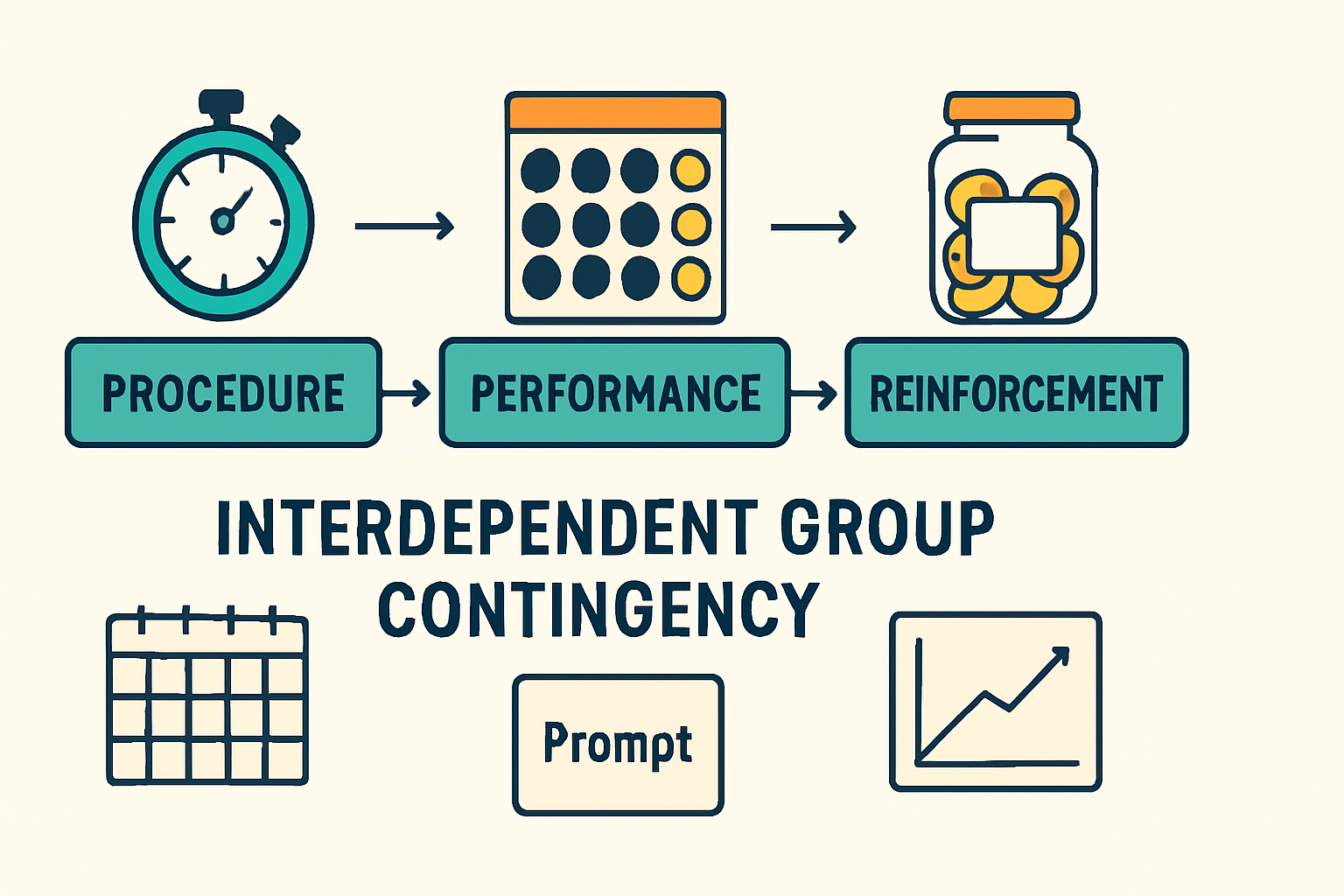
Use this practical checklist when designing or evaluating interdependent group contingencies in clinical or educational settings.
- Define clear criteria for group performance that all members can understand
- Select appropriate reinforcement that is motivating for all group members
- Establish measurement procedures to track group progress objectively
- Monitor for ethical concerns including peer pressure and free-riding
- Consider group composition and dynamics before implementation
- Plan for generalization and maintenance of target behaviors
- Collect social validity data from participants and stakeholders
Summary and Key Takeaways
Interdependent group contingencies represent a powerful tool in the behavior analyst’s toolkit when implemented thoughtfully. The approach creates natural opportunities for social learning and cooperative behavior while being efficient to implement across group settings.
Key points to remember include the all-or-nothing nature of reinforcement delivery, the importance of clear collective criteria, and the need for ongoing ethical monitoring. When used appropriately, this strategy can effectively promote desired behaviors while teaching valuable social skills. For additional exam preparation resources, explore our BCBA exam prep guide and learn more about ethics in ABA practice.
For authoritative information on behavior analytic principles, refer to the Behavior Analyst Certification Board and consult peer-reviewed literature on group contingencies in applied settings.


