
Positive Punishment ABA: Defining Positive Punishment for the BCBA Exam
Understanding positive punishment requires precise terminology that often confuses exam candidates. In operant conditioning, this concept follows a specific pattern that you must recognize quickly during testing.
Table of Contents
- Positive Punishment ABA: Defining Positive Punishment for the BCBA Exam
- Positive Punishment in Practice: Worked ABA Examples
- Positive Punishment on the BCBA Exam: What to Expect
- Summary and Key Takeaways
The Two-Part Definition: Addition and Decrease
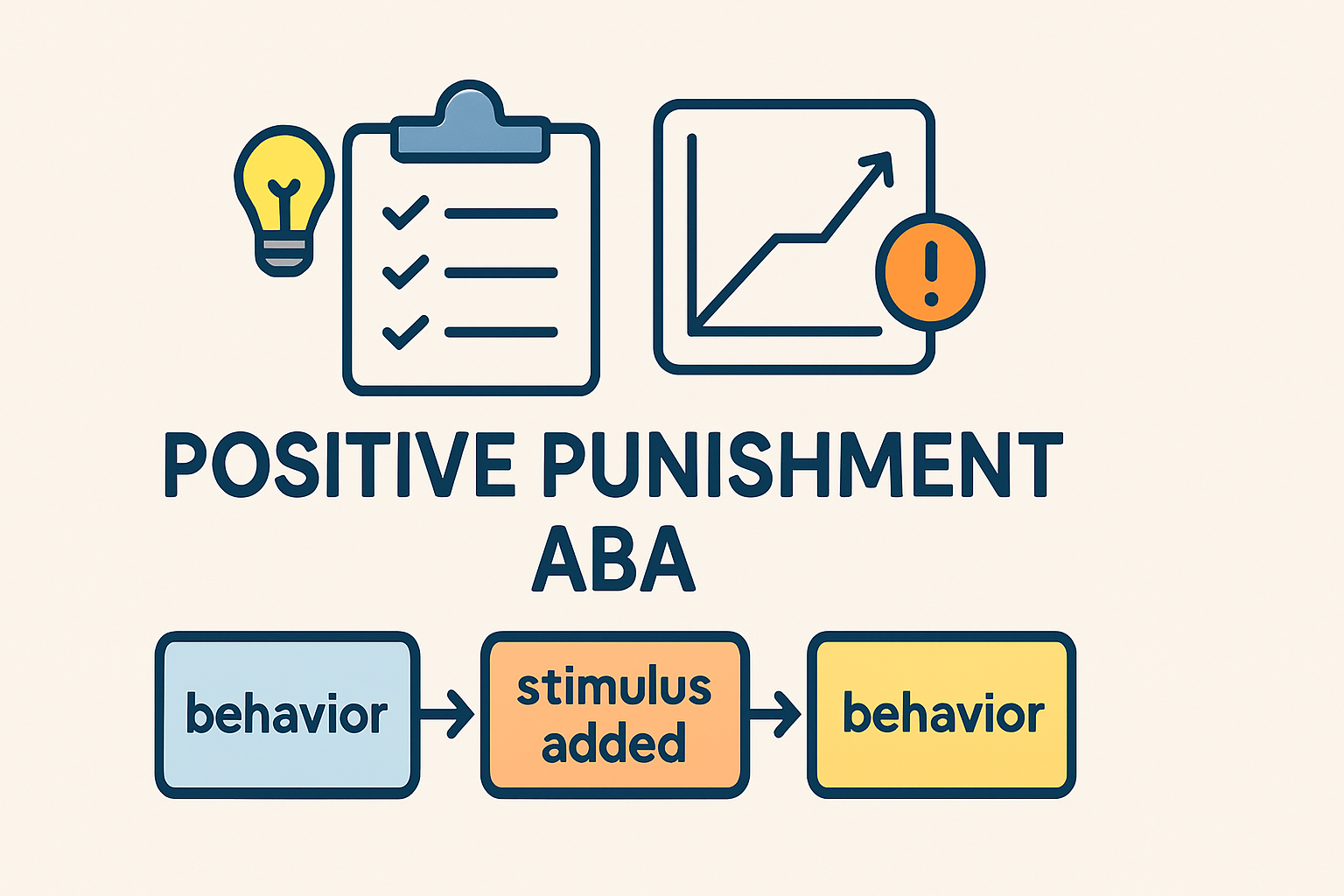
The term ‘positive’ in behavioral analysis means a stimulus is added or presented following a behavior. ‘Punishment’ refers to any consequence that decreases the future frequency of that behavior. Together, positive punishment occurs when adding a stimulus after a behavior makes that behavior less likely to occur again.
Remember this simple formula: Behavior → Add Stimulus → Behavior ↓. This differs from negative punishment, where something is removed to decrease behavior.
Positive Punishment vs. Negative Reinforcement: The Critical Distinction
This distinction causes more exam errors than almost any other concept. Both involve aversive stimuli, but their effects on behavior differ fundamentally.
Positive punishment decreases behavior by adding something unpleasant. Negative reinforcement increases behavior by removing something unpleasant. The key is observing whether the target behavior goes up or down after the consequence.
For example, if a student stops talking after receiving a reprimand (stimulus added, behavior decreases), that’s positive punishment. If a student raises their hand to escape a difficult task (aversive removed, behavior increases), that’s negative reinforcement.
Positive Punishment in Practice: Worked ABA Examples
Let’s examine practical applications through complete ABC analysis examples. Each includes antecedent, behavior, consequence, and hypothesized function.
Example 1: Verbal Reprimand for Hand Biting
Antecedent: Therapist presents a non-preferred academic task. Behavior: Client bites their own hand. Consequence: Therapist says ‘No biting!’ in a firm tone. Function: Escape from demand.
The added verbal reprimand serves as the positive punisher. If hand-biting decreases in similar future situations, the consequence functioned as punishment. This example illustrates how even verbal stimuli can serve as punishers when they follow the behavior and decrease its frequency.
Example 2: Overcorrection for Property Destruction
Antecedent: Access to preferred tablet is denied. Behavior: Client throws a toy across the room. Consequence: Required to pick up the thrown toy plus tidy the entire play area. Function: Tangible access.
This demonstrates restitutional overcorrection, where the added effort of cleaning beyond the original mess serves as the punisher. The aversive stimulus is the extra work required, which aims to decrease future property destruction.
Ethical Considerations and Last-Resort Status
These examples are educational illustrations. In actual practice, positive punishment procedures require rigorous ethical review and should only follow comprehensive functional assessment. According to BACB guidelines, reinforcement-based interventions must be exhausted first.
Potential side effects include emotional reactions, avoidance behaviors, and damage to the therapeutic relationship. Always consider least restrictive alternatives and document the decision-making process thoroughly.
Positive Punishment on the BCBA Exam: What to Expect
Exam questions test both conceptual understanding and practical application. You’ll encounter several common formats that require careful analysis.
Common Exam Item Formats and Traps
The biggest trap is confusing ‘positive’ with ‘good’ or misidentifying the behavioral effect. Watch for these patterns:
- Scenario identification: You’ll read a brief case and must identify the operative contingency
- Comparative analysis: Questions asking you to distinguish positive punishment from negative reinforcement
- Ethical decision-making: Selecting the most appropriate intervention from a list where positive punishment should not be the first choice
- Function-based traps: Items that describe punishment but where the behavior actually increases (indicating reinforcement)
Always verify both components: stimulus addition and behavior decrease. Don’t assume a consequence is punishing just because it seems unpleasant.
Quick-Review Checklist for Test Day
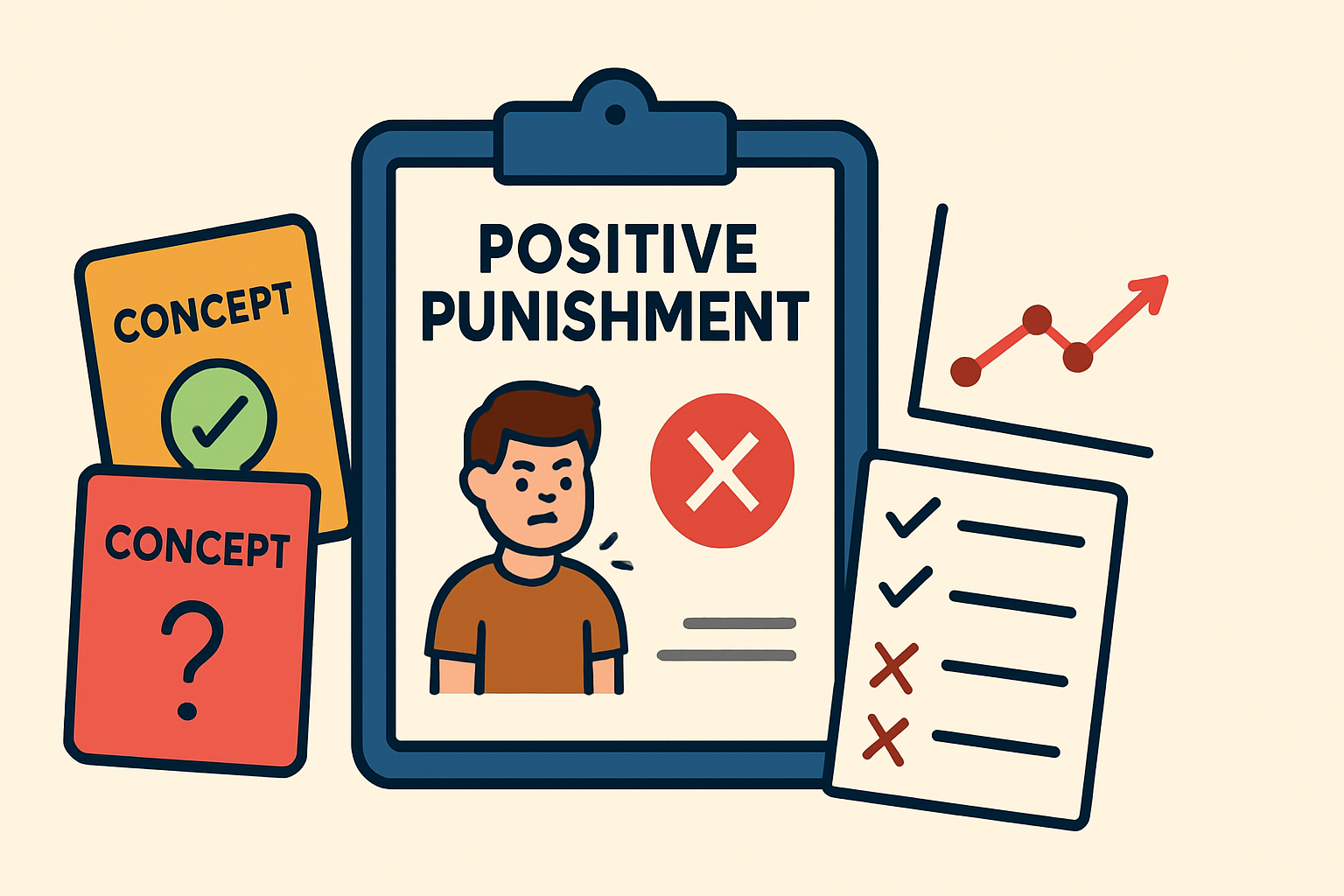
Use this systematic approach when analyzing exam scenarios:
- Was a stimulus added or presented following the behavior?
- Did the target behavior subsequently decrease in frequency?
- Is the behavior change due to this specific contingency (rule out extinction or satiation)?
- Have you ruled out negative reinforcement (where behavior increases to remove aversives)?
- If yes to the first two questions, it’s positive punishment
This checklist helps avoid common errors and ensures you’re applying the definition correctly. For more on related concepts, see our guide on the four functions of behavior.
Summary and Key Takeaways
Positive punishment remains one of the most frequently misunderstood concepts in applied behavior analysis. Master these essential points:
- Positive means addition of a stimulus, not that the procedure is beneficial
- Punishment means decrease in future behavior frequency
- Distinguish carefully from negative reinforcement, which increases behavior
- In practice, these procedures require ethical justification and are last-resort options
- Exam questions test both identification and appropriate application contexts
Remember that effective behavior change typically emphasizes reinforcement-based strategies first. Positive punishment, when necessary, should be part of a comprehensive plan that includes teaching alternative behaviors and monitoring for unwanted side effects. For comprehensive ethical guidance, review the BACB Ethics Code regarding punishment procedures.


