

In applied behavior analysis, understanding antecedent stimuli that signal when reinforcement is available versus when it is not forms a cornerstone of effective intervention. The stimulus delta ABA concept represents a critical component of this discriminative control framework. This guide provides a comprehensive examination of S-delta, moving from foundational definitions to practical applications and exam preparation strategies.
Table of Contents
- Stimulus Delta ABA: What is a Stimulus Delta? The Core Definition
- Stimulus Delta in Action: Worked ABA Examples
- Stimulus Delta on the BCBA Exam: Relevance and Common Traps
- Quick-Study Checklist and Summary
Stimulus Delta ABA: What is a Stimulus Delta? The Core Definition
A stimulus delta (abbreviated as S-delta or SΔ) is defined as an antecedent stimulus in the presence of which a specific behavior has not been reinforced in the past. This establishes a discriminative control relationship where the stimulus signals that reinforcement is not currently available for that particular response.
The key distinction lies in the reinforcement history associated with the stimulus, not in any inherent property of the stimulus itself. When a behavior occurs in the presence of an S-delta, it typically decreases in frequency because it does not produce the desired consequence.
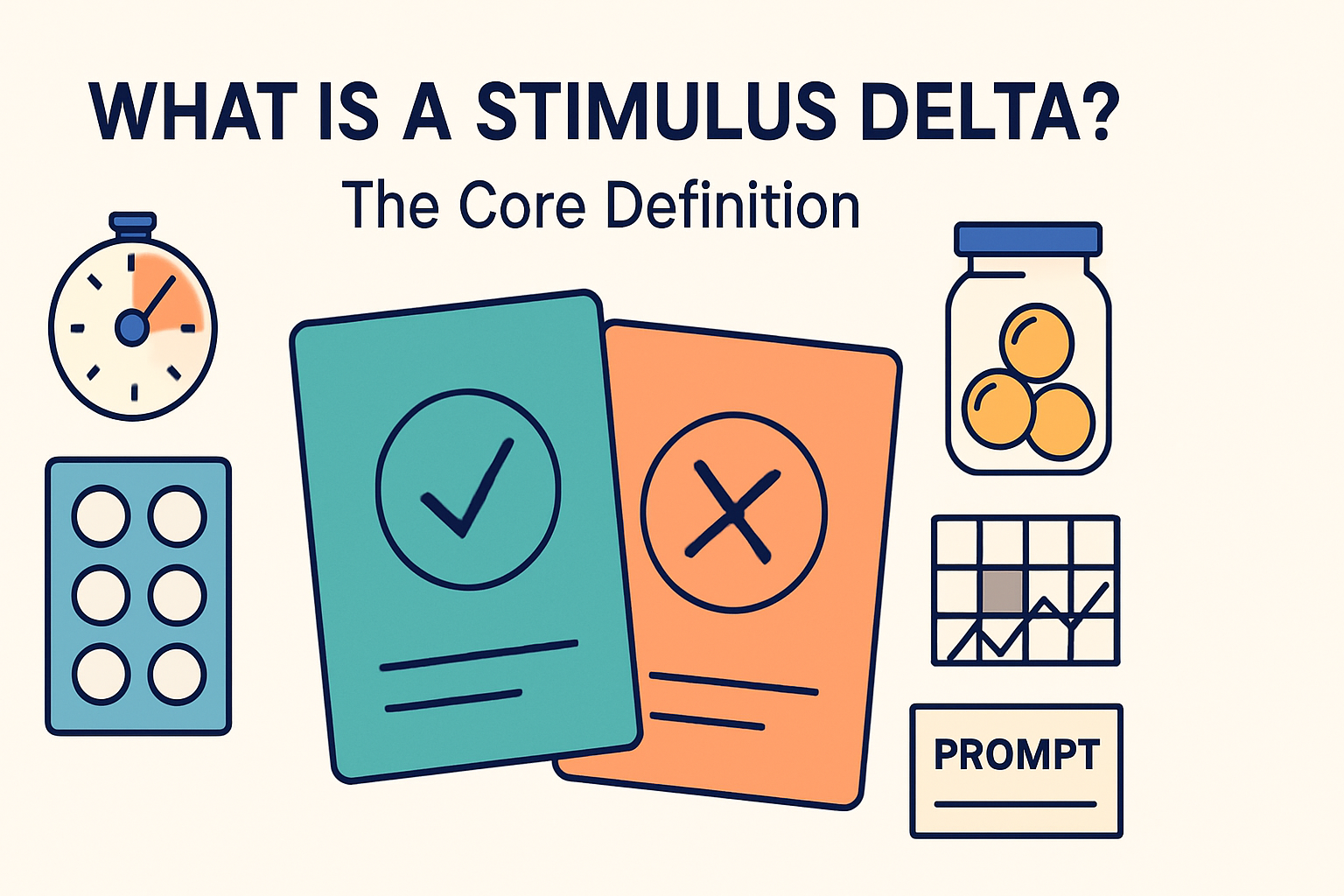
Stimulus Delta vs. Discriminative Stimulus (S-D): A Critical Pair
These two concepts form complementary components of stimulus control. Understanding their relationship is essential for analyzing behavior-environment interactions.
- Discriminative Stimulus (S-D): Signals that reinforcement is available for a specific behavior
- Stimulus Delta (S-delta): Signals that reinforcement is NOT available for that same behavior
- Reinforcement History: Both are defined by past consequences, not stimulus properties
- Behavioral Effect: S-D increases response probability; S-delta decreases it
- Environmental Context: They often alternate in natural settings to establish discrimination
Official Terminology and Common Abbreviations
The term stimulus delta is formally defined in behavior analytic literature and appears consistently across textbooks and research. The abbreviation S-delta or SΔ is universally accepted. Within the three-term contingency, it functions as the antecedent component when the consequence is no reinforcement.
For a deeper understanding of how antecedents function within behavior analysis, see our guide on antecedent strategies and common exam traps.
Stimulus Delta in Action: Worked ABA Examples
Translating the theoretical definition into practical scenarios helps solidify understanding. Each example follows the ABC framework and includes hypothesized behavioral function.
Example 1: Manding for a Snack
This common scenario illustrates how environmental cues establish discriminative control over verbal behavior.
- Antecedent: Parent is actively engaged in a phone conversation
- Behavior: Child says “Cookie, please” while approaching the parent
- Consequence: Parent does not respond or provide the cookie
- Hypothesized Function: Access to tangibles (the cookie)
- Analysis: The parent’s engagement with the phone serves as an S-delta because past attempts to mand during phone conversations have not been reinforced
Example 2: Raising a Hand in Class
Educational settings provide rich examples of stimulus control, particularly with attention-seeking behaviors.
- Antecedent: Teacher’s back is turned while writing on the whiteboard
- Behavior: Student raises hand and waits to be called on
- Consequence: Teacher does not acknowledge or call on the student
- Hypothesized Function: Access to adult attention/instructional help
- Analysis: The teacher’s orientation away from the class signals that hand-raising is unlikely to be reinforced with attention at that moment
Example 3: Checking a Smartphone
Modern technology provides relatable examples of how stimulus control operates in everyday life.
- Antecedent: Phone screen is dark with no visible notification lights
- Behavior: Person taps the screen to check for messages
- Consequence: No new notifications appear on the unlocked screen
- Hypothesized Function: Access to social stimuli (messages, updates)
- Analysis: The dark screen serves as an S-delta because checking during this stimulus condition has not been reinforced with new social content in the past
Stimulus Delta on the BCBA Exam: Relevance and Common Traps
Understanding how S-delta concepts are tested can significantly improve exam performance. The BACB often assesses this content through scenario-based questions requiring discrimination between stimulus types.
Trap 1: Confusing S-delta with ‘Absence of an S-D’
A frequent error involves treating any situation without an S-D as automatically containing an S-delta. This oversimplification misses the critical requirement that an S-delta must be a specific stimulus present in the environment that signals no reinforcement.
Consider this distinction: In a completely empty room with no discriminative stimuli, there is no S-delta present—just an absence of stimulus control. An S-delta requires a specific environmental feature that has been correlated with non-reinforcement.
Trap 2: Misidentifying the ‘Delta’ in Behavioral Momentum
The Greek letter delta (Δ) appears in multiple behavior analytic contexts, creating potential confusion. In behavioral momentum theory, delta represents change in response rate (ΔB). This is distinct from the S-delta concept, where delta refers to the stimulus itself.
Exam questions may include both uses of “delta” to test conceptual clarity. Always check the context: if discussing response rates or resistance to change, it’s likely behavioral momentum; if discussing antecedent stimuli, it’s S-delta.
Exam Question Formats to Expect
Familiarity with common question structures can reduce test anxiety and improve accuracy.
- Scenario Identification: “Which of the following describes an S-delta in this situation?”
- Function Matching: “In the presence of an S-delta, a behavior is likely to…”
- Comparative Analysis: Questions requiring discrimination between S-D and S-delta in the same scenario
- Three-Term Contingency: Completing ABC analyses where the antecedent is an S-delta
- Application Questions: Determining appropriate interventions based on stimulus control analysis
For additional exam preparation resources, explore our comprehensive BCBA exam study guide.
Quick-Study Checklist and Summary
This concise review consolidates key points for efficient study and last-minute preparation.
- Define S-delta precisely: A stimulus in whose presence a behavior has NOT been reinforced
- Contrast with S-D: S-D signals reinforcement availability; S-delta signals non-availability
- Remember the history: Both are defined by past reinforcement contingencies
- Identify in scenarios: Look for specific stimuli correlated with non-reinforcement
- Avoid common traps: Don’t confuse with absence of S-D or behavioral momentum delta
- Apply to interventions: Use S-delta analysis to inform discrimination training
- Practice identification: Work through multiple ABC examples with varied functions
- Review official sources: Consult the BACB task list and Cooper et al. for authoritative definitions
Mastering the stimulus delta concept enhances both exam performance and clinical practice. By understanding what signals non-reinforcement, behavior analysts can more effectively teach discrimination, reduce problem behaviors maintained by inappropriate reinforcement, and design environments that promote adaptive responding. This fundamental component of stimulus control remains essential across assessment, intervention, and ethical practice domains in applied behavior analysis.


