
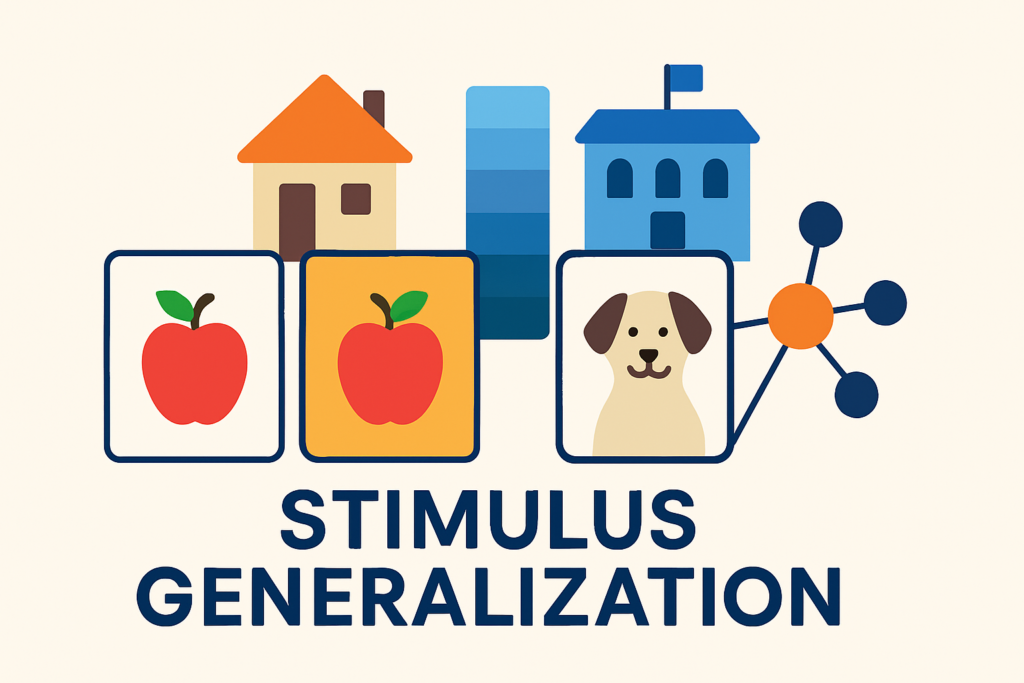
Understanding stimulus generalization is essential for both effective ABA practice and success on the BCBA exam. This fundamental concept explains how learned behaviors transfer across different situations and settings. When a behavior occurs in the presence of stimuli that share properties with the original training stimulus, you’re observing stimulus generalization in action.
Table of Contents
- What is Stimulus Generalization? A Core Concept Defined
- Stimulus Generalization in Action: Worked ABA Examples
- Stimulus Generalization on the BCBA Exam: Relevance and Common Traps
- A Quick Checklist for Programming and Assessing Generalization
- Summary and Key Takeaways for Your Studies
What is Stimulus Generalization? A Core Concept Defined
Stimulus generalization occurs when a behavior learned in the presence of one specific stimulus appears in the presence of other, similar stimuli. This transfer happens because the new stimuli share relevant physical properties with the original discriminative stimulus.
The Formal Definition and Key Characteristics
Formally, stimulus generalization refers to the occurrence of a behavior in the presence of stimuli that share similar physical properties with the original discriminative stimulus. This contrasts with stimulus discrimination, where a behavior occurs only in the presence of the specific training stimulus and not with similar ones.
The generalization gradient illustrates this concept visually. As stimuli become less similar to the original SD, the probability of the behavior occurring decreases. This gradient shows how response strength varies with stimulus similarity.
Stimulus Generalization vs. Response Generalization
These two concepts often confuse exam candidates. Stimulus generalization involves different stimuli evoking the same response. Response generalization involves the same stimulus evoking different, functionally similar responses.
For example, if a child learns to say ‘hello’ to their therapist and then says ‘hello’ to other adults, that’s stimulus generalization. If they learn to say ‘hello’ and then spontaneously use ‘hi’ or ‘hey’ with the same therapist, that’s response generalization.
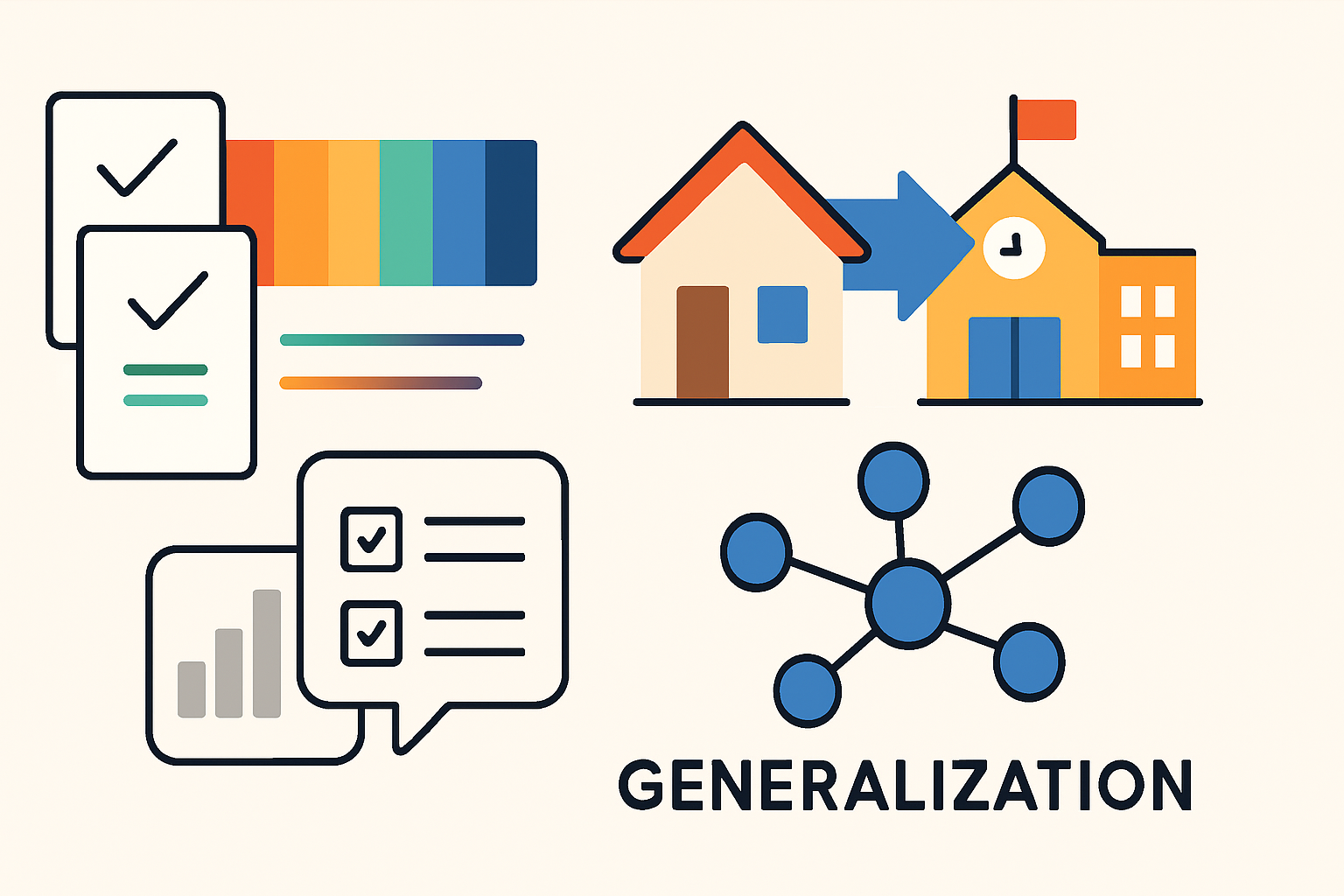
Stimulus Generalization in Action: Worked ABA Examples
Real-world examples make abstract concepts concrete. These scenarios demonstrate how stimulus generalization appears in clinical practice and daily life.
Example 1: Greeting Across People
A child learns to say ‘Hi’ when their primary therapist enters the room (SD1). After successful training, the child now says ‘Hi’ to a new therapist (SD2), their parent (SD3), and even a store clerk (SD4).
ABC Analysis: Antecedent – New person present; Behavior – Saying ‘Hi’; Consequence – Social attention and reciprocal greeting. The hypothesized function is access to social reinforcement and attention.
Example 2: Manding with Different Cups
A learner taught to mand ‘cup’ when presented with a specific red plastic cup (SD1) now mands ‘cup’ when shown a blue ceramic mug (SD2) and a paper cup (SD3).
ABC Analysis: Antecedent – Presence of any cup-like container; Behavior – Saying ‘cup’; Consequence – Access to a drink. The function is tangible reinforcement through access to preferred liquids.
Example 3: Math Skills in Novel Settings
A student learns to solve addition problems on a whiteboard in their classroom (SD1). They successfully solve similar problems in a workbook (SD2), on a tablet app (SD3), and during a grocery store game (SD4).
ABC Analysis: Antecedent – Math problem presented in various formats; Behavior – Solving the problem; Consequence – Teacher praise or correct answer confirmation. The function may involve escape from negative evaluation or access to academic success.
Stimulus Generalization on the BCBA Exam: Relevance and Common Traps
The BCBA exam frequently tests your ability to identify and apply generalization concepts. Understanding common pitfalls can significantly improve your exam performance.
How the Exam Tests This Concept
Exam questions typically present scenarios and ask you to identify examples of stimulus generalization. You might need to differentiate it from other concepts like response generalization or stimulus discrimination. Some questions ask you to select appropriate strategies for promoting generalization in clinical situations.
Frequent Exam Pitfalls and How to Avoid Them
- Confusing stimulus with response generalization: Remember that stimulus generalization involves different stimuli evoking the same response, while response generalization involves the same stimulus evoking different responses.
- Mistaking lack of discrimination for generalization: True generalization involves transfer of learning, not simply failure to discriminate between stimuli.
- Overlooking stimulus features: Pay attention to what physical properties the stimuli share (e.g., all involve people, all are containers, all present math problems).
- Missing the generalization gradient: Remember that response probability decreases as stimuli become less similar to the original SD.
For more on related concepts, see our guide on stimulus equivalence and the seven dimensions of ABA.
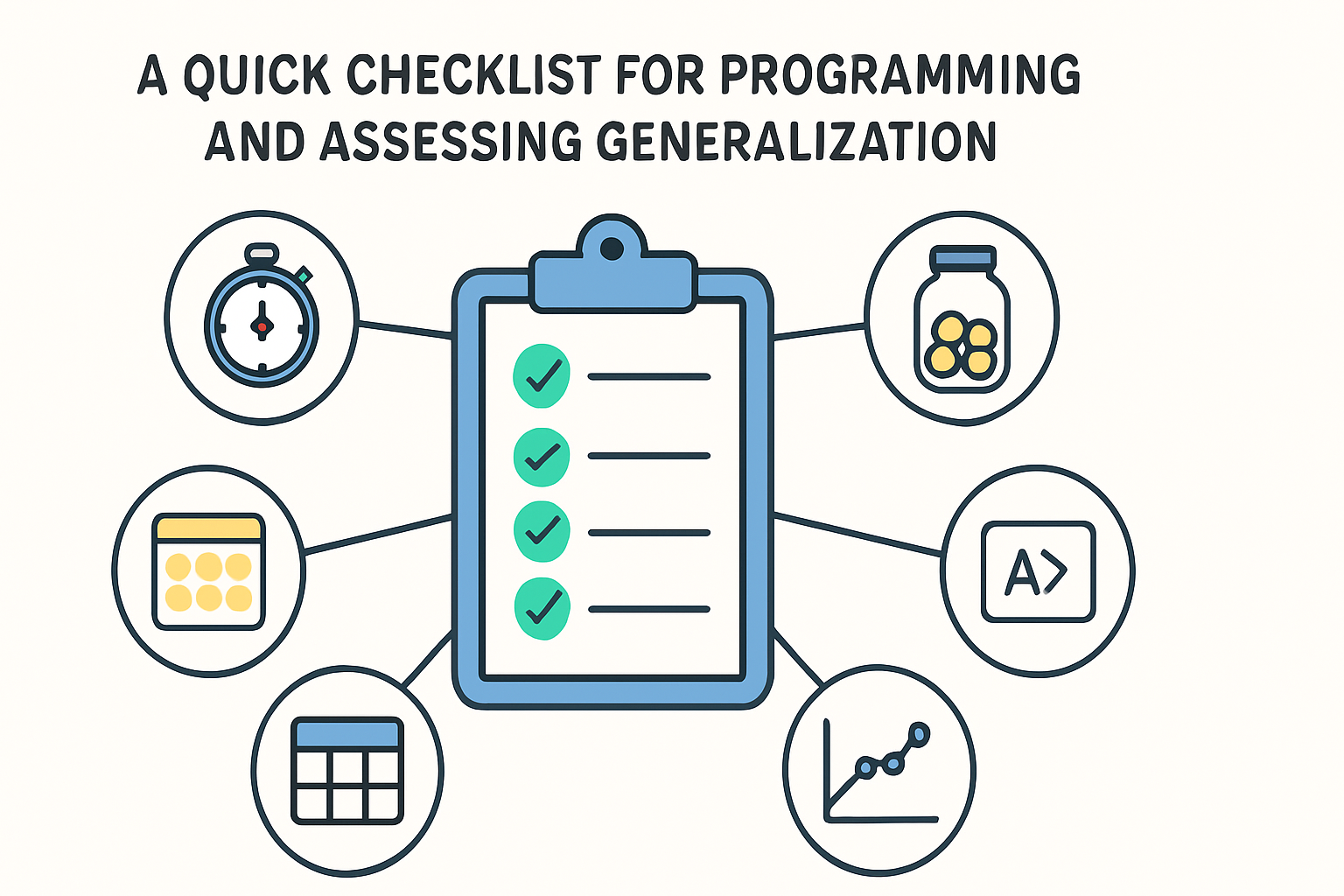
A Quick Checklist for Programming and Assessing Generalization
Effective generalization doesn’t happen by accident. Use this checklist to systematically program for generalization in your interventions.
- Teach with multiple exemplars: Use different examples during training to increase the likelihood of generalization.
- Vary teaching settings: Conduct sessions in different environments where the behavior should occur.
- Include relevant people: Involve different instructors, family members, or peers in training.
- Program common stimuli: Include elements from natural environments in your teaching setting.
- Use indiscriminable contingencies: Make reinforcement schedules less predictable to maintain behavior across settings.
- Teach self-management skills: Equip learners to monitor and reinforce their own behavior.
- Assess generalization regularly: Systematically test whether behaviors occur with novel stimuli and in new settings.
For comprehensive exam preparation strategies, explore our BCBA exam prep guide.
Summary and Key Takeaways for Your Studies
Stimulus generalization represents a critical component of effective behavior change. When behaviors transfer across similar stimuli, interventions become more efficient and meaningful.
- Stimulus generalization involves the same response occurring with different, similar stimuli
- It contrasts with stimulus discrimination (responding only to specific stimuli) and response generalization (different responses to the same stimulus)
- The generalization gradient shows how response probability decreases with decreasing stimulus similarity
- Effective programming requires systematic planning using multiple exemplars, varied settings, and common stimuli
- On the BCBA exam, carefully distinguish between stimulus and response generalization in scenario questions
- Always consider the shared physical properties that enable generalization to occur
For authoritative information on behavior analysis concepts, refer to the Behavior Analyst Certification Board and peer-reviewed journals like the Journal of Applied Behavior Analysis.


