
Supervisee Meaning in ABA: Defining the Supervisee in Applied Behavior Analysis
In Applied Behavior Analysis, the term supervisee has a specific, technical meaning that differs from casual usage. Understanding this precise definition is crucial for both professional practice and certification preparation.
Table of Contents
- Supervisee Meaning in ABA: Defining the Supervisee in Applied Behavior Analysis
- Supervisee Responsibilities and Ethical Obligations
- Applied Examples: Supervisee Behavior in Practice
- Supervisee Knowledge on the BCBA Exam
- Final Summary and Key Takeaways
The BACB’s Perspective on the Supervisee Role
The Behavior Analyst Certification Board defines a supervisee as an individual who is accruing supervised experience toward certification as a Board Certified Behavior Analyst or Board Certified Assistant Behavior Analyst. This role is formalized through documented supervision contracts and structured experience hours.
According to BACB standards, a supervisee must be actively working toward certification while receiving regular, documented supervision from a qualified BCBA or BCBA-D. This relationship is governed by specific ethical guidelines and experience standards that ensure proper professional development.
Supervisee vs. Client: A Critical Ethical Distinction
One of the most important distinctions in ABA practice is between a supervisee and a client. The supervisee is a professional-in-training whose behavior is shaped for skill acquisition, while the client is the recipient of behavioral services.
Confusing these roles represents a major ethical violation that can compromise both professional development and client welfare. The supervisee’s learning objectives focus on developing clinical skills, assessment abilities, and intervention implementation under supervision.
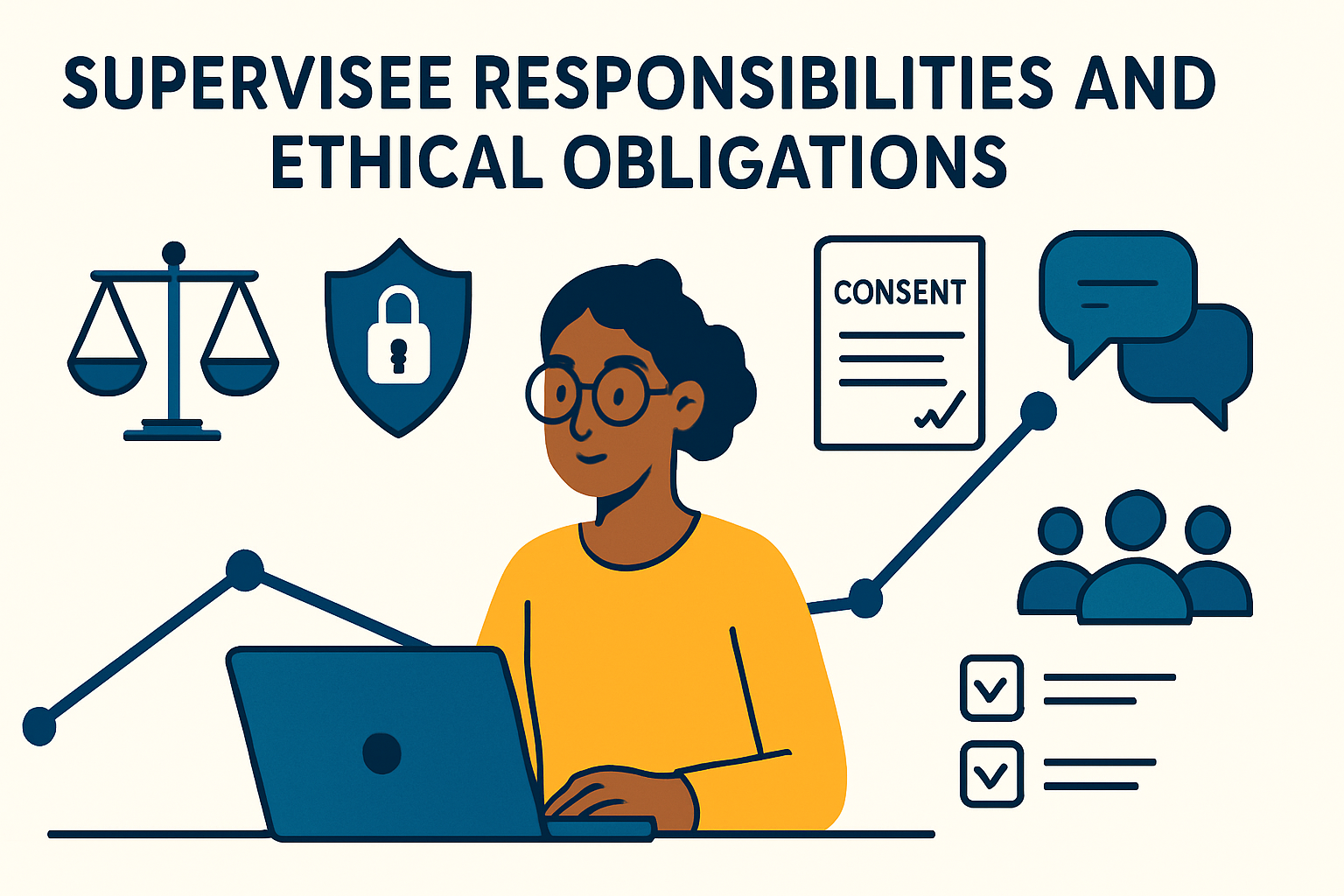
Supervisee Responsibilities and Ethical Obligations
Beyond the basic definition, supervisees carry specific responsibilities that are essential for professional growth and ethical practice. These duties form the foundation of effective supervision relationships.
Core Duties: From Data Collection to Professional Conduct
Supervisees must demonstrate competence across several key areas while working toward certification. These responsibilities include:
- Implementing behavioral interventions with fidelity and accuracy
- Collecting reliable data on client progress and program effectiveness
- Accepting and implementing corrective feedback from supervisors
- Maintaining strict client confidentiality and professional boundaries
- Engaging in ongoing professional development and self-assessment
- Adhering to the BACB Ethics Code in all professional activities
Navigating the Dual Relationship with Your Supervisor
The supervision relationship involves a unique power dynamic that requires careful navigation. Supervisees must balance openness to feedback with understanding their rights to ethical treatment.
A formal supervision contract is essential, outlining expectations, meeting frequency, evaluation procedures, and grievance processes. This document protects both parties and ensures clarity about the professional relationship’s parameters.
Applied Examples: Supervisee Behavior in Practice
Concrete examples help illustrate how supervisee responsibilities manifest in real-world scenarios. These practical applications demonstrate the concept’s relevance to daily practice.
Example 1: Accepting Corrective Feedback (ABC Analysis)
Consider a scenario where a supervisor provides written feedback on a session note. The antecedent is the supervisor’s feedback delivery. The behavior involves the supervisee reviewing feedback, asking clarifying questions, and revising the note appropriately.
The consequence includes the supervisor providing positive reinforcement and the supervisee’s professional writing skills improving. The hypothesized function is positive reinforcement through access to improved skills and professional approval.
Example 2: An Ethical Dilemma Involving Confidentiality
In another scenario, a friend asks a supervisee about a client they know attends the same clinic. The antecedent is the friend’s inquiry about client information. The behavior involves the supervisee stating they cannot discuss any client information due to confidentiality obligations.
The consequence is momentary disappointment from the friend but maintenance of professional boundaries. The function is negative reinforcement through removal of threat to ethical standing and certification eligibility.

Supervisee Knowledge on the BCBA Exam
Understanding the supervisee role is directly relevant to certification success. Exam questions often test this knowledge through scenario-based items that require ethical decision-making.
Common Exam Traps and How to Avoid Them
Several common pitfalls can trip up candidates on exam questions related to supervision. Being aware of these traps helps prevent costly mistakes:
- Confusing supervisee with client in scenario questions – always check who is receiving services versus who is providing them
- Misidentifying ultimate responsibility for client care – remember the supervisor holds final responsibility, not the supervisee
- Overlooking the requirement for a formal, documented supervision contract – this is mandatory, not optional
- Forgetting that supervisees must adhere to the full BACB Ethics Code, not just selected portions
- Assuming all supervision hours count equally – only hours meeting specific criteria qualify toward certification
Quick-Reference Supervisee Checklist
Use this checklist to quickly assess supervisee readiness and compliance:
- Has a signed supervision contract with clear terms?
- Is actively accruing supervised experience toward certification?
- Implements programs under direct supervision as required?
- Receives regular, documented feedback and evaluation?
- Adheres to the complete BACB Ethics Code for supervisees?
- Maintains proper client confidentiality and boundaries?
- Engages in ongoing professional development activities?
Final Summary and Key Takeaways
The supervisee meaning in ABA encompasses both a specific definition and a set of professional responsibilities. This role represents a critical developmental phase where future behavior analysts acquire essential skills under guided supervision.
Key elements include the formal relationship defined by BACB standards, distinct separation from client roles, and adherence to specific ethical obligations. Practical application through scenarios demonstrates how these concepts operate in real practice settings.
For exam preparation, focus on understanding the ethical distinctions, recognizing common traps in scenario questions, and remembering the mandatory requirements for supervision contracts and documentation. Resources like our guide to ethics in ABA practice provide additional context for these concepts.
Remember that proper supervision is not just a certification requirement but a fundamental component of developing clinical competence and ethical practice. The BACB provides detailed supervision resources that outline current standards and requirements.
As you prepare for certification, consider how our BCBA exam study framework can help structure your preparation across all content areas, including supervision concepts.


