

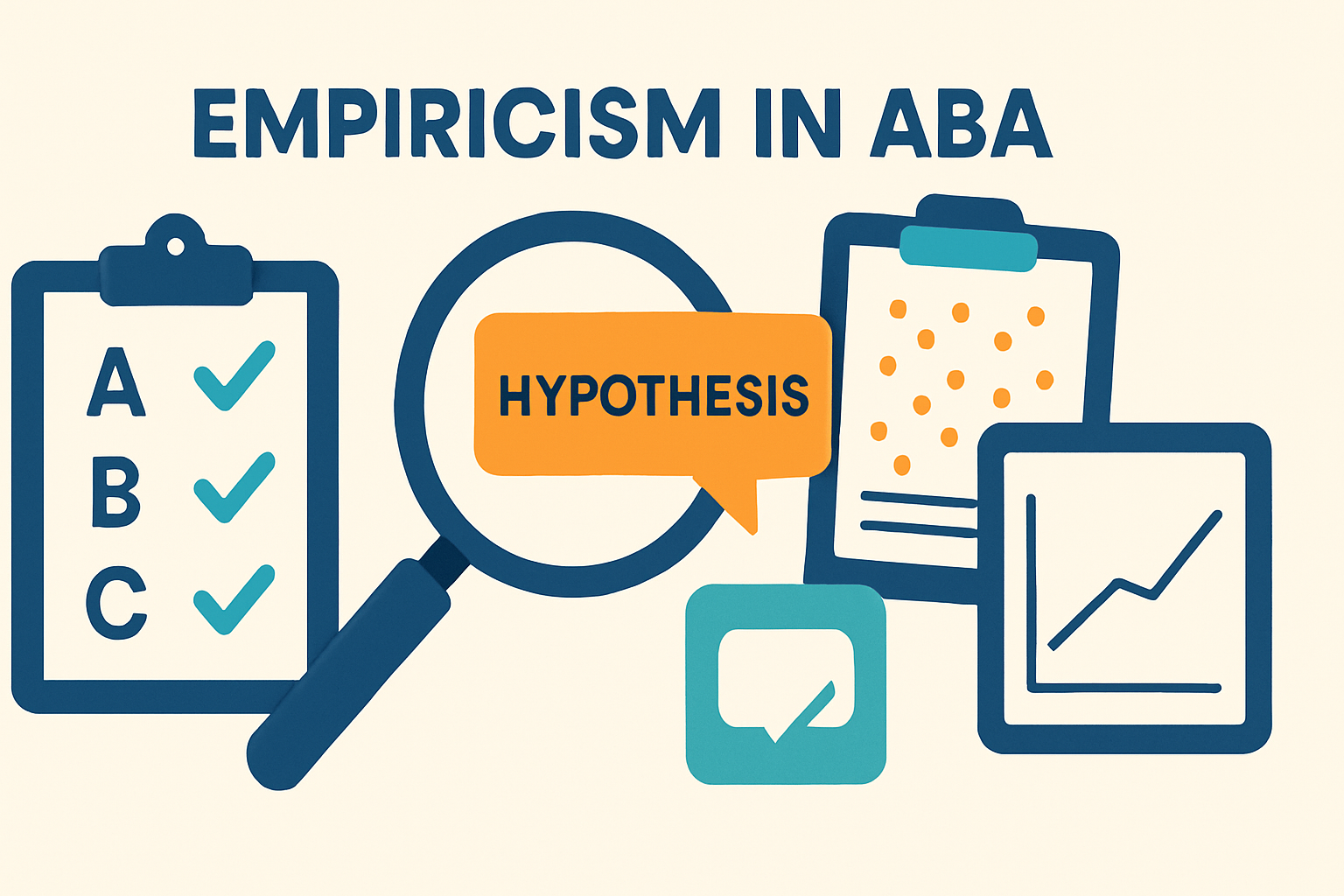
Empiricism in ABA is the philosophical assumption that guides all scientific practice in behavior analysis. It means relying on objective observation and systematic measurement rather than subjective opinion or anecdotal evidence. This principle ensures that behavior analysts make decisions based on data, not intuition.
Table of Contents
- Empiricism in ABA: What is Empiricism in Applied Behavior Analysis?
- Empiricism in Action: Three ABA Case Examples
- Empiricism on the BCBA Exam: What to Expect and Common Traps
- Your Empiricism Application Checklist
Empiricism in ABA: What is Empiricism in Applied Behavior Analysis?
Empiricism represents the commitment to data-based decision making in behavior analysis. It’s one of the seven philosophical assumptions underlying the science, alongside determinism, parsimony, and pragmatism.
The Definition: Objective Observation Over Subjective Opinion
Empiricism requires practitioners to measure observable phenomena using reliable methods. This means collecting baseline data before intervention, tracking progress with valid measurement systems, and making decisions based on visual analysis of graphed results. The alternative—relying on clinical intuition or anecdotal reports—violates this core principle.
Empiricism vs. Determinism, Parsimony, and Pragmatism
These four assumptions work together but serve distinct purposes. Determinism assumes behavior is lawful and predictable. Empiricism provides the method to discover those laws through observation. Parsimony guides us to choose the simplest explanation supported by data. Pragmatism asks whether our interventions work in practice. Empiricism is the data collection engine that drives all three.
Empiricism in Action: Three ABA Case Examples
Real-world applications show how empiricism transforms clinical practice from guesswork to science.
Example 1: Evaluating a Tactile Prompting Procedure
A BCBA considers using hand-over-hand prompting for tooth-brushing. Instead of assuming effectiveness, they collect baseline data on independent steps completed. During intervention, they measure prompt dependency and track treatment integrity. The data reveal whether the procedure actually increases independence or creates escape-maintained behavior.
Example 2: Testing a Hypothesis About Attention-Maintained Behavior
When a teacher reports a student “acts out for attention,” empiricism demands verification. The BCBA conducts a functional analysis with conditions including attention, demand, alone, and play. Data from ABC recordings might show the behavior actually serves an automatic reinforcement function, completely changing intervention planning.
Example 3: Data-Driven Revision of a Token Economy
A token system isn’t increasing homework completion. Empirical review includes checking interobserver agreement on token delivery, assessing reinforcer potency, and implementing an ABAB reversal design to test revised criteria. This systematic approach identifies whether the issue is with implementation, reinforcement schedule, or target behavior definition.
Empiricism on the BCBA Exam: What to Expect and Common Traps
Exam questions test your ability to distinguish empirical practice from subjective approaches.
Recognizing Empiricism in Vignettes and Scenarios
Look for keywords indicating data-based decisions: “the graph shows,” “measurement indicates,” “objective observation revealed.” Red flags include phrases like “the therapist felt,” “it was assumed,” or “clinical intuition suggested.” The exam consistently rewards answers that prioritize systematic measurement over subjective judgment.
Four Frequent Exam Traps (and How to Avoid Them)
- Confusing empiricism with pragmatism: Remember that empiricism is about how we know something works (data), while pragmatism asks if it works (outcome).
- Selecting compassionate-sounding subjective answers: Ethical practice requires data, even when subjective opinions sound more caring.
- Overlooking ongoing measurement needs: Good initial ideas still require empirical validation through continuous data collection.
- Mistaking correlation for causation: Two events occurring together don’t prove functional relationships without experimental control.

Your Empiricism Application Checklist
Use this practical guide to ensure empirical practice in your work and exam preparation.
- Define observable target behaviors using clear, measurable criteria before any intervention
- Collect baseline data using appropriate measurement systems (frequency, duration, latency, etc.)
- Implement with treatment integrity checks and interobserver agreement measures
- Graph results continuously and analyze trends, levels, and variability visually
- Make data-based decisions about intervention modifications, not based on feelings or anecdotes
- Use single-subject designs like reversal or multiple baseline to demonstrate experimental control
- Document everything so others can replicate your procedures and verify your findings
Empiricism transforms ABA from art to science. By committing to objective measurement and data-driven decisions, you ensure ethical practice and exam success. Remember that every clinical decision should be traceable back to observable data, not subjective opinion. For more on related philosophical assumptions, see our guide on philosophical assumptions in behavior analysis and the seven dimensions of ABA. The BACB Ethics Code also emphasizes data-based decision making throughout.


