

Understanding the distinction between control variables and independent variables is fundamental to conducting valid research in applied behavior analysis. These concepts form the backbone of experimental design and are frequently tested on the BCBA exam. This guide breaks down both variables with ABA-specific examples to help you master this essential research concept.
Table of Contents
- Control Variable versus Independent Variable: Defining the Core Variables in ABA Research
- Applied Examples: Seeing Variables in ABA Practice
- Exam Relevance and Common Points of Confusion
- Quick-Study Checklist and Summary
Control Variable versus Independent Variable: Defining the Core Variables in ABA Research
In behavior analysis, we systematically investigate relationships between variables to understand and change behavior. The experimental framework relies on precise identification of what we manipulate, what we measure, and what we control.
The Independent Variable: What You Manipulate
The independent variable (IV) is the intervention or condition that the experimenter systematically changes to observe its effect on behavior. In ABA practice, this typically refers to the treatment procedure, antecedent strategy, or specific intervention being tested.
Key characteristics of an independent variable include:
- It is actively manipulated by the researcher
- It has at least two levels or conditions (e.g., baseline vs. treatment)
- Changes in the IV are hypothesized to cause changes in the dependent variable
- In single-subject designs, the IV is introduced and withdrawn systematically
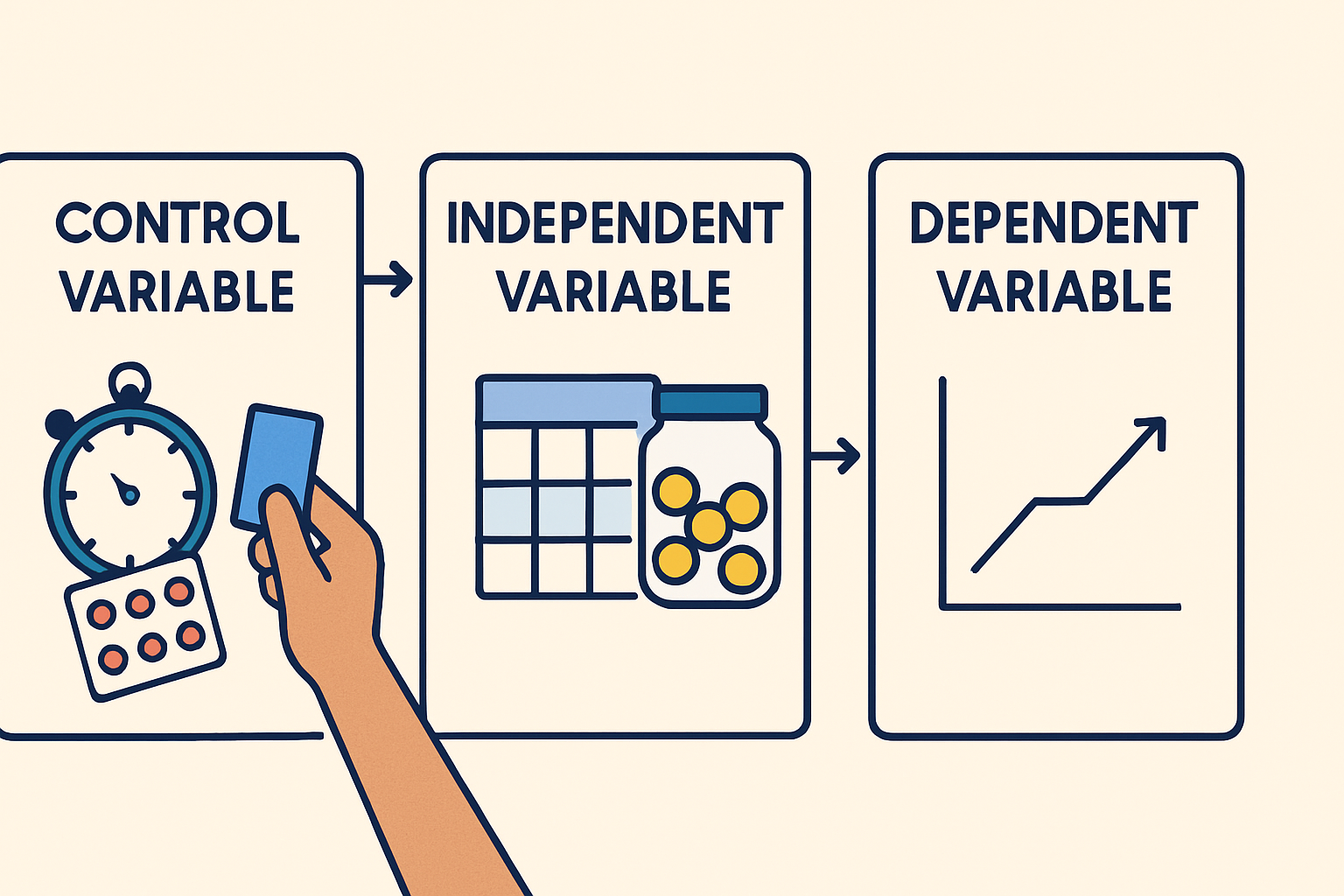
The Control Variable: What You Hold Constant
A control variable is any extraneous factor that must be kept consistent across experimental conditions. This ensures that any measured change in the dependent variable is due to the independent variable, not other influences.
Control variables differ from a control condition, which is a specific level of the independent variable (like baseline). Common control variables in ABA research include:
- Session duration and time of day
- Specific materials or stimuli used
- Therapist or implementer characteristics
- Environmental conditions and setting
- Measurement procedures and data collection methods
Applied Examples: Seeing Variables in ABA Practice
Moving from abstract definitions to concrete applications helps solidify understanding. Let’s examine two common ABA scenarios with explicit variable identification.
Example 1: Evaluating a Visual Schedule on Transition Tantrums
A BCBA wants to test whether implementing a first-then visual schedule reduces tantrums during classroom transitions.
- Independent Variable: Implementation of the visual schedule procedure
- Dependent Variable: Frequency of tantrums during transitions (measured per session)
- Control Variables: Time of day transitions occur (consistently after morning circle), specific staff member implementing, identical transition cues, same classroom setting, consistent measurement method using frequency recording
Example 2: Testing a Specific Praise Procedure for Task Engagement
A researcher examines whether behavior-specific praise delivered on a fixed ratio 3 schedule increases on-task behavior during academic work.
- Independent Variable: Delivery of behavior-specific praise on FR3 schedule
- Dependent Variable: Percentage of 10-second intervals with on-task behavior
- Control Variables: Task difficulty level (maintained at instructional level), absence of preferred items in the environment, consistent 15-minute session length, same work materials, identical prompting procedures
Exam Relevance and Common Points of Confusion
These concepts appear frequently on the BCBA exam, often in scenarios testing your understanding of experimental control and internal validity. Recognizing common traps is crucial for exam success.
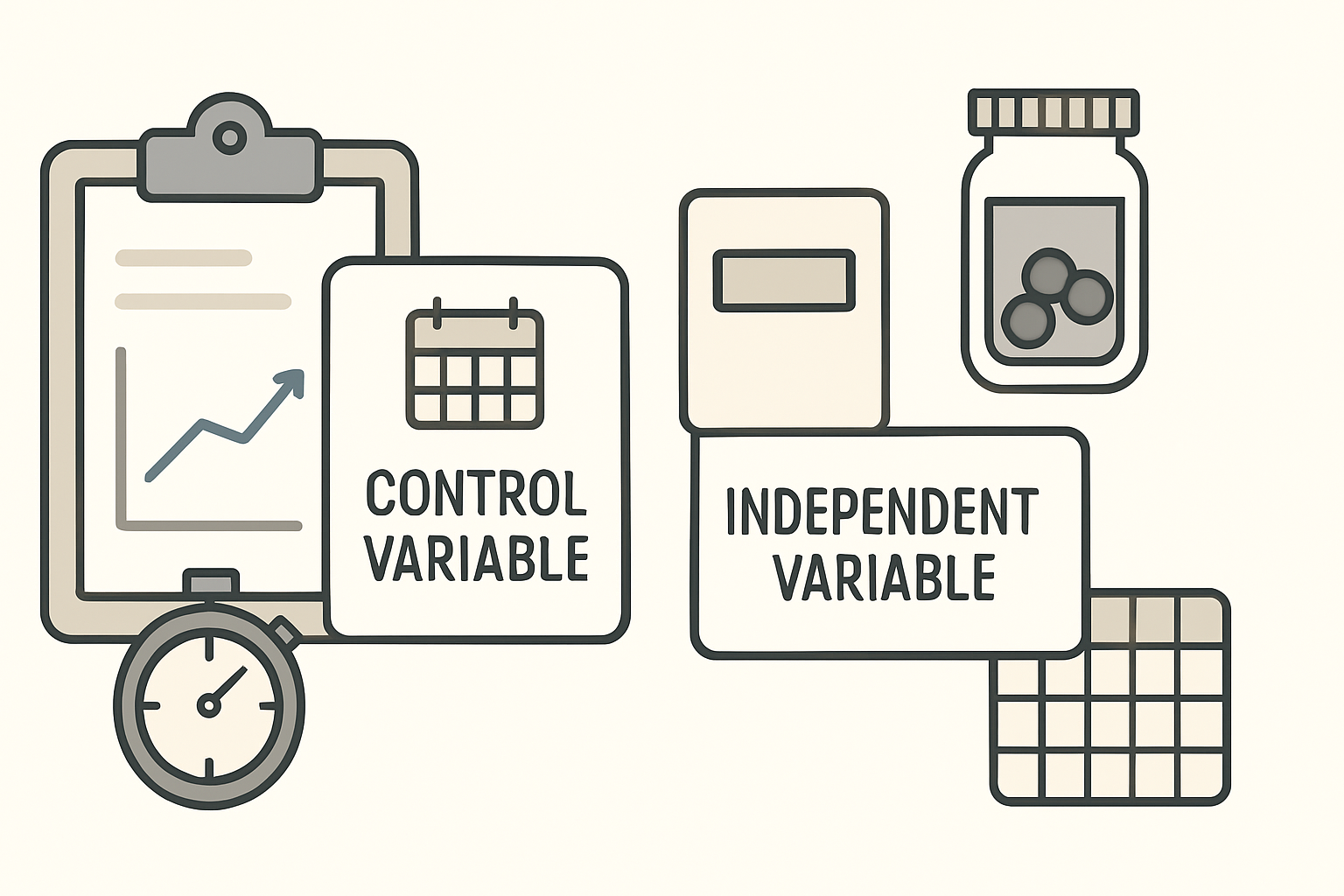
Trap #1: Confusing Control Variables with a Control Condition
Many candidates mistakenly equate control variables with a control condition. A control condition (like baseline or no-treatment phase) represents a specific level of the independent variable. In contrast, control variables are factors held constant across ALL conditions.
For example, in an ABAB reversal design, the baseline phases (A) are control conditions of the IV. The consistent session duration across all phases is a control variable.
Trap #2: Misidentifying the IV in Complex Interventions
When interventions involve multiple components (like DRA + extinction), candidates may struggle to identify the true independent variable. The IV is the specific component being tested for its effect. If multiple components are changed simultaneously, this creates confounded variables, threatening internal validity.
Exam questions often test whether you can identify when variables are confounded versus properly controlled. According to the BACB ethics code, practitioners must use research designs that allow for clear demonstration of treatment effects.
Quick-Study Checklist and Summary
Use this checklist to reinforce your understanding before the exam:
- Identify the IV by asking: “What is being manipulated or changed between conditions?”
- List control variables by asking: “What factors must stay constant to ensure valid comparison?”
- Remember that control conditions are levels of the IV, while control variables are held constant across conditions
- Watch for confounded variables when multiple factors change simultaneously
- Practice with BCBA mock exam questions that test variable identification
Mastering the distinction between control and independent variables strengthens your ability to design valid research and interpret experimental results. These concepts are foundational to the seven dimensions of ABA, particularly the dimensions of analytic and technological. By clearly identifying what you manipulate, what you measure, and what you control, you ensure your interventions are both effective and scientifically sound.


