

For BCBA candidates, understanding cultural humility is essential for both ethical practice and exam success. This concept moves beyond simple awareness to active, ongoing engagement with cultural differences in assessment and intervention.
Table of Contents
- Defining Cultural Humility for the BCBA
- Cultural Humility in Practice: Applied ABA Examples
- Cultural Humility on the BCBA Exam
- A BCBA’s Checklist for Culturally Humble Practice
Defining Cultural Humility for the BCBA
Cultural humility represents a lifelong commitment to self-reflection and critique regarding one’s cultural biases. It requires recognizing and addressing power imbalances in therapeutic relationships.
Core Principles: Lifelong Learning and Power Imbalances
The first pillar involves continuous self-evaluation of personal cultural assumptions. Practitioners must regularly examine how their background influences clinical decisions.
The second pillar focuses on redressing power dynamics between practitioner and client. This means actively creating space for client perspectives and preferences in treatment planning.
Cultural Humility vs. Cultural Competence: A Key Distinction
Cultural competence often implies a finite achievement—a set of skills or knowledge that can be mastered. In contrast, cultural humility recognizes an ongoing process of learning and adaptation.
This distinction matters because competence can lead to ethnocentric assumptions about what constitutes appropriate behavior across cultures. Humility maintains openness to learning from each unique client.
Ethical Foundations in the BACB Code
The BACB Ethics Code explicitly addresses cultural considerations. Code 1.07 requires cultural responsiveness and consideration of diversity in service delivery.
Code 4.07 emphasizes incorporating client perspectives into treatment decisions. These ethical standards provide the foundation for culturally humble practice.

Cultural Humility in Practice: Applied ABA Examples
Moving from theory to application requires concrete examples. These scenarios demonstrate how cultural humility influences assessment, intervention, and data interpretation.
Example 1: Assessment and the ‘Function’ of Eye Contact
A BCBA observes what appears to be poor eye contact during an initial assessment. A culturally humble approach first considers cultural norms around gaze before labeling this as a target behavior.
- Antecedent: BCBA gives instruction while maintaining direct eye contact
- Behavior: Client looks away or downward
- Consequence: BCBA notes ‘avoidance behavior’ in assessment
The hypothesized function might be culturally appropriate social behavior rather than escape. In some cultures, avoiding direct eye contact demonstrates respect for authority figures.
Example 2: Intervention and Family-Centered Reinforcement
A BCBA designs a token economy using a child’s favorite cartoon characters. The family, for cultural or religious reasons, disapproves of screen time and character-based reinforcement.
- Antecedent: Opportunity to earn token with cartoon-based activity
- Behavior: Child shows non-engagement or refusal
- Consequence: No token earned, potential punishment from family
The function here involves avoiding cultural mismatch between home values and intervention strategies. A humble practitioner collaborates to identify culturally congruent reinforcers.
Example 3: Data Collection and Cultural Interpretation of Behavior
Data shows high rates of behavior labeled as ‘tantrums’ during family gatherings. A culturally humble practitioner investigates the cultural context before making assumptions.
The practitioner discovers that these gatherings involve different social expectations, noise levels, and role assignments than typical settings. The behavior might serve a communicative function within that specific cultural context rather than representing maladaptive behavior.
Cultural Humility on the BCBA Exam
The exam tests your ability to apply cultural humility principles in various scenarios. Understanding common question formats and traps is crucial for success.
Common Exam Question Formats and Traps
Exam questions often present scenarios where cultural factors influence assessment or intervention decisions. Common traps include:
- Confusing cultural competence with cultural humility as the preferred approach
- Selecting interventions that prioritize the BCBA’s cultural assumptions over client perspectives
- Failing to consider assessment bias when interpreting behavior across cultural contexts
- Overlooking the importance of stakeholder collaboration in culturally responsive practice
Key Terms and Concepts to Know
Master these essential terms for exam success:
- Cultural humility: Ongoing process of self-reflection and addressing power imbalances
- Cultural responsiveness: Adapting services to meet cultural needs
- Implicit bias: Unconscious attitudes affecting clinical decisions
- Ethnocentrism: Judging other cultures by one’s own standards
- Client-centered practice: Prioritizing client preferences and values
- Assent: Agreement to participate, especially important across developmental levels
- Stakeholder collaboration: Working with all relevant parties in treatment
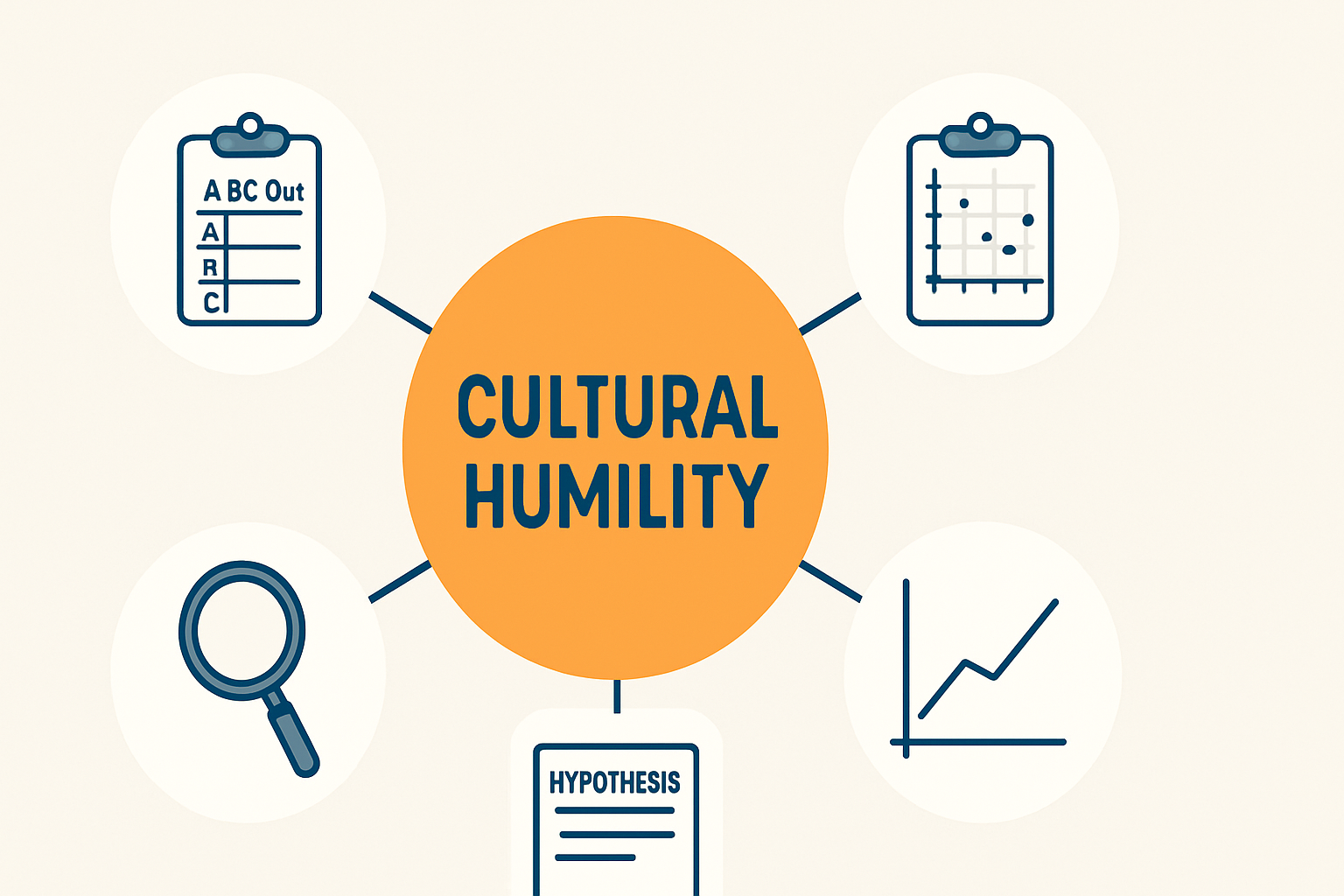
A BCBA’s Checklist for Culturally Humble Practice
This actionable checklist helps integrate cultural humility into daily practice and exam preparation:
- Regularly examine your own cultural assumptions and biases
- Seek ongoing education about cultural diversity in your practice area
- Collaborate with clients and families to identify culturally congruent goals
- Consider cultural factors during functional behavior assessment
- Select interventions that respect family values and preferences
- Monitor for ethnocentric interpretations of behavior data
- Document how cultural factors influence treatment decisions
- Seek supervision when navigating cultural differences in practice
Cultural humility transforms ABA practice from a one-size-fits-all approach to truly individualized care. By embracing this ongoing learning process, BCBAs can provide more effective, ethical services while avoiding common exam pitfalls. Remember that cultural humility isn’t about achieving perfect knowledge—it’s about maintaining openness to learning from each unique client and cultural context you encounter.
For more on ethical practice, explore our guide on ethics in ABA practice. To understand how cultural variables integrate into assessment, see our article on integrating cultural variables. For foundational concepts, review philosophical assumptions in behavior analysis.
For authoritative guidance, consult the BACB Ethics Code and research on cultural humility in behavior analysis.


