

What Are Threats to Internal Validity?
Understanding threats to internal validity is essential for any behavior analyst evaluating intervention effectiveness. This concept directly impacts your ability to make data-based decisions in clinical practice.
Table of Contents
- What Are Threats to Internal Validity?
- Key Threats to Internal Validity in ABA Practice
- Connecting Threats to the BCBA Exam & Single-Subject Design
- Summary and Next Steps for Your Study
The Core Definition for BCBA Candidates
Internal validity refers to the degree to which an experiment demonstrates that the independent variable alone caused changes in the dependent variable. Think of it like ruling out other suspects in a mystery – you need to be confident that your intervention, not some other factor, produced the behavior change.
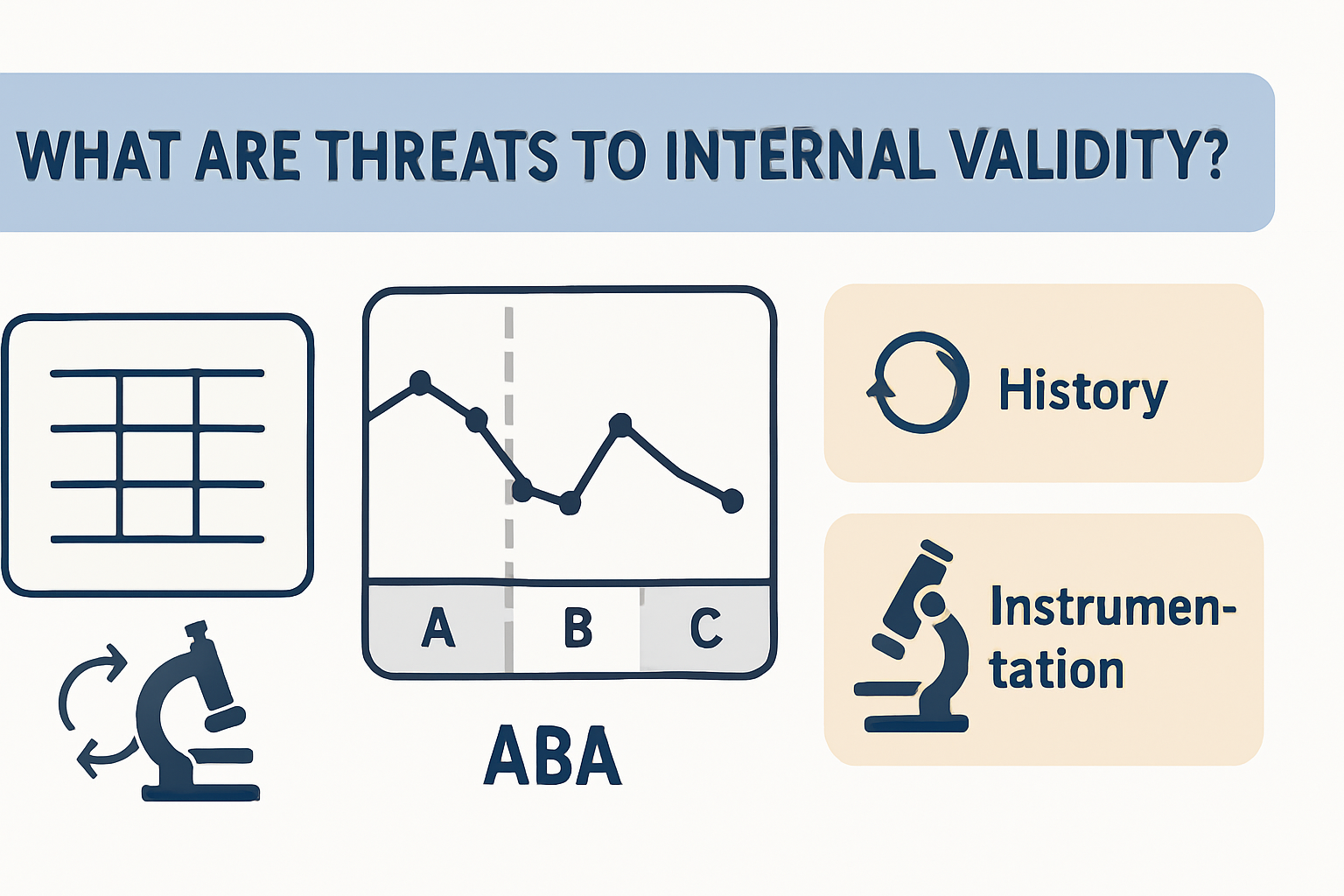
Threats to internal validity are alternative explanations for observed changes. When you see improvement in a client’s behavior, you must ask: “Was this truly my intervention, or could something else explain it?”
Why This Matters for Practicing Behavior Analysts
Every day, BCBAs implement interventions and collect data. Strong internal validity ensures your clinical decisions are based on accurate conclusions about what’s working. This connects directly to evidence-based practice and ethical service delivery.
Unlike external validity (generalizability), internal validity focuses on causal relationships within your specific study or intervention. You need both, but internal validity comes first – you can’t generalize results that aren’t valid to begin with.
Key Threats to Internal Validity in ABA Practice
Let’s examine the most common threats you’ll encounter in both clinical practice and on the BCBA exam. Each threat represents a potential confounding variable that could mislead your interpretation.
History, Maturation, and Testing: Worked Examples
History refers to external events that occur during your intervention. Imagine implementing a self-management program for on-task behavior. If the school simultaneously introduces a new classroom reward system, you can’t determine which intervention caused the improvement.
Maturation involves natural development or changes over time. A social skills intervention with a 4-year-old might show progress, but some improvement would likely occur through normal developmental maturation regardless of your program.
Testing effects occur when repeated measurement influences performance. If you use the same assessment tool weekly, clients may improve simply from practice effects rather than skill acquisition.
Instrumentation, Regression, and Attrition
Instrumentation threats involve changes in measurement tools or procedures. Consider different RBTs collecting duration data with inconsistent stopwatch use, or a behavior rating scale that gets modified mid-study.
Statistical regression happens when you select clients based on extreme scores. If you start an aggression intervention immediately after a client’s worst-ever episode, some reduction might occur naturally through regression toward the mean.
Attrition (or mortality) occurs when participants drop out. If your most challenging client leaves a social skills group, the group’s average improvement might reflect selection bias rather than true intervention effects.
Connecting Threats to the BCBA Exam & Single-Subject Design
The BCBA exam frequently tests your ability to identify threats within single-subject designs. These experimental approaches are fundamental to ABA research methodology.

Common Exam Traps and How to Avoid Them
Many candidates confuse similar threats. Remember: history involves specific external events, while maturation refers to gradual, natural processes. Testing effects relate to measurement repetition, not skill development.
- Red flag: Any time measurement procedures change mid-study
- Red flag: Interventions starting after extreme behavior peaks
- Red flag: Multiple environmental changes coinciding with treatment
- Red flag: Participant dropout affecting group composition
Exam questions often describe clinical scenarios where multiple threats could be present. Your task is to identify the most plausible alternative explanation based on the details provided.
Your Quick-Review Checklist for Internal Validity
When analyzing data or answering exam questions, systematically consider these questions:
- Did any external events (history) occur during the intervention phase?
- Could natural development (maturation) explain the observed changes?
- Were measurement procedures (instrumentation) consistent throughout?
- Was there repeated testing that might have created practice effects?
- Were participants selected based on extreme scores (regression)?
- Did any participants drop out (attrition) during the study?
This checklist helps you methodically evaluate causal claims in both research and practice settings.
Summary and Next Steps for Your Study
Mastering threats to internal validity strengthens your ability to design rigorous interventions and interpret data accurately. This knowledge is essential for both the BCBA exam and ethical practice.
Remember that no single study is perfect, but understanding these threats helps you minimize confounding variables and draw more valid conclusions. The BACB emphasizes research methodology, making this a high-yield topic for exam preparation.
For further study, explore independent and dependent variables and practice identifying threats in various experimental designs. Consider reviewing the BACB Test Content Outline for additional guidance on research methodology requirements.
As you prepare, focus on applying these concepts to real-world scenarios rather than just memorizing definitions. This approach will serve you well both on exam day and throughout your career as a behavior analyst.



