
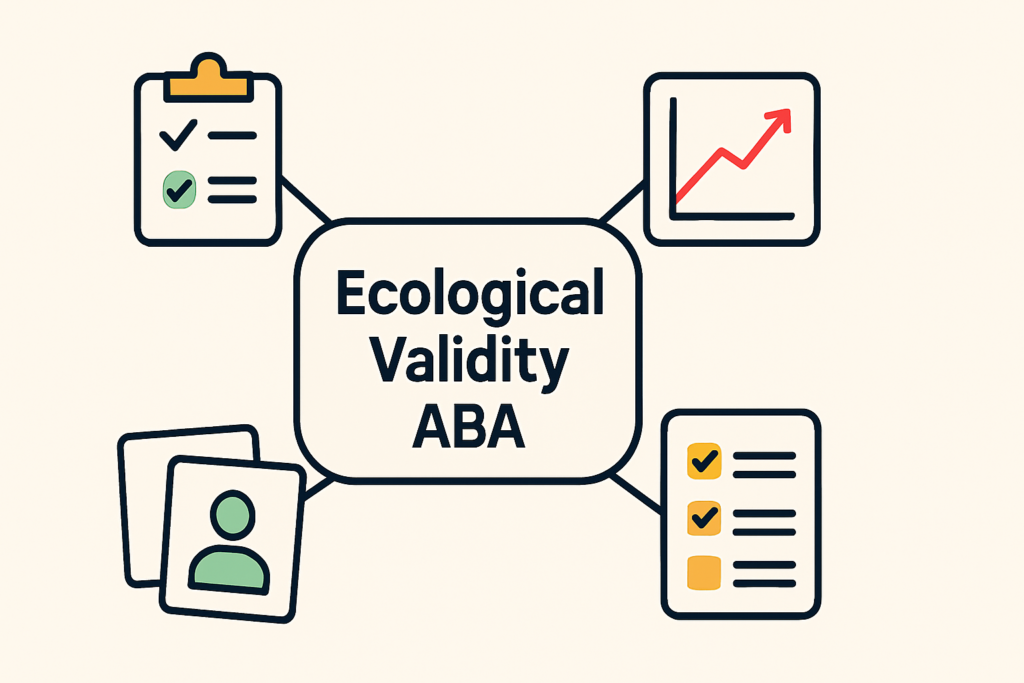
Ecological validity ABA: What is Ecological Validity in Applied Behavior Analysis?
In applied behavior analysis, ecological validity refers to how closely assessment or intervention conditions resemble the natural environment where the target behavior typically occurs. This concept measures whether results accurately predict performance in real-world settings. Understanding ecological validity is crucial for creating effective, ethical interventions that work beyond clinical or controlled environments.
Table of Contents
- Ecological validity ABA: What is Ecological Validity in Applied Behavior Analysis?
- Practical ABA Examples Demonstrating Ecological Validity
- Ecological Validity and BCBA Exam Preparation
- Enhancing Ecological Validity: A Practical Checklist
- Summary and Key Takeaways
A Behavioral Definition for BCBA Candidates
Ecological validity specifically addresses the degree to which experimental conditions mimic the client’s everyday life. The BACB Task List (Section 2: Measurement) emphasizes using measurement procedures that produce data representing the behavior’s occurrence in natural contexts. When ecological validity is high, assessment findings and intervention outcomes are more likely to generalize to the client’s actual environment.
Distinguishing Ecological Validity from Other Validity Types
BCBA exam questions often test your ability to differentiate between validity types. Internal validity concerns control within a study, while external validity addresses generalizability across people or settings. Social validity measures consumer acceptability of goals, procedures, and outcomes. Ecological validity focuses specifically on environmental representativeness—how well the assessment or intervention setting matches the natural context where the behavior needs to occur.
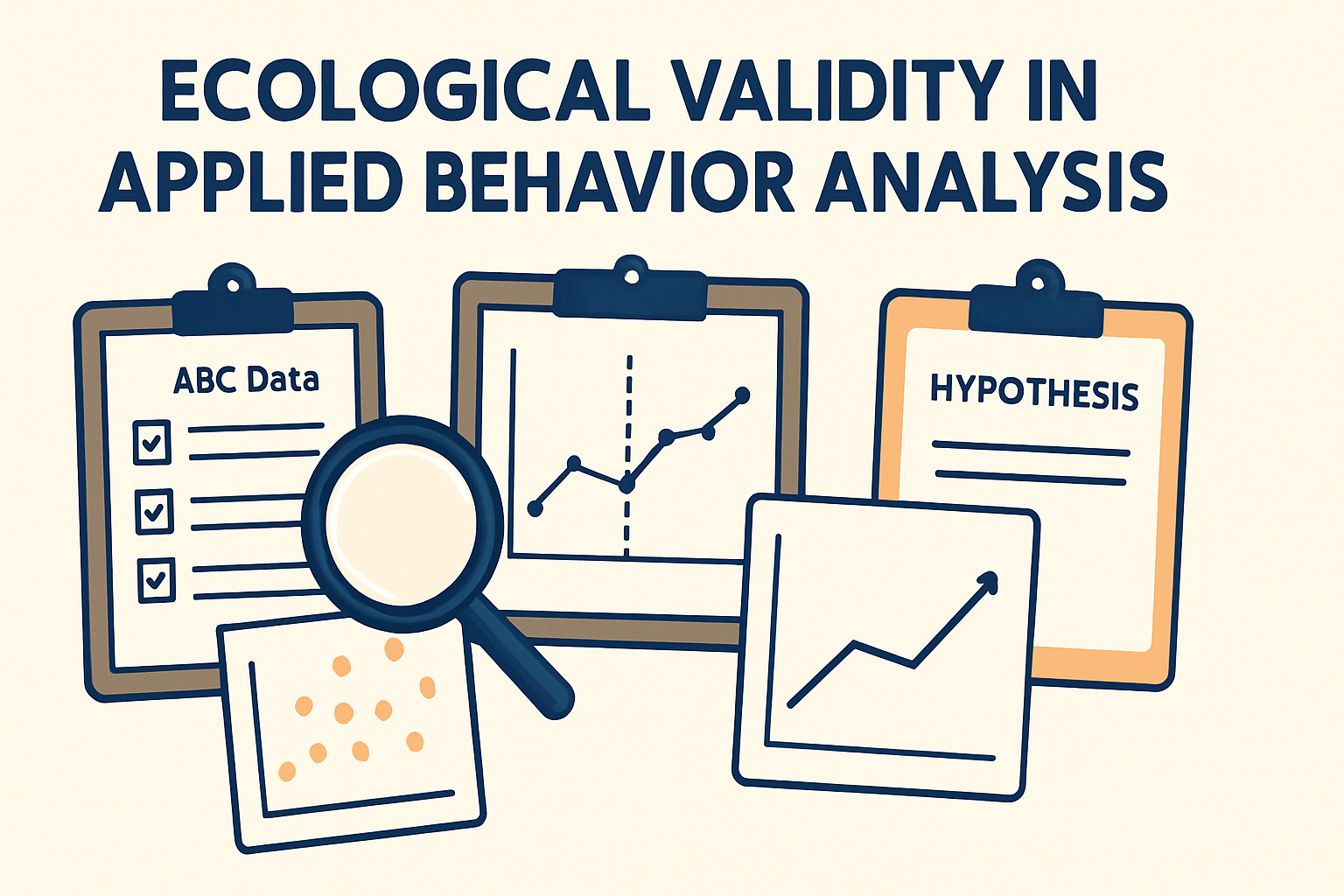
Practical ABA Examples Demonstrating Ecological Validity
These real-world scenarios illustrate how ecological validity affects assessment accuracy and intervention effectiveness. Each example contrasts low and high ecological validity approaches.
Elopement Assessment: Clinic vs. Grocery Store
A child elopes from caregivers in community settings. A clinic-based functional analysis might identify escape from demands as the function. However, a descriptive assessment conducted in an actual grocery store could reveal escape from overstimulation as the maintaining variable. The clinic assessment has low ecological validity because it lacks the sensory complexity of a real store environment.
Social Skills Training: Table vs. Playground
Teaching turn-taking through discrete trial training at a table with an adult provides controlled conditions but limited ecological validity. The function may be access to adult attention. Implementing pivotal response training during recess with peers increases ecological validity dramatically. Here, the function becomes access to peer interaction and continued play—the natural reinforcement maintaining the skill.
Toileting Protocol: Clinical Bathroom vs. Home Environment
A highly structured, staff-led toileting protocol in a clinical bathroom may teach the sequence but with low ecological validity. The function could be avoidance of correction. A parent-implemented protocol in the home bathroom, using natural reinforcers like independence and typical routines, demonstrates high ecological validity. This approach better predicts success in the client’s actual living environment.
Ecological Validity and BCBA Exam Preparation
Understanding how ecological validity appears on the BCBA exam helps you avoid common pitfalls and select correct answers confidently.
Common Exam Traps and How to Avoid Them
Several patterns consistently trip up candidates. First, confusing ecological validity with generalization—ecological validity is a property of the assessment or intervention conditions, while generalization is an outcome. Second, selecting an analog functional analysis when the question emphasizes ‘real-world prediction’—descriptive assessments typically offer higher ecological validity. Third, mistaking social validity (acceptability) for ecological validity (representativeness).
Sample Exam-Style Practice Questions
Consider this scenario: ‘A BCBA assesses nail-biting behavior in a quiet, private office. The intervention based on this assessment proves ineffective at the client’s busy, open-plan workplace.’ The most relevant validity concern is ecological validity—the assessment conditions didn’t match the natural environment. Another example: ‘A researcher conducts all social skills training in a therapy room with one adult partner. The skills don’t transfer to recess with peers.’ This demonstrates low ecological validity in the training setting.
Enhancing Ecological Validity: A Practical Checklist
Use this actionable framework to improve ecological validity in your assessment and intervention planning.
Steps for Assessment and Intervention Planning
- Conduct assessments in the natural environment whenever safety and feasibility allow
- Use stimuli and materials from the client’s daily life rather than clinical substitutes
- Include typical interaction partners like peers, family members, or coworkers
- Program for generalization from the start rather than as an afterthought
- Continuously measure outcomes in the target setting to validate ecological validity
- Consider using natural environment training approaches when appropriate
Summary and Key Takeaways
Ecological validity ensures that our assessments and interventions accurately represent real-world conditions. High ecological validity increases the likelihood that skills will generalize and maintain in natural environments. For BCBA candidates, mastering this concept involves understanding its distinction from other validity types, recognizing practical applications, and avoiding common exam traps.
Remember that ecological validity connects directly to ethical practice—interventions developed in artificial settings may not serve clients effectively in their daily lives. By prioritizing ecological validity, behavior analysts create more meaningful, sustainable behavior change. For more on related concepts, explore our guide on generalization and maintenance or learn about functional analysis versus descriptive assessment approaches.
For authoritative information on measurement standards, refer to the BACB Ethics Code and the Journal of Applied Behavior Analysis for research on ecological validity in practice.


