
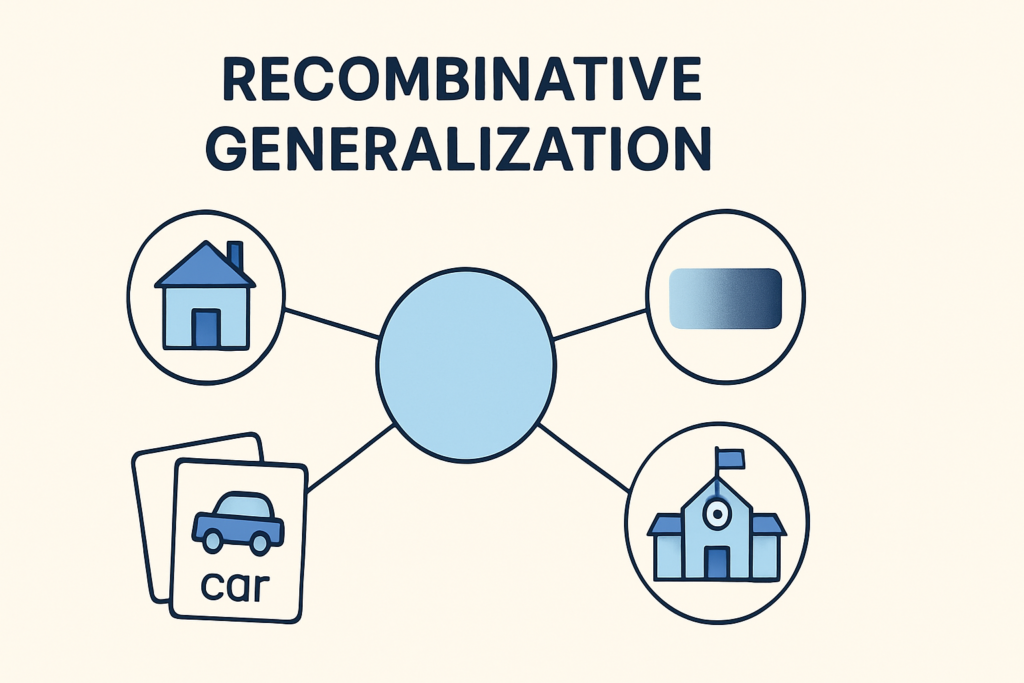
What is Recombinative Generalization?
Recombinative generalization represents a sophisticated form of emergent behavior where a learner demonstrates a novel response to a combination of stimulus elements that have been previously trained separately. This concept is fundamental to understanding how language and complex skills develop without direct teaching of every possible combination.
Table of Contents
- What is Recombinative Generalization?
- Recombinative Generalization in Practice: 3 ABA Examples
- Recombinative Generalization and the BCBA Exam
- Quick-Study Checklist and Summary
A Formal Definition
In technical terms, recombinative generalization occurs when a person responds appropriately to a novel combination of stimulus components that have been part of other trained discriminations. Think of it as the recombination of minimal units – like building new words from known letters or creating new sentences from familiar words.
This process is particularly important in verbal behavior development, where learners combine known elements to create novel, functional communication. For more on related concepts, see our guide to stimulus equivalence.
Recombinative vs. Stimulus & Response Generalization
Understanding the distinctions between generalization types is crucial for accurate identification:
- Recombinative generalization: Involves novel combinations of known stimulus elements. The key is recombination rather than similarity.
- Stimulus generalization: Occurs when a response trained to one stimulus occurs to similar, untrained stimuli. This is about stimulus similarity, not recombination.
- Response generalization: Involves variations of a trained response that serve the same function. This focuses on response variation rather than stimulus recombination.
The critical difference lies in the novel combination aspect – recombinative generalization creates something new from familiar parts.
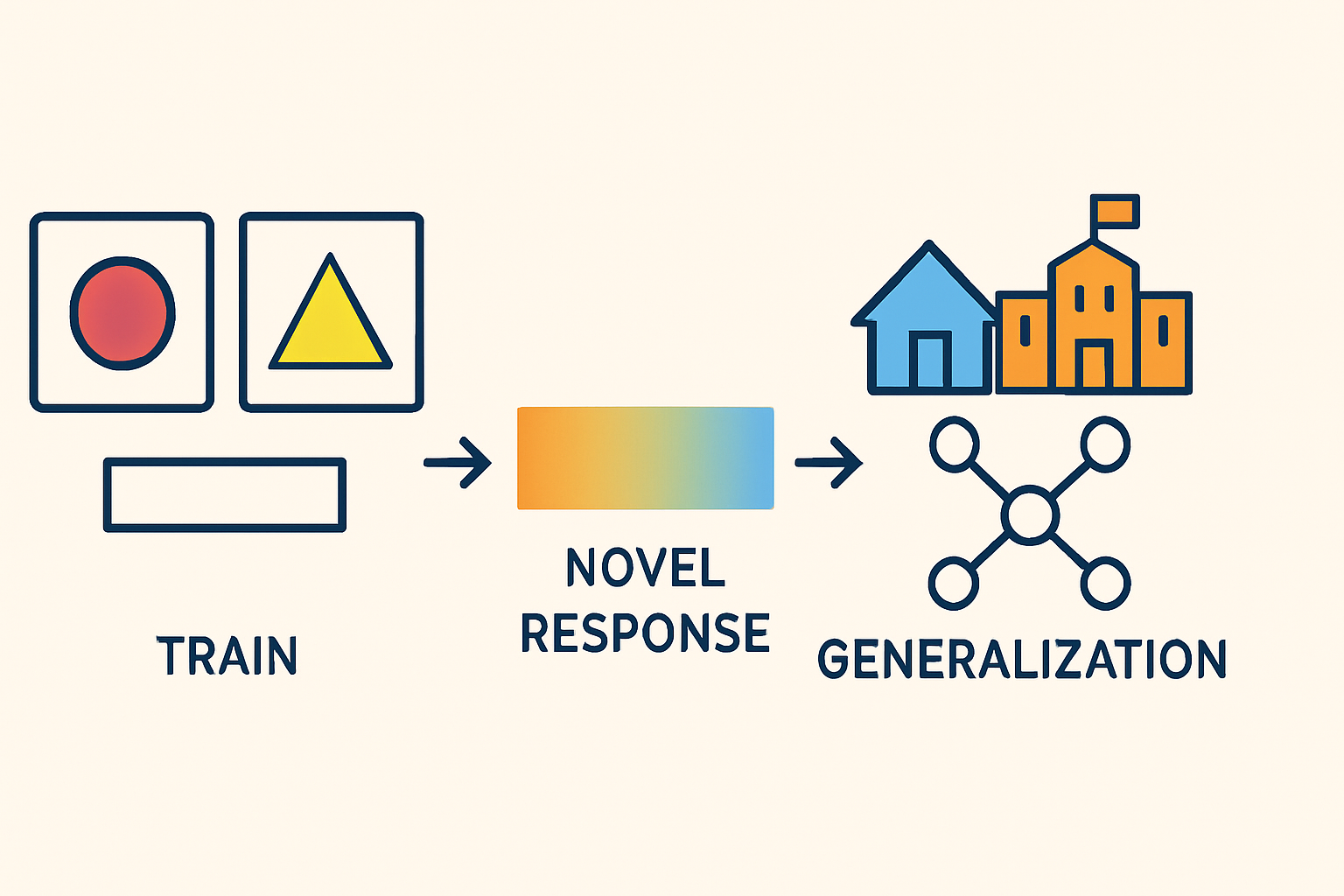
Recombinative Generalization in Practice: 3 ABA Examples
These practical examples illustrate how recombinative generalization appears in clinical settings. Each includes ABC analysis and hypothesized function to help you recognize patterns.
Example 1: Recombining Visual Cues for Manding
A learner has been taught to mand for ‘red ball’ when seeing a red ball and ‘blue car’ when seeing a blue car. During a session, both a blue ball and red car are present for the first time.
- Antecedent: Novel blue+ball combination present (blue ball visible)
- Behavior: Learner mands ‘blue ball’ without direct teaching
- Consequence: Access to blue ball
- Function: Tangible access to preferred item
This demonstrates recombinative generalization because the learner combined known color and object words to request a novel combination.
Example 2: Recombining Instructions for Intraverbals
A learner can answer ‘What do you drink?’ (response: juice) and ‘What is red?’ (response: apple). When asked ‘What is red and you drink?’ for the first time:
- Antecedent: Novel question combining two previously separate question elements
- Behavior: Answers ‘tomato juice’ or similar appropriate response
- Consequence: Social praise or continuation of conversation
- Function: Social reinforcement, attention
This shows verbal recombination where question components are combined to generate a novel, appropriate answer.
Example 3: Recombining Settings & People for Greetings
A learner has been taught to say ‘Hi’ to Ms. Smith at school and ‘Hello’ to Dad at home. When Dad visits the school unexpectedly:
- Antecedent: Dad present in school setting (novel person+setting combination)
- Behavior: Says ‘Hi, Dad’ appropriately
- Consequence: Social greeting returned, positive interaction
- Function: Social interaction, attention
This illustrates contextual recombination where social behaviors transfer across novel combinations of people and settings.
Recombinative Generalization and the BCBA Exam
This concept appears regularly on the BCBA exam, often testing your ability to distinguish it from other generalization types. Understanding how it’s tested can significantly improve your exam performance.
How It’s Tested: Question Formats
Exam questions typically follow these patterns:
- Scenario identification: ‘This is an example of which type of generalization?’
- Definition matching: ‘Which best describes recombinative generalization?’
- Clinical application: ‘How would you program for recombinative generalization?’
- Distinction questions: ‘How does this differ from stimulus generalization?’
For comprehensive exam preparation, explore our BCBA exam prep guide.
Common Exam Traps and How to Avoid Them
Candidates frequently make these mistakes when identifying recombinative generalization:
- Confusing with stimulus generalization: Remember that stimulus generalization involves similar stimuli, not novel combinations.
- Over-applying the concept: Not every novel response involves recombination – look for specific combination of previously separate elements.
- Missing the ‘novel combination’ key: The critical feature is the recombination aspect, not just novelty.
- Ignoring training history: Recombinative generalization requires prior training on the separate elements being combined.
To avoid these traps, ask yourself: ‘Are previously trained stimulus elements being combined in a novel way?’ If yes, it’s likely recombinative generalization.
Quick-Study Checklist and Summary
Use this checklist to quickly review and reinforce your understanding before the exam:
- Identify the key feature: Novel combination of previously trained stimulus elements
- Distinguish from others: Not stimulus similarity (stimulus generalization) or response variation (response generalization)
- Look for recombination: Elements that were taught separately now combined
- Check training history: Both elements must have been previously trained
- Recognize clinical examples: Novel mands, intraverbals, or social behaviors combining known elements
- Apply to programming: Teach component skills separately to promote later recombination
Final Summary: Recombinative generalization represents a powerful form of emergent behavior where learners combine known elements to create novel, functional responses. This concept is essential for understanding language development and complex skill acquisition in ABA. For the BCBA exam, focus on the novel combination aspect and distinguish it carefully from other generalization types. Mastery of this concept demonstrates understanding of how behavior becomes generative and flexible – a key goal of effective ABA programming.
For further reading on generalization concepts, the BACB Ethics Code and research on emergent relations provide valuable context.


