
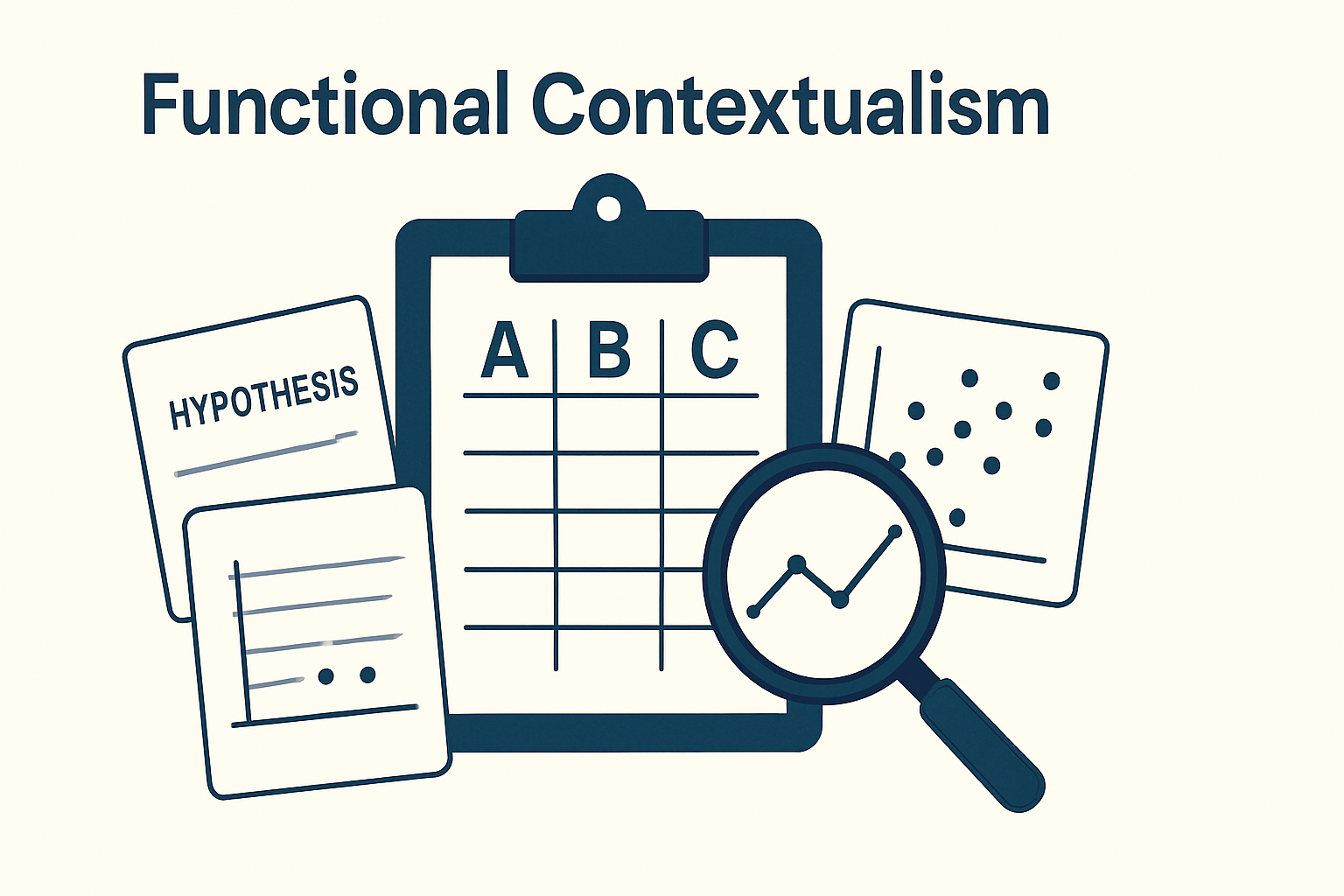
Understanding functional contextualism is essential for BCBA candidates, as this philosophical framework underpins effective applied behavior analysis practice. This pragmatic approach emphasizes practical outcomes and contextual understanding rather than abstract theory alone.
Table of Contents
- What is Functional Contextualism? Defining the ABA Philosophy
- Functional Contextualism in Practice: Worked ABA Examples
- Functional Contextualism on the BCBA Exam: Relevance and Common Traps
- Study Summary and Next Steps
What is Functional Contextualism? Defining the ABA Philosophy
Functional contextualism represents a pragmatic philosophy that guides behavior analysts in their work. It focuses on achieving workable solutions to behavioral challenges by understanding behavior within its specific context.
The philosophy emphasizes two primary goals: prediction and influence of behavior with precision, scope, and depth. This aligns directly with the scientific dimensions of ABA as described in our guide to philosophical assumptions underlying behavior analysis.
Core Tenets: Prediction and Influence in Context
Functional contextualism operates on several key principles that distinguish it from other philosophical approaches:
- Prediction with precision: The ability to accurately forecast behavior based on contextual variables
- Influence through context: Modifying behavior by altering environmental factors rather than focusing solely on internal states
- Workable outcomes: Judging success by practical effectiveness in real-world settings
- Contextual analysis: Understanding behavior as inseparable from its environmental context
- Analytic approach: Breaking down complex behaviors into measurable, observable components
How It Differs: Functional Contextualism vs. Radical Behaviorism
Many candidates confuse these related but distinct concepts. While both stem from behaviorist traditions, they serve different purposes in ABA practice.
Functional contextualism is a pragmatic philosophy focused on achieving practical outcomes in applied settings. It asks: “Does this intervention work in this specific context to achieve meaningful change?” In contrast, radical behaviorism represents a comprehensive worldview about the subject matter of psychology, addressing both public and private events. Our detailed comparison in radical behaviorism vs methodological behaviorism explores these distinctions further.
Functional Contextualism in Practice: Worked ABA Examples
Moving from theory to application demonstrates how this philosophy guides real-world assessment and intervention decisions.
Example 1: Addressing Elopement in a Classroom
Consider a student who frequently leaves their seat during math instruction. A functional contextualist approach would involve:
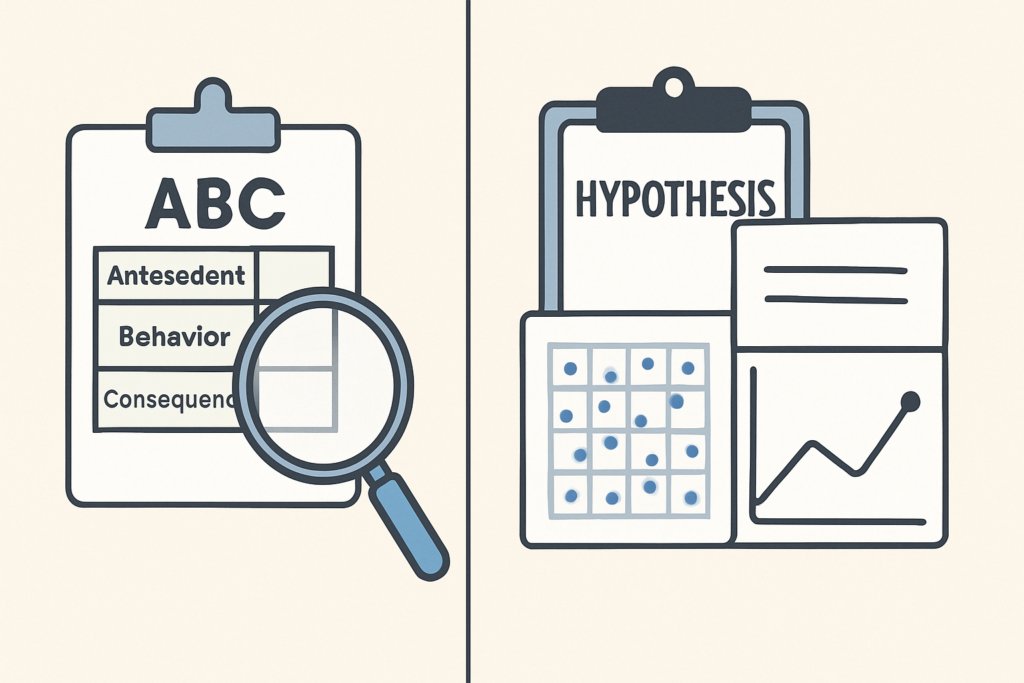
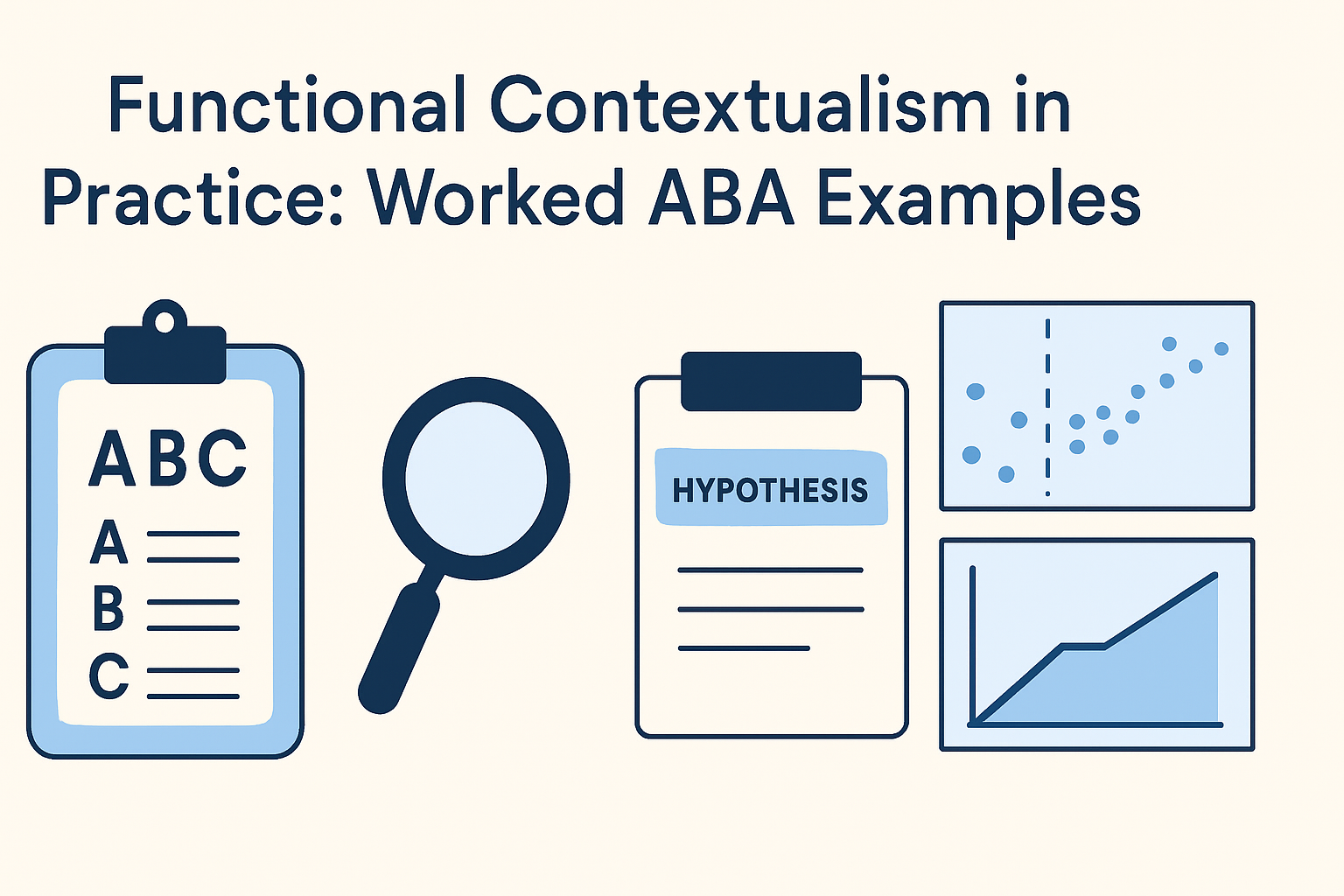
- Conducting a thorough ABC analysis to identify specific contextual variables
- Analyzing not just the function (escape) but the precise conditions: task difficulty, staff presence, physical setting
- Designing interventions that are workable for that specific student in that particular environment
- Considering the social validity of interventions as discussed in our treatment integrity guide
The intervention’s success would be judged by its practical effectiveness in reducing elopement while maintaining instructional quality, not merely by decreasing a behavior count.
Example 2: Increasing Social Initiations for an Adult in Group Home
For an adult with developmental disabilities in a group home setting, increasing social interactions requires a contextual approach:
- Assessing the individual’s values and preferences regarding social interaction
- Analyzing the social context of the group home environment
- Identifying natural opportunities for social initiation within daily routines
- Measuring success by quality of life improvements, not just frequency counts
This approach aligns with ethical principles of client dignity and meaningful outcomes, ensuring interventions respect individual autonomy while addressing behavioral goals.
Functional Contextualism on the BCBA Exam: Relevance and Common Traps
Understanding how this philosophy appears on the exam helps candidates avoid common mistakes and demonstrate comprehensive knowledge.
Linking Philosophy to the Task List and Ethics Code
Functional contextualism connects directly to multiple areas of the BACB Task List and Ethics Code:
- Task List B-1: Defining behavior in observable, measurable terms within context
- Task List G-1: Using positive reinforcement strategies that are contextually appropriate
- Ethical Principle 1.01: Beneficence – promoting clients’ welfare through effective interventions
- Ethical Principle 2.01: Client dignity – respecting individual values and preferences
- Seven dimensions of ABA: Particularly applied, behavioral, analytic, and effective dimensions
This philosophical foundation ensures interventions are not only technically sound but also ethically grounded and contextually appropriate.
Exam Traps to Avoid: Misidentification and Overgeneralization
Candidates frequently make these errors when answering questions about philosophical foundations:
- Confusing with methodological behaviorism: Unlike methodological behaviorism, functional contextualism does not reject private events
- Assuming it’s only about overt behavior: It addresses both public and private events within context
- Overgeneralizing principles: Failing to consider specific contextual variables in case scenarios
- Neglecting social validity: Focusing only on behavior change without considering practical effectiveness
- Missing the pragmatic focus: Overemphasizing theoretical purity at the expense of workable solutions
For comprehensive exam preparation, review our BCBA exam prep guide to integrate philosophical concepts with practical application.
Study Summary and Next Steps
Mastering functional contextualism requires both conceptual understanding and practical application skills.
Key takeaways for BCBA candidates include recognizing that this philosophy emphasizes practical outcomes over theoretical purity, values contextual analysis of behavior, and judges success by workable solutions in real-world settings. It provides the philosophical foundation for ethical, effective ABA practice that respects client dignity and promotes meaningful change.
For further study, consult authoritative sources including the Behavior Analyst Certification Board resources and peer-reviewed literature on contextual behavioral science. Integrate this understanding with other foundational concepts through our 7 dimensions of ABA guide to develop a comprehensive approach to behavior analysis practice.



