

What is Whole Interval Recording? Definition and Core Concept
Whole interval recording is a time sampling method used in applied behavior analysis to measure the duration of behaviors. This measurement procedure provides valuable data about how long a behavior persists across observation periods.
Table of Contents
- What is Whole Interval Recording? Definition and Core Concept
- Whole Interval Recording in Practice: Worked ABA Examples
- Whole Interval Recording and the BCBA Exam: Relevance and Traps
- Quick Checklist for Implementing Whole Interval Recording
- Summary and Key Takeaways
Understanding this method is essential for accurate data collection and effective intervention planning in ABA practice.
The Official Definition and Scoring Rule
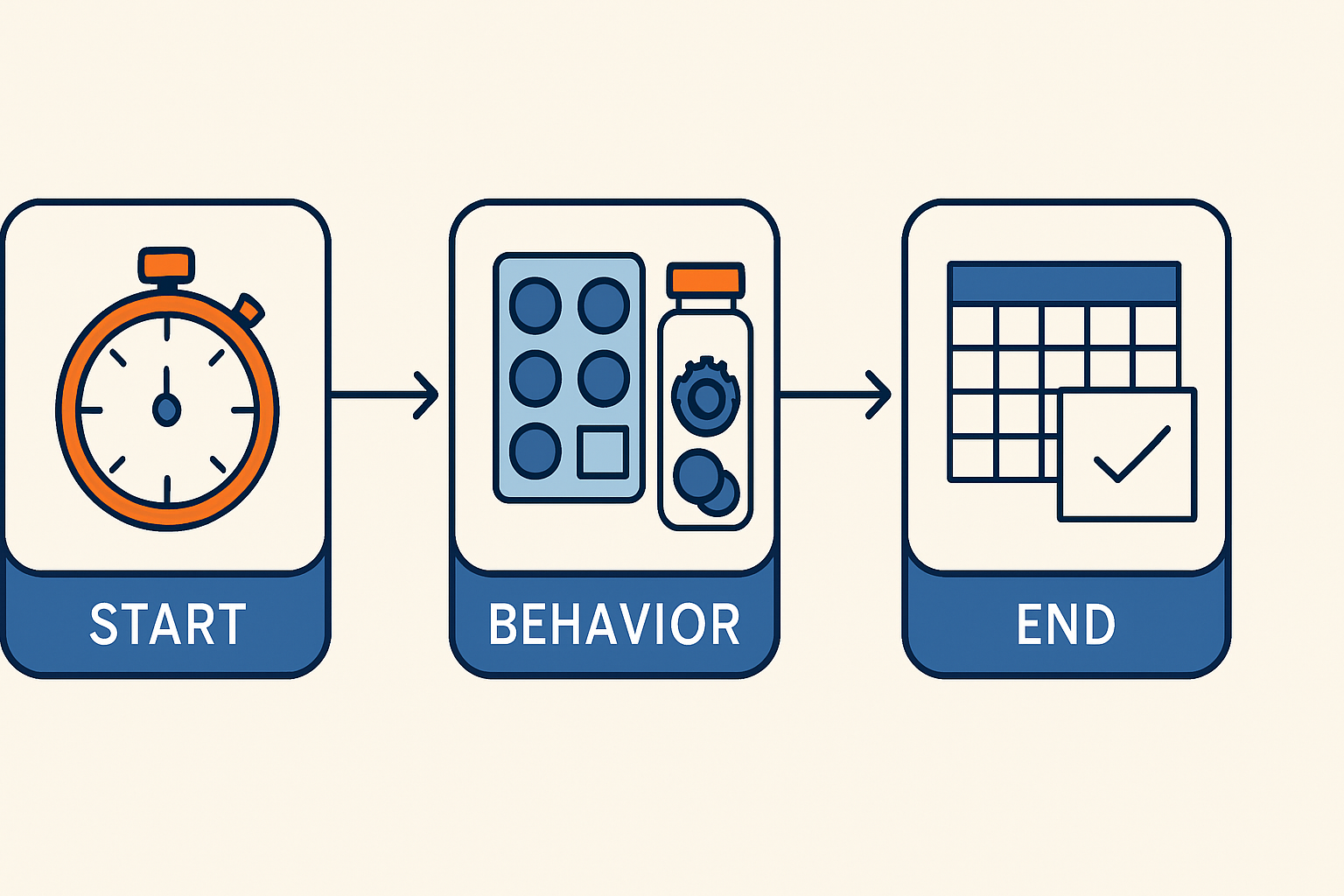
In whole interval recording, an observer divides the observation period into equal time intervals and records whether the target behavior occurs throughout the entire duration of each interval. The scoring rule is straightforward: if the behavior occurs for the complete interval, it’s scored as an occurrence; if it stops at any point, it’s scored as non-occurrence.
This differs from partial interval recording, which scores an occurrence if the behavior happens at any point during the interval. The key distinction lies in the duration requirement – whole interval demands continuous behavior throughout the entire interval.
When to Use This Measurement Procedure
Whole interval recording is ideal for measuring behaviors with clear duration that you want to increase. It’s particularly useful when knowing whether a behavior persisted continuously is more important than knowing exactly how long it lasted.
Common applications include measuring on-task behavior, social engagement, or compliance with sustained activities. However, it’s important to remember that this method underestimates actual duration because any break in behavior, no matter how brief, results in a non-occurrence score.
Whole Interval Recording in Practice: Worked ABA Examples
Moving from theory to application, these concrete examples demonstrate how whole interval recording works in real ABA scenarios. Each example includes ABC data and hypothesized function to illustrate comprehensive measurement practice.
Example 1: Increasing On-Task Behavior During Independent Work
Scenario: A 10-year-old student during 20-minute independent work sessions. The target behavior is defined as eyes on work and hands actively writing or manipulating materials.
Using 5-minute intervals, the observer scores occurrence only if the student maintains continuous engagement throughout each entire interval. ABC data shows: Antecedent = worksheet given, Behavior = on-task engagement, Consequence = teacher praise and earned break. The hypothesized function is escape from task demands with potential access to reinforcement through praise.
This measurement approach helps determine if intervention strategies are effectively increasing sustained work periods. For more on measurement fundamentals, see our guide to data collection methods in ABA.
Example 2: Measuring Social Engagement in a Group Setting
Scenario: A client participating in a social skills group with peers. The target behavior includes oriented to peers, responding to questions, and sharing materials appropriately.
Using 2-minute intervals, the observer records occurrence only if the client demonstrates continuous social engagement throughout each interval. Partial engagement or brief disengagement scores as non-occurrence. The hypothesized function is access to social reinforcement from peers and facilitators.
This application highlights how whole interval recording captures sustained participation rather than momentary interactions. The method provides data on whether social skills interventions are creating lasting engagement patterns.
Example 3: A Common Misapplication Pitfall
Scenario: A practitioner attempts to use whole interval recording for measuring hand-flapping behavior that occurs in rapid, brief bursts throughout the day.
This represents a measurement error because whole interval recording requires continuous behavior throughout intervals. For high-frequency, brief behaviors, this method would likely score 0% occurrence, failing to capture the actual behavior pattern.
The appropriate alternative would be frequency recording or momentary time sampling. This example demonstrates the importance of matching measurement procedures to behavior characteristics. For understanding different measurement approaches, review our assessment in ABA guide.
Whole Interval Recording and the BCBA Exam: Relevance and Traps
Whole interval recording frequently appears on the BCBA examination, testing candidates’ understanding of measurement procedures and their appropriate applications. Mastering this concept requires recognizing both when to use it and when to avoid it.

How the Exam Tests This Concept
The BCBA exam typically presents this concept through several question formats. Candidates might need to select the correct procedure from a clinical vignette, interpret data collected using interval systems, or identify advantages and disadvantages of different measurement methods.
Common question types include comparing whole interval with partial interval recording and momentary time sampling, analyzing data patterns from interval recording systems, and selecting appropriate measurement procedures based on behavior characteristics and assessment goals.
Top 3 Common Exam Traps to Avoid
- Confusing measurement procedures: Mixing up whole interval with partial interval (which overestimates occurrence) or momentary time sampling (which samples at specific moments)
- Forgetting the underestimation bias: Not recognizing that whole interval recording systematically underestimates total behavior duration
- Selecting inappropriate applications: Choosing whole interval for behaviors that are too brief, high-frequency, or lack clear duration boundaries
For comprehensive exam preparation, explore our BCBA exam prep guide covering all measurement domains.
Quick Checklist for Implementing Whole Interval Recording
Use this practical checklist to ensure proper implementation of whole interval recording in both clinical practice and exam scenarios:
- Define the target behavior with clear onset and offset criteria
- Select appropriate interval length based on behavior duration and observation period
- Train observers thoroughly on scoring rules and decision criteria
- Use consistent timing with reliable interval signals or timers
- Record data immediately after each interval to prevent memory errors
- Calculate percentage of intervals with behavior occurrence for analysis
- Consider measurement limitations and potential underestimation in interpretation
This checklist helps maintain measurement integrity and supports accurate data-based decision making in ABA practice.
Summary and Key Takeaways
Whole interval recording serves as a valuable measurement tool in applied behavior analysis when applied appropriately. Key takeaways for BCBA candidates and practitioners include:
- Whole interval recording measures whether behavior occurs continuously throughout intervals
- It’s ideal for behaviors with clear duration that you want to increase
- The method systematically underestimates total behavior duration
- Avoid using it for brief, high-frequency behaviors without sustained duration
- On the BCBA exam, focus on distinguishing it from other interval methods
- Proper implementation requires clear behavior definitions and trained observers
For authoritative information on measurement standards, refer to the BACB Task List and peer-reviewed sources like the Journal of Applied Behavior Analysis.
Mastering whole interval recording enhances both clinical practice and exam performance by developing precise measurement skills essential for effective behavior analysis.



