
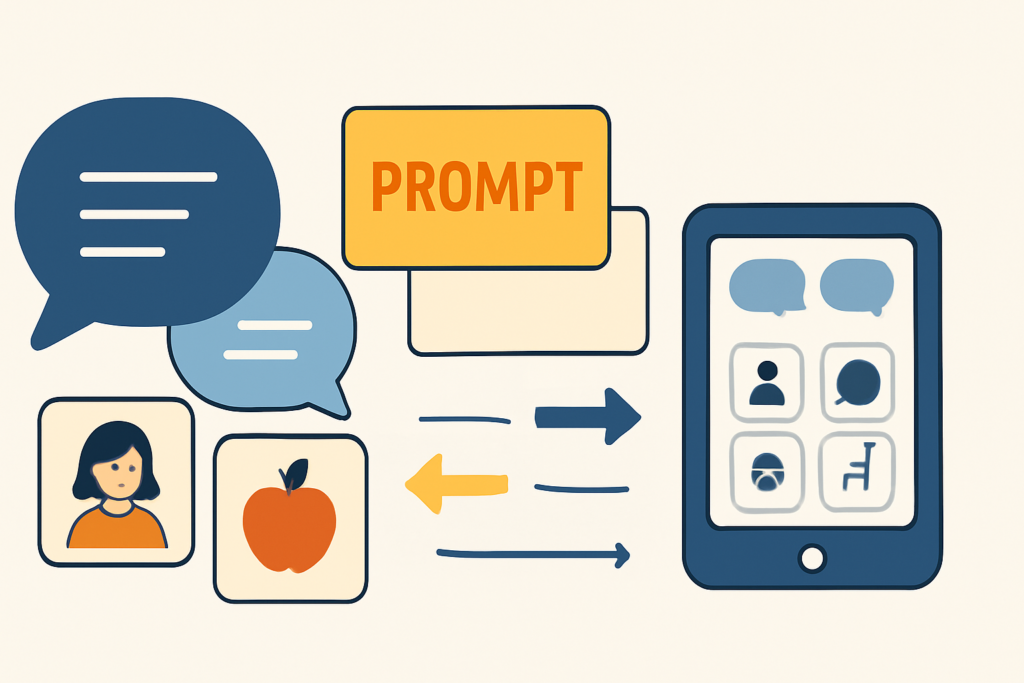
In applied behavior analysis, prompts are essential tools for teaching new skills, and verbal prompts represent a specific category of auditory assistance. Understanding the precise meaning of verbal prompts in ABA is crucial for both clinical practice and exam success. This guide breaks down the technical definition, provides practical examples, and highlights common exam pitfalls.
Table of Contents
- verbal prompts ABA: Defining Verbal Prompts in an ABA Context
- Verbal Prompts in Practice: Worked Examples from Simple to Complex
- Verbal Prompts on the BCBA Exam: What to Watch For
- Quick Checklist for Ethical and Effective Use
- Summary and Key Takeaways
verbal prompts ABA: Defining Verbal Prompts in an ABA Context
A verbal prompt is an auditory antecedent delivered by another person to occasion a specific response. Unlike the natural discriminative stimulus, verbal prompts are supplemental stimuli added to increase the likelihood of correct responding during skill acquisition.
The Core Definition: More Than Just Words
Verbal prompts differ from instructions or rules. An instruction often serves as the target SD (discriminative stimulus), while a verbal prompt provides additional auditory support. For example, ‘Put on your shoes’ might be the instruction, while ‘First, untie the laces’ serves as a verbal prompt when the learner hesitates.
These prompts function as supplemental antecedents that should be systematically faded to transfer stimulus control to the natural environment. Understanding this distinction is fundamental for both clinical implementation and exam questions.
Verbal Prompts vs. Other Prompt Types: A Quick Hierarchy
Within the prompting hierarchy, verbal prompts occupy a specific position:
- Full physical prompts: Most intrusive, involving hand-over-hand guidance
- Partial physical prompts: Light touch or partial guidance
- Model prompts: Visual demonstration of the target behavior
- Verbal prompts: Auditory instructions or cues
- Gestural prompts: Pointing, nodding, or other non-verbal cues
- Positional prompts: Least intrusive, involving placement of materials
Verbal prompts are generally considered less intrusive than physical prompts but more intrusive than gestural or positional prompts.
Verbal Prompts in Practice: Worked Examples from Simple to Complex
Let’s examine concrete scenarios showing how verbal prompts function in real ABA sessions.
Example 1: Teaching Motor Imitation
The therapist says ‘Do this’ while clapping hands (SD + model). The client doesn’t respond. The therapist adds, ‘Clap your hands’ as a verbal prompt. In this ABC analysis:
- Antecedent: ‘Do this’ + model + verbal prompt
- Behavior: Client claps hands
- Consequence: Reinforcement (praise, token)
The verbal prompt’s hypothesized function is evocative, increasing the value of compliance through the establishing operation of reinforcement availability.
Example 2: Fading Prompts in Daily Living Skills
Teaching handwashing demonstrates systematic fading:
- Full verbal prompt: ‘Turn on the water, get soap, rub hands…’
- Partial verbal prompt: ‘What’s next?’ after turning on water
- Time delay: Wait 3 seconds before prompting
- Natural SD control: Visual cues of sink prompt independent responding
This fading sequence prevents prompt dependency and ensures skill maintenance. The ethical imperative of prompt fading cannot be overstated—prompts should always be temporary supports.
Example 3: The Ethical Line – Prompt vs. Coercion
Consider a client non-responsive to a task demand. An appropriate faded verbal prompt might be ‘Try the first step’ after a brief delay. In contrast, repeated, escalating demands (‘Do it now!’, ‘I said do it!’) may function as aversive stimuli rather than helpful prompts.
This distinction relates directly to client dignity and avoiding coercive practices. Effective prompting respects learner pace while inappropriate prompting can create escape-maintained behaviors.
Verbal Prompts on the BCBA Exam: What to Watch For
Exam questions about verbal prompts often test subtle distinctions and application knowledge.

Common Exam Traps and Misconceptions
Several patterns trip up candidates:
- Confusing verbal prompts with the SD: Remember, prompts are supplemental to the natural discriminative stimulus
- Selecting ‘verbal prompt’ for model prompts: Verbal = auditory, Model = visual demonstration
- Forgetting prompt fading requirements: All prompts should include a fading plan
- Overlooking supplemental nature: Prompts support, not replace, the target SD
- Missing the auditory component: If it’s not spoken/heard, it’s not a verbal prompt
Key Linked Concepts and Vocabulary
Verbal prompts connect to several critical ABA concepts:
- Stimulus control transfer: Moving control from prompts to natural SDs
- Most-to-least prompting: Starting with more intrusive prompts
- Least-to-most prompting: Beginning with minimal assistance
- Time delay procedures: Systematic delay before prompting
- Errorless learning: Minimizing errors through prompt hierarchy
- Prompt dependency: When learners rely on prompts rather than natural cues
For deeper understanding of related concepts, explore our guide on SD vs MO differences and errorless learning techniques.
Quick Checklist for Ethical and Effective Use
Use this checklist to ensure proper verbal prompt implementation:
- ✓ Always pair verbal prompts with the natural SD initially
- ✓ Include a systematic fading plan from the beginning
- ✓ Monitor for prompt dependency regularly
- ✓ Use the least intrusive prompt necessary
- ✓ Consider learner’s auditory processing abilities
- ✓ Document prompt level and fading progress
- ✓ Ensure prompts don’t become aversive or coercive
- ✓ Train staff on consistent prompt delivery
Summary and Key Takeaways
Verbal prompts are auditory antecedents that supplement natural discriminative stimuli to occasion correct responses. They occupy a middle position in the prompting hierarchy and require systematic fading to prevent dependency.
Key points for clinical practice:
- Verbal prompts should always be temporary supports
- Ethical use requires avoiding coercive patterns
- Systematic fading is non-negotiable for skill maintenance
- Consider individual learner characteristics when selecting prompt types
For exam preparation, remember that verbal prompts are specifically auditory supplements to the SD, not the SD itself. Distinguish them clearly from model prompts and always consider the fading requirement. For additional exam strategies, see our comprehensive BCBA exam prep guide.
For authoritative guidance on prompting procedures, consult the BACB Task List and research on effective prompting strategies.



