

verbal prompting ABA: What is Verbal Prompting? Definition and Key Concepts
In applied behavior analysis, verbal prompting refers to the addition of a vocal or verbal stimulus to increase the likelihood of a correct response. This technique is essential for teaching new skills and supporting learners who need additional guidance beyond the initial instruction.
Table of Contents
- verbal prompting ABA: What is Verbal Prompting? Definition and Key Concepts
- Verbal Prompting in Action: Worked ABA Examples
- BCBA Exam Focus: Common Traps and Must-Knows
- Quick Checklist for Ethical and Effective Verbal Prompting
- Summary and Key Takeaways for Your Studies
Understanding verbal prompting requires distinguishing it from other antecedent interventions and recognizing its proper place within systematic teaching procedures.
Operational Definition: More Than Just Talking
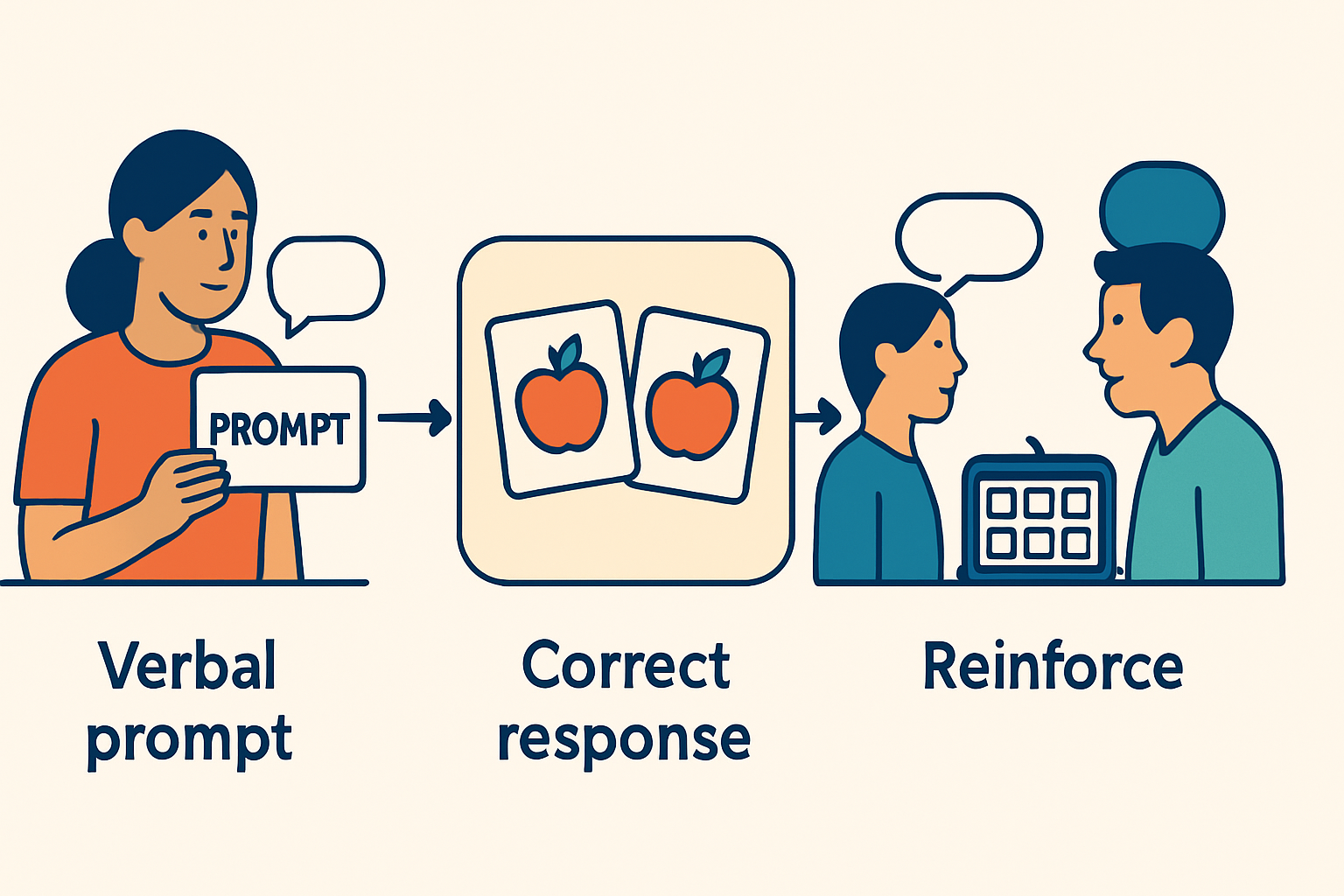
A verbal prompt is specifically defined as a supplemental vocal cue provided after or alongside a discriminative stimulus (Sd) when the target behavior is not yet under stimulus control. The key distinction is that while an Sd signals that reinforcement is available for a behavior already in the repertoire, a prompt provides additional information to evoke a correct response.
Verbal prompts can range from full verbal prompts (complete verbal model) to partial verbal prompts (initial sound or word fragment). The effectiveness depends on proper implementation and systematic fading.
Place in the Prompt Hierarchy: Intrusiveness and Fading
Verbal prompts occupy a specific position in the prompt hierarchy, which organizes prompts from least to most intrusive:
- Positional prompts (least intrusive)
- Gestural prompts
- Verbal prompts
- Model prompts
- Physical prompts (most intrusive)
This hierarchy guides ethical practice by emphasizing the use of the least intrusive prompt necessary to evoke the correct response. Verbal prompts are considered moderately intrusive—less intrusive than physical guidance but more intrusive than gestural cues.
Verbal Prompting in Action: Worked ABA Examples
Seeing verbal prompting applied in real scenarios helps solidify understanding and prepares you for both clinical practice and exam questions.
Example 1: Teaching a Greeting Response
This example demonstrates how verbal prompts support skill acquisition:
- Antecedent: Therapist says ‘Say hi!’ (Sd) + ‘H…’ (partial verbal prompt)
- Behavior: Client says ‘Hi’
- Consequence: Therapist provides praise and social reinforcement
The partial verbal prompt functions as a response prompt to overcome a skill deficit. As the client masters the response, the prompt should be systematically faded to a gestural prompt (like a wave) and eventually eliminated entirely.
Example 2: Following a Multi-Step Instruction
Complex tasks often require sequenced verbal prompting:
- Antecedent: Instruction ‘Get your shoes and coat’ (Sd). Client hesitates.
- Added Antecedent: Therapist adds ‘First, find your shoes’ (verbal prompt)
- Behavior: Client gets shoes
- Consequence: Natural reinforcement of continuing the chain
This prompt assists with task sequencing and breaking down complex instructions into manageable steps. The prompt should gradually be reduced to a single cue like ‘What’s first?’
Example 3: The Ethical Boundary: Prompt vs. Coercion
Not all verbal prompting is ethical or effective. Consider this negative example:
- Antecedent: Repeated, loud verbal prompts for non-compliance
- Potential Function: May serve as an aversive antecedent rather than a teaching tool
- Ethical Alternative: Calm, clear prompt followed by appropriate wait time
Ethical verbal prompting requires careful planning, appropriate prompt latency, and consideration of the learner’s readiness. For more on ethical considerations, see our guide on ethics in ABA practice.
BCBA Exam Focus: Common Traps and Must-Knows
The BCBA exam frequently tests your understanding of verbal prompting through scenario-based questions. Recognizing common traps can significantly improve your performance.
Trap 1: Confusing Prompts with Discriminative Stimuli (Sd)
This is perhaps the most frequent exam trap. Remember this key distinction:
- A discriminative stimulus signals that reinforcement is available for a behavior already in the learner’s repertoire
- A verbal prompt is added when the behavior is not yet under the control of the Sd
- Test yourself: If the learner can perform the behavior without the additional cue, it’s likely an Sd, not a prompt
For deeper understanding of stimulus control, review our article on Sd vs S-delta differences.
Trap 2: Overlooking the ‘Least-to-Most’ vs. ‘Most-to-Least’ Decision
Choosing the wrong prompting strategy is a common exam error:
- Use least-to-most prompting when teaching error prevention with some existing skill foundation
- Use most-to-least prompting when teaching brand new skills or with learners who have significant learning challenges
- The exam will present scenarios requiring you to select the appropriate procedure based on learner characteristics
Trap 3: Neglecting Prompt Fading and Dependency
Any effective prompting procedure must include a plan for fading. Exam questions often test this critical component:
- Scenarios may present a client who is prompt dependent
- Correct answers typically involve systematic fading strategies like time delay or increasing prompt latency
- Remember: The goal is always to transfer stimulus control from the prompt to the natural Sd
For more on addressing prompt dependency, see our comprehensive guide on prompt dependency in ABA.
Quick Checklist for Ethical and Effective Verbal Prompting
Use this actionable checklist to ensure proper implementation and avoid common pitfalls:
- Determine necessity: Is a prompt truly needed, or would errorless learning be more appropriate?
- Select appropriate type: Choose between full, partial, or indirect verbal prompts based on learner needs
- Plan fading from the start: Design your fading procedure before implementing the prompt
- Monitor effectiveness: Track whether prompts are decreasing over time as planned
- Ensure consistency: All team members should use the same prompting procedures
- Consider learner perspective: Prompts should feel supportive, not intrusive or aversive
- Document procedures: Clearly record prompting strategies in behavior plans
Summary and Key Takeaways for Your Studies
Mastering verbal prompting requires understanding both the technical aspects and ethical considerations. Key points to remember:
- Verbal prompts are supplemental antecedents added when behavior is not yet under stimulus control
- They occupy a specific place in the prompt hierarchy and should be the least intrusive necessary
- Effective prompting always includes a systematic fading plan to prevent dependency
- On the BCBA exam, carefully distinguish between prompts and discriminative stimuli in scenario questions
- Ethical implementation considers the learner’s dignity and uses prompts as teaching tools, not compliance devices
For additional study resources and practice questions, explore our BCBA mock exam materials and review the BACB’s official ethics code for guidance on ethical prompting practices.



