
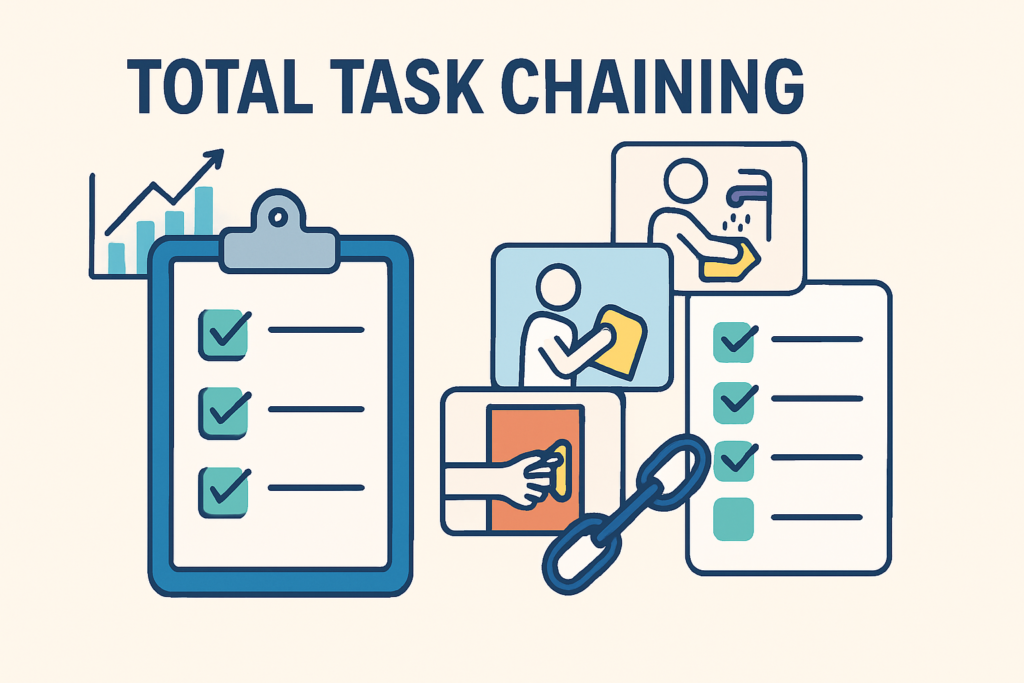
Total task chaining is a behavioral teaching procedure where learners attempt every step of a task analysis during each instructional trial. This approach differs from other chaining methods by presenting the entire sequence from start to finish, with prompting support provided only for steps where assistance is needed. Understanding this procedure is essential for BCBA candidates preparing for certification.
Table of Contents
- What is Total Task Chaining? Definition and Core Concept
- Total Task Chaining in Action: Worked ABA Examples
- Exam Relevance and Common Candidate Traps
- Quick-Reference Implementation Checklist
- Summary and Key Takeaways for Your Studies
What is Total Task Chaining? Definition and Core Concept
This teaching method involves presenting all steps of a behavior chain during every learning opportunity. The learner attempts the complete sequence, receiving prompting assistance as necessary for individual components.
The Formal Definition for Your Exam
Total task chaining is defined as a chaining procedure where the learner attempts every step of the task analysis on each trial. The practitioner provides prompts as needed for any steps the learner cannot complete independently, while reinforcement is delivered upon completion of the entire chain.
Total Task vs. Forward and Backward Chaining
Understanding the differences between chaining procedures is crucial for exam success. Here’s how they compare:
- Total task chaining: All steps attempted each session; prompting provided for any step as needed
- Forward chaining: Steps taught sequentially from first to last; reinforcement after each new step mastered
- Backward chaining: Steps taught from last to first; learner completes final step initially
The key differentiator is that total task chaining presents the entire chain each time, while other methods introduce steps sequentially.
Total Task Chaining in Action: Worked ABA Examples
Practical examples demonstrate how this procedure functions in real-world settings. These scenarios include ABC data and functional considerations to model exam thinking.
Example 1: Teaching Hand Washing to a Young Learner
A 7-step task analysis for hand washing includes: 1) Turn on water, 2) Wet hands, 3) Get soap, 4) Rub hands together, 5) Rinse soap, 6) Turn off water, 7) Dry hands. During a trial, the learner independently completes steps 1-3 and 5-7 but requires a gestural prompt for step 4 (rubbing hands).
ABC data shows: Antecedent – “Time to wash hands,” Behavior – Completes all steps with prompt on step 4, Consequence – Praise and access to snack. The hypothesized function may be access to reinforcement (clean hands for eating) rather than escape from germs.
Example 2: A Vocational Skill: Assembling a Package
For a packaging job, the 8-step analysis includes: 1) Select box, 2) Insert liner, 3) Select correct item, 4) Place item, 5) Add packing material, 6) Seal box, 7) Apply label, 8) Place on conveyor. Data shows independence on most steps but consistent errors on step 3 (selecting correct item).
The error correction procedure within total task chaining involves immediately providing a model prompt when the error occurs, then allowing the learner to continue with the remaining steps. This maintains the behavioral momentum of the chain while addressing specific skill deficits.
Example 3: Academic Routine: Setting Up a Morning Workstation
A classroom routine includes: 1) Hang backpack, 2) Get materials, 3) Sharpen pencils, 4) Place homework folder, 5) Sit at desk, 6) Begin first task. Data collection reveals that steps 2 and 3 consistently require least-to-most prompting, while other steps show independence.
This pattern suggests that discriminative stimuli for steps 2 and 3 may not be sufficiently established, requiring targeted intervention within the total task framework. For more on establishing stimulus control, see our guide on discriminative stimuli.
Exam Relevance and Common Candidate Traps
BCBA exam questions often test your ability to identify and implement appropriate chaining procedures. Recognizing common pitfalls can prevent losing valuable points.
Spotting the Key Cue in Exam Vignettes
Exam questions describing total task chaining typically include specific language cues. Look for phrases like “attempts all steps each session,” “prompted through any step as needed,” or “completes entire sequence with assistance on specific steps.” These indicate the total task approach rather than sequential chaining methods.
Frequent Misconceptions and Exam Traps
Several common errors trip up candidates:
- Confusing total task chaining with “whole task” presentation (which isn’t a chaining procedure)
- Assuming it’s only appropriate for high-functioning learners (it can be adapted for various skill levels)
- Forgetting that reinforcement delivery occurs upon completion of the entire chain, not after individual steps
- Overlooking the importance of data collection on each step’s independence level
Remember that total task chaining requires careful task analysis and systematic prompt fading strategies. For related procedures, explore our article on chaining in ABA.
Quick-Reference Implementation Checklist
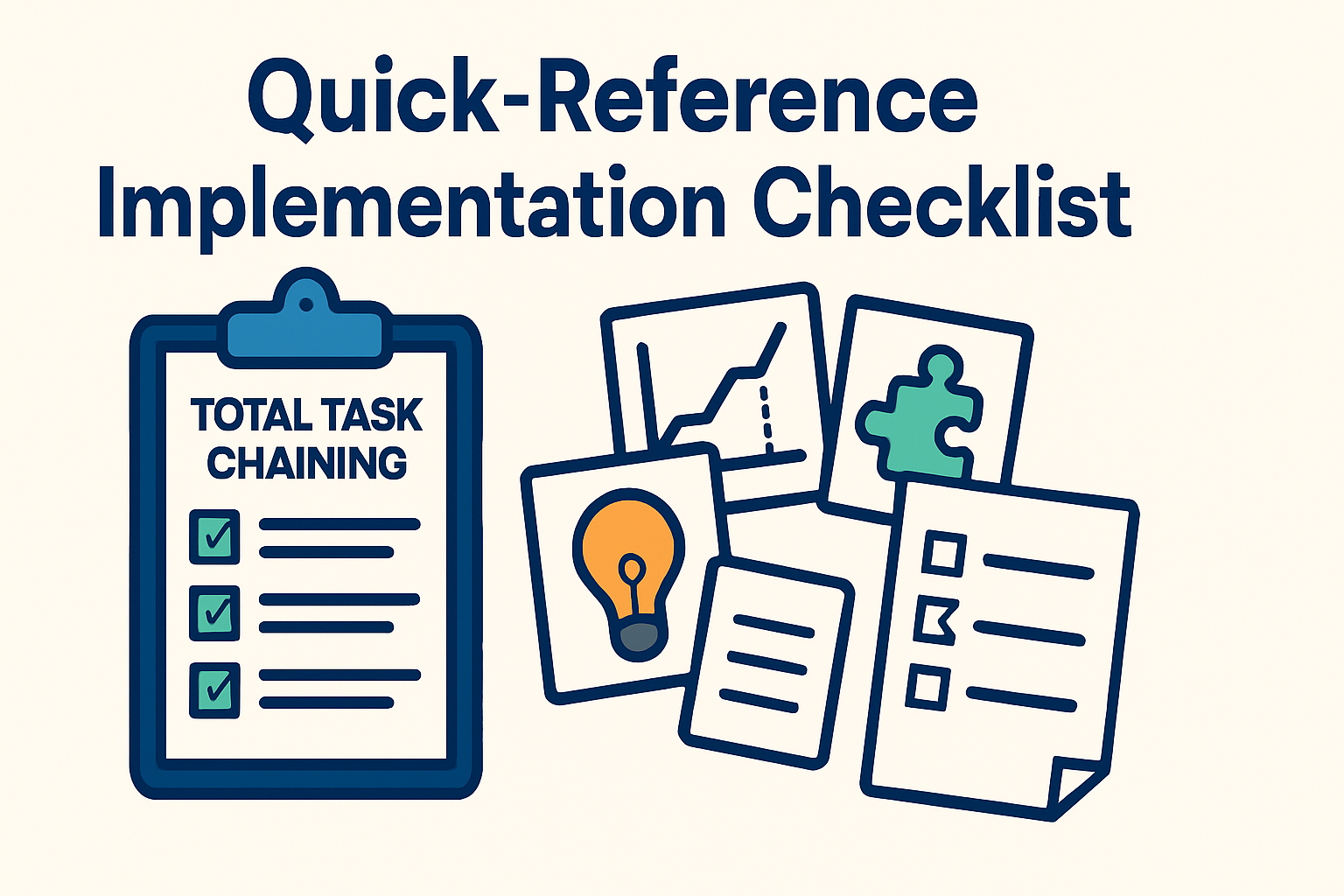
Use this actionable checklist to implement total task chaining correctly and answer application questions on the exam.
- Develop a detailed task analysis breaking the skill into sequential steps
- Establish baseline data on current performance for each step
- Select appropriate prompting hierarchy (most-to-least or least-to-most)
- Present the entire chain during each instructional trial
- Provide prompts only for steps requiring assistance
- Collect ABC data on prompting needs and errors
- Deliver reinforcement upon completion of the entire chain
- Systematically fade prompts as independence increases
- Monitor treatment integrity and make data-based decisions
Summary and Key Takeaways for Your Studies
Total task chaining represents a valuable teaching strategy in applied behavior analysis. Key points to remember include its distinctive feature of presenting all steps each session, the importance of systematic prompting, and the delivery of reinforcement after chain completion.
For exam preparation, focus on differentiating this procedure from other chaining methods, recognizing implementation scenarios, and avoiding common misconceptions. The BACB Task List references these procedures in Domain G: Behavior Change Procedures. Additional resources on behavioral teaching methods can be found in the BACB Task List and peer-reviewed literature on chaining procedures.
Mastering total task chaining requires understanding both its procedural components and its appropriate applications across different skill domains and learner characteristics. This knowledge supports effective intervention planning and successful exam performance.



