
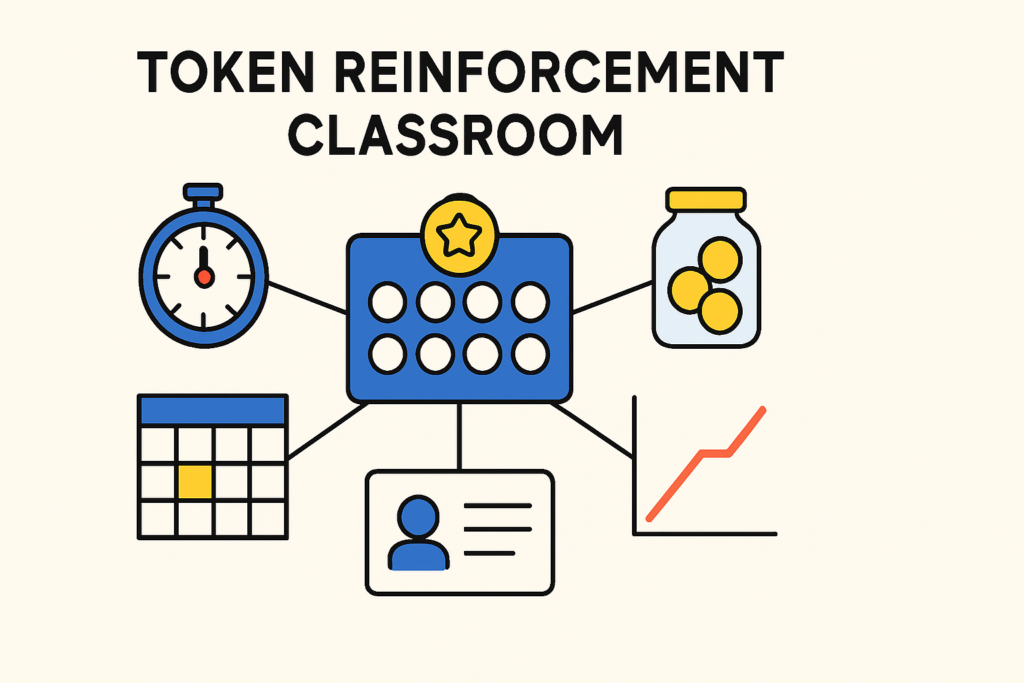
Token reinforcement represents one of the most effective behavior management strategies in educational settings, combining behavioral principles with practical classroom application. This system bridges the gap between immediate reinforcement and long-term goals, making it particularly valuable for group contingencies and individual behavior plans. Understanding token reinforcement classroom implementation requires mastery of both technical components and ethical considerations.
Table of Contents
- token reinforcement classroom: What is a Token Reinforcement System?
- Implementing Token Reinforcement: From Theory to Practice
- Ethical Considerations and Common Pitfalls
- Token Reinforcement on the BCBA Exam
- Quick-Start Classroom Checklist
token reinforcement classroom: What is a Token Reinforcement System?
A token reinforcement system is a behavioral intervention where learners earn tokens for demonstrating target behaviors, which can later be exchanged for preferred items or activities. This approach leverages the principles of operant conditioning to shape and maintain desired behaviors across various educational contexts.
Core Components and Behavioral Principles
Every token system consists of three essential elements. First, the token itself serves as a conditioned reinforcer that gains value through pairing with backup reinforcers. Second, backup reinforcers are the actual rewards that maintain the token’s reinforcing properties. Third, the exchange rate determines how many tokens are needed for each backup item.
Tokens function as generalized conditioned reinforcers because they maintain their value across different establishing operations. Their effectiveness depends on establishing a clear stimulus-response relationship between earning tokens and accessing meaningful rewards.
Token Reinforcement vs. Other Classroom Strategies
Unlike simple social praise or immediate tangible rewards, token systems provide several distinct advantages. They allow for delayed reinforcement while maintaining motivation, support response generalization across settings, and facilitate group contingencies more effectively than individual reinforcement alone.
Compared to differential reinforcement procedures like DRO or DRA, token systems offer greater flexibility in reinforcement schedules and can be combined with these strategies for enhanced effectiveness. They differ from response cost procedures by focusing on earning rather than losing privileges.
Implementing Token Reinforcement: From Theory to Practice
Successful implementation requires careful planning and systematic execution. These examples demonstrate how token systems translate behavioral principles into practical classroom interventions.
Example 1: Increasing Task Engagement During Independent Work
This intervention targets on-task behavior during independent work periods. The antecedent is the teacher’s instruction to begin a 20-minute worksheet. The target behavior involves remaining seated, working quietly, and completing assigned problems for 5-minute intervals.
- Consequence: Teacher delivers one token at the end of each 5-minute interval of continuous on-task behavior
- Exchange rate: Five tokens = 10 minutes of computer time
- Hypothesized function: Access to tangible reinforcement (computer time)
- Data collection: Momentary time sampling every 2 minutes
- Fading plan: Gradually increase interval length from 5 to 15 minutes
Example 2: Reducing Disruptive Transitions with a Group Contingency
This group-oriented system addresses disruptive classroom transitions. The antecedent is the bell ringing signaling transition to lunch. The target behavior requires all students to line up quietly within 60 seconds without pushing or shouting.
- Consequence: Each student receives one token when the class meets the group criterion
- Exchange rate: Ten tokens = extra recess time for the entire class
- Hypothesized function: Access to activity reinforcement (lunch) plus social reinforcement
- Measurement: Whole interval recording of 60-second transition period
- Social validity: Student input on backup reinforcer selection
Ethical Considerations and Common Pitfalls
Ethical implementation requires alignment with the BACB Ethics Code and consideration of potential system failures. These considerations ensure both effectiveness and respect for learner dignity.
Aligning Your System with the BACB Ethics Code
Several ethics code sections directly apply to token reinforcement implementation. Code 1.01 emphasizes respecting client dignity and avoiding demeaning procedures. Code 2.14 requires selecting the least restrictive effective procedure, which may influence token system design.
Code 2.10 mandates explaining procedures to clients in understandable terms, including token earning criteria and exchange rules. Code 2.09 requires documenting effectiveness through data collection and making adjustments when needed. Backup reinforcer selection should consider cultural relevance and individual preferences.
Troubleshooting and Fading the System
Common system failures often stem from implementation errors rather than conceptual flaws. Poor backup reinforcers that lack motivating value undermine the entire system. Unclear earning criteria create confusion and reduce effectiveness.
- Infrequent token delivery reduces immediate reinforcement value
- Inconsistent implementation across staff members creates confusion
- Overly complex exchange systems that learners cannot understand
- Failure to thin reinforcement schedules as behaviors stabilize
The ethical imperative includes planning for systematic fading to promote generalization and maintenance of target behaviors in natural environments.

Token Reinforcement on the BCBA Exam
Exam questions often test both conceptual understanding and practical application of token systems. Recognizing common question patterns and distractors improves exam performance.
Recognizing Key Terms and Question Types
Several technical terms frequently appear in exam questions about token systems. Understanding conditioned reinforcer versus generalized conditioned reinforcer distinctions is essential. Questions may ask about appropriate exchange rates or methods for establishing token value.
Common question stems include selecting the most appropriate token system for a given scenario, identifying implementation errors in described systems, or determining when to modify or fade a token economy. Questions may also test understanding of how token systems relate to motivating operations and establishing operations.
Avoiding Common Exam Distractors
Several predictable traps appear in token reinforcement questions. One common error involves confusing tokens with primary reinforcers rather than conditioned reinforcers. Another trap involves selecting fading strategies too early, before behaviors have stabilized under the token system.
- Missing the importance of establishing operations for backup reinforcer value
- Confusing token systems with response cost procedures
- Overlooking the need for social validity assessment in system design
- Selecting overly complex systems when simpler alternatives would suffice
Understanding these patterns helps candidates navigate challenging questions more effectively. For additional exam preparation strategies, explore our BCBA exam study framework.
Quick-Start Classroom Checklist
This actionable checklist guides implementation from initial planning through ongoing evaluation. Each step incorporates both behavioral principles and practical considerations.
- Conduct preference assessments to identify effective backup reinforcers
- Define target behaviors using observable, measurable criteria
- Establish clear earning rules and exchange rates appropriate for age and ability
- Select token type (physical, digital, or point system) based on context
- Train all implementers on consistent token delivery procedures
- Create data collection system to monitor effectiveness and make adjustments
- Plan fading strategy from the beginning of implementation
- Obtain social validity feedback from students and staff regularly
- Document procedures for replication and ethical compliance
- Review BACB Ethics Code sections relevant to reinforcement procedures
Token reinforcement systems represent powerful tools for behavior change when implemented with technical precision and ethical consideration. Their effectiveness depends on careful attention to both behavioral principles and practical implementation details. By mastering these systems, practitioners can create supportive learning environments that promote skill acquisition and behavioral success. For more information on related behavioral procedures, see our guide to differential reinforcement procedures and the official BACB Ethics Code for comprehensive ethical guidance.



