

A token economy is a systematic reinforcement procedure where individuals earn tokens for demonstrating target behaviors, which can later be exchanged for preferred items or activities. This powerful behavior change strategy bridges the gap between immediate performance and delayed reinforcement, making it particularly effective for teaching new skills and reducing challenging behaviors. Understanding token economy behavior systems is essential for BCBA candidates, as these interventions appear frequently in exam scenarios and clinical practice.
Table of Contents
- token economy behavior: What is a Token Economy? A Foundational Definition
- Implementing a Token Economy: Worked ABA Examples
- Ethical Considerations and Practical Guidelines
- Token Economies on the BCBA Exam: Relevance and Common Traps
token economy behavior: What is a Token Economy? A Foundational Definition
A token economy represents a sophisticated reinforcement system that uses conditioned reinforcers to bridge delays to reinforcement. Unlike simple reinforcement schedules, token economies create a flexible system where tokens serve as generalized conditioned reinforcers that maintain their value across different contexts and time periods.
The Three Essential Components
Every effective token economy includes three critical elements that work together to shape behavior:
- Tokens: These are conditioned reinforcers that gain value through pairing with backup reinforcers. Common examples include stickers, points, checkmarks, or poker chips.
- Backup Reinforcers: These are established reinforcers that maintain the token’s value through exchange. They’re identified through preference assessments and might include activities, tangible items, or privileges.
- Exchange System: This includes the rules governing when and how tokens can be exchanged for backup reinforcers, including exchange rates, schedules, and procedures.
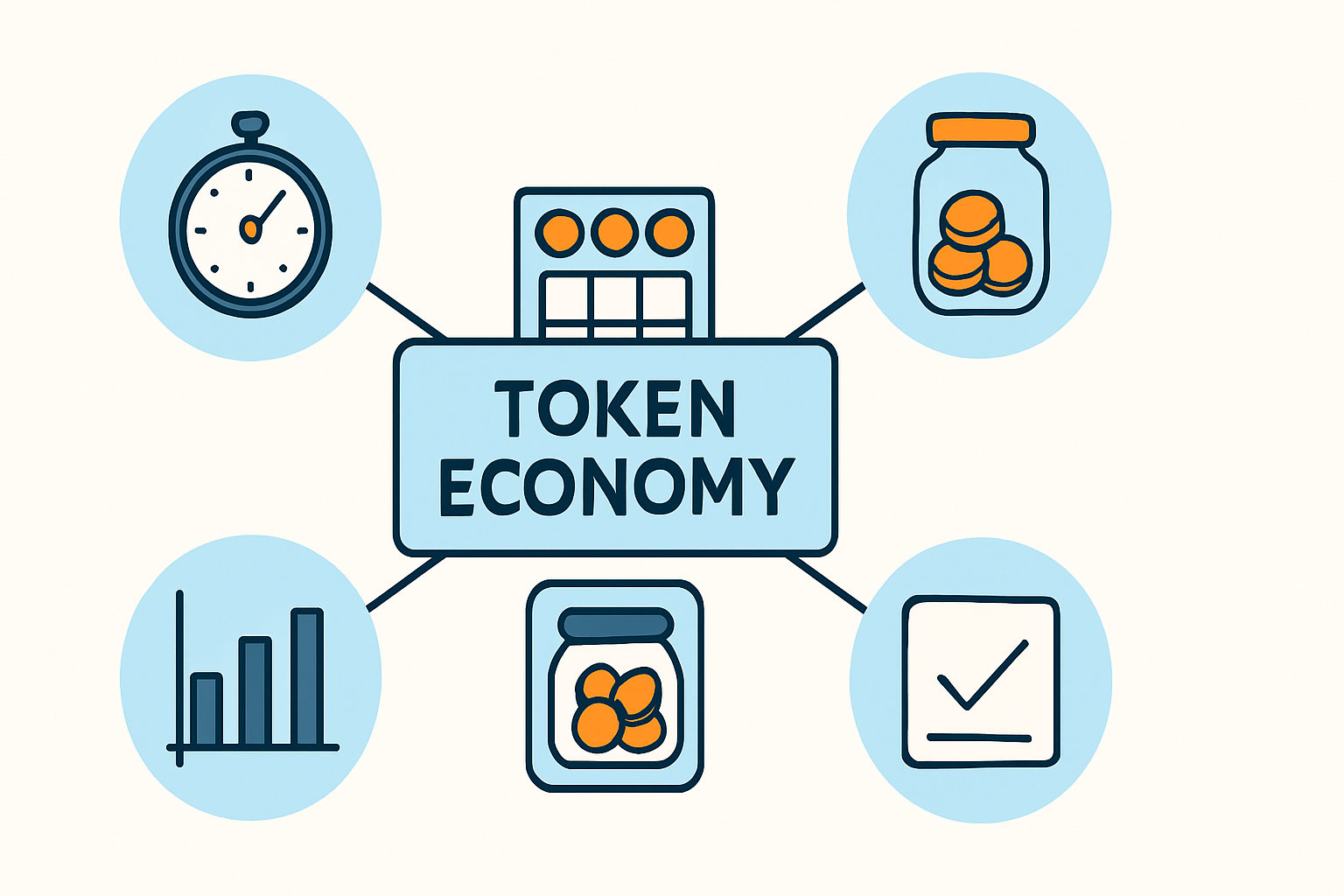
Token Economy vs. Other Reinforcement Systems
Token economies differ from simpler reinforcement approaches in several key ways. While simple reinforcement schedules deliver reinforcement directly for target behaviors, token economies introduce an intermediate step. Unlike contingency contracts that specify agreements between parties, token economies create a more systematic and generalized system. The primary advantage of token economies lies in their ability to bridge delays to reinforcement, making them particularly effective for teaching delayed gratification and maintaining behavior across longer time intervals.
Implementing a Token Economy: Worked ABA Examples
Let’s examine practical applications of token economies through concrete scenarios that demonstrate how these systems work in real-world settings.
Example 1: Increasing Academic Engagement in a Classroom
Scenario: A 9-year-old student with ADHD demonstrates frequent off-task behavior during independent math work. Functional assessment indicates the behavior is maintained by escape from difficult tasks.
- Antecedent: Teacher presents math worksheet with 10 problems
- Target Behavior: Student completes 5 problems without leaving seat or vocal protest
- Consequence: Student earns one token immediately upon completion
- Exchange System: 5 tokens exchange for 5 minutes of preferred computer time at the end of the session
Example 2: Decreasing Aggression During Transitions
Scenario: A 6-year-old child with ASD engages in hitting and screaming when asked to clean up preferred toys. Functional analysis reveals the behavior is maintained by access to tangibles.
- Antecedent: Parent gives instruction to “clean up toys”
- Target Behavior: Child puts away all toys within 2 minutes without aggression
- Consequence: Child earns one token immediately after compliance
- Exchange System: 3 tokens exchange for 2 minutes of uninterrupted play with the preferred toy
Ethical Considerations and Practical Guidelines
Implementing token economies requires careful attention to ethical principles and practical implementation details to ensure effectiveness and respect for client dignity.

Aligning Token Systems with Client Dignity and Choice
Ethical implementation of token economies requires balancing effectiveness with respect for client autonomy. According to the BACB Ethics Code, practitioners must involve clients in selecting both tokens and backup reinforcers whenever possible. This aligns with Code item 2.09 regarding treatment/intervention efficacy and 4.10 regarding informed consent. Systems should never feel coercive, and practitioners must plan for systematic fading to promote independence.
A Quick-Start Implementation Checklist
Follow this systematic approach when designing and implementing a token economy:
- Conduct comprehensive preference assessments to identify powerful backup reinforcers
- Select appropriate, age-appropriate tokens that are easy to manage and track
- Define clear, observable, and measurable target behaviors using objective criteria
- Set initial exchange rates that are achievable yet require some effort
- Plan for systematic thinning of reinforcement schedules and eventual fading of the system
- Monitor regularly for satiation effects and adjust backup reinforcers as needed
Token Economies on the BCBA Exam: Relevance and Common Traps
Token economy concepts appear frequently on the BCBA exam, particularly in scenarios involving reinforcement systems and ethical implementation. Understanding these systems requires mastery of specific terminology and awareness of common exam pitfalls.
Key Exam Terms and Concepts to Master
BCBA candidates should be thoroughly familiar with these essential terms related to token economies:
- Conditioned Reinforcer: A previously neutral stimulus that gains reinforcing properties through pairing with established reinforcers
- Generalized Conditioned Reinforcer: A conditioned reinforcer that maintains value across multiple contexts and backup reinforcers
- Backup Reinforcer: The established reinforcer that maintains the token’s value through exchange
- Exchange Rate: The ratio of tokens required to obtain backup reinforcers
- Thinning Schedules: The process of gradually increasing response requirements or delaying reinforcement
Avoiding These Frequent Exam Mistakes
Several common errors appear regularly in exam questions about token economies:
- Confusing tokens (conditioned reinforcers) with backup reinforcers (unconditioned/established reinforcers)
- Misidentifying the reinforcement schedule for token delivery versus exchange for backup reinforcers
- Forgetting that ethical implementation requires client assent/assent where possible
- Overlooking the importance of systematic fading to promote maintenance and generalization
- Failing to recognize when a token economy might be contraindicated due to client characteristics
For additional preparation on related concepts, explore our guide to preference assessments and ethics in ABA practice. The BACB Ethics Code provides essential guidance for ethical implementation of all behavior change procedures.
Token economies represent a powerful tool in the behavior analyst’s toolkit when implemented thoughtfully and ethically. By understanding the core components, practical applications, and ethical considerations, BCBA candidates can confidently approach exam questions and clinical scenarios involving these systems. Remember that effective token economies always prioritize client dignity while systematically shaping behavior toward meaningful outcomes.



