
Understanding reinforcement principles is fundamental to applied behavior analysis, and socially mediated negative reinforcement represents a critical concept that often appears on certification assessments. This principle explains how behaviors are strengthened when they result in the removal or avoidance of aversive stimuli through the actions of another person. Mastery of this concept requires precise identification of the social mediator’s role in the behavior-consequence relationship.
Table of Contents
- Defining Socially Mediated Negative Reinforcement
- Applied Examples in ABA Practice
- Exam Relevance and Common Traps
- Quick-Reference Checklist for Analysis
- Summary and Key Takeaways
Defining Socially Mediated Negative Reinforcement
This behavioral principle occurs when a behavior is followed by the removal or avoidance of an aversive stimulus, and this consequence is delivered by another person. The social mediator’s action must be contingent upon the target behavior, creating a functional relationship that strengthens future occurrences of that behavior under similar conditions.
The Two-Part Mechanism
The mechanism operates through two essential components. First, the behavior must result in the termination or postponement of an aversive condition. Second, this consequence must be mediated by another person’s actions, distinguishing it from automatic negative reinforcement where the behavior directly affects the environment.
Consider how this differs from related concepts:
- Negative reinforcement always involves removing aversive stimuli
- Social mediation requires another person’s contingent response
- The behavior’s function is escape or avoidance of aversive conditions
- The consequence strengthens behavior through stimulus removal

Key Components for Identification
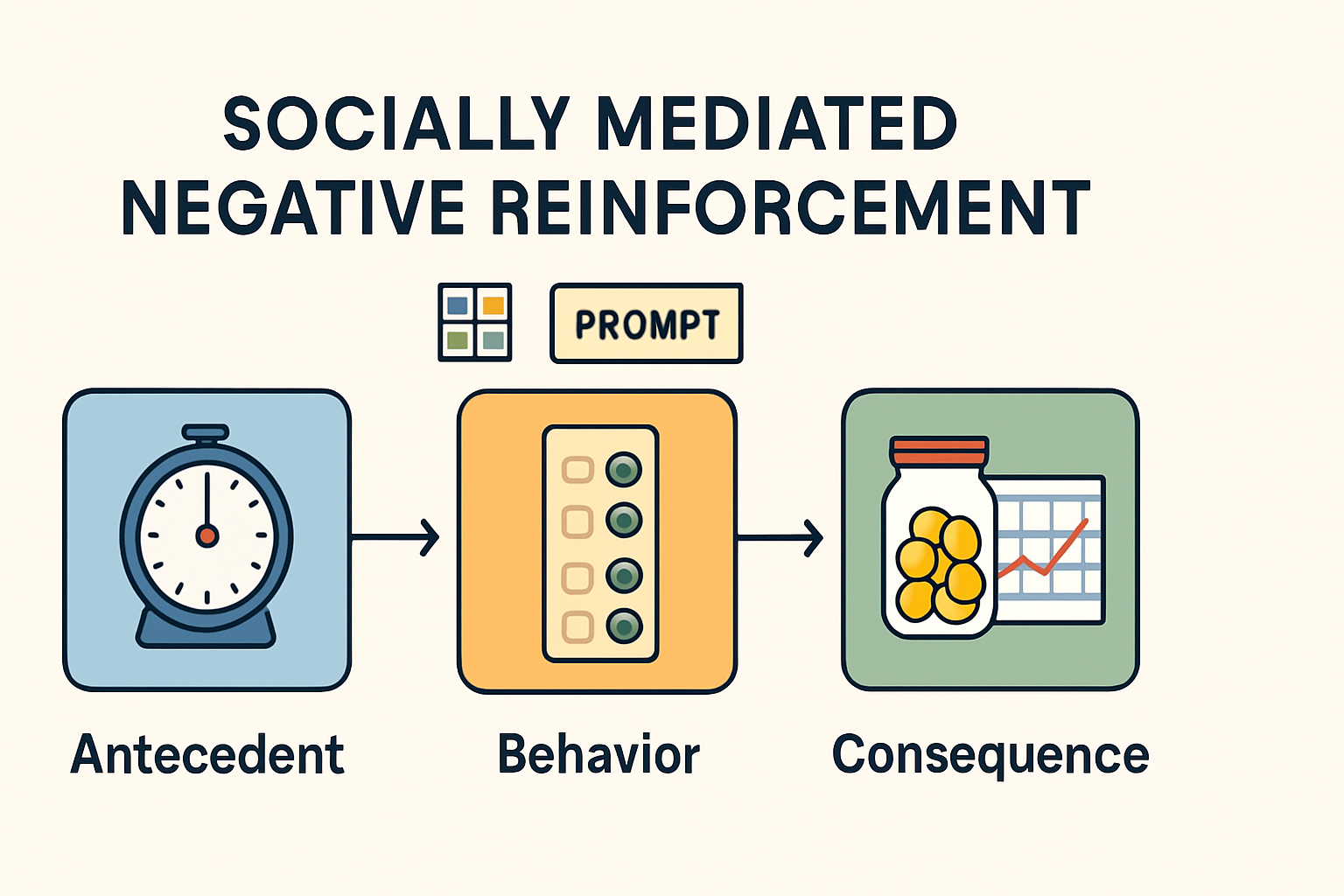
Accurate identification requires analyzing four critical elements in the behavioral contingency. These components form the foundation for functional assessment and intervention planning in functional behavior assessment.
- Aversive antecedent: The stimulus or condition the individual finds unpleasant
- Target behavior: The specific response that occurs
- Social mediator’s action: Another person’s contingent response to the behavior
- Consequence: The resulting termination or postponement of the aversive condition
Applied Examples in ABA Practice
Real-world scenarios illustrate how this principle operates in clinical and educational settings. Each example demonstrates the ABC contingency and highlights the social mediator’s critical role in maintaining the behavior.
Example 1: Escape from Academic Demands
A student is presented with a challenging math worksheet (antecedent). The student begins crying and pushing materials off the desk (behavior). The teacher removes the worksheet and offers a break (consequence). The social mediator (teacher) contingently removes the aversive demand, reinforcing the escape behavior through socially mediated negative reinforcement.
Example 2: Avoidance of Social Interaction
During group activities, a client finds peer interactions aversive (antecedent). The client complains of a headache and asks to lie down (behavior). The staff member allows the client to skip the group activity (consequence). This represents avoidance behavior maintained by socially mediated negative reinforcement, as the staff member’s action postpones the aversive social situation.
Example 3: Termination of Non-Preferred Activities
A client is required to complete household chores (antecedent). The client makes sarcastic comments toward family members (behavior). Family members stop assigning chores to avoid conflict (consequence). The aversive stimulus (chores) is removed through others’ actions, reinforcing the sarcastic behavior. This pattern often requires intervention through functional communication training.
Exam Relevance and Common Traps
This concept frequently appears on certification assessments, often in scenarios requiring precise discrimination between reinforcement types. Common errors involve misidentifying the social mediator or confusing this principle with automatic negative reinforcement.
Distinguishing It from Automatic Negative Reinforcement
The critical distinction lies in whether the behavior directly affects the environment or requires another person’s intervention. Automatic negative reinforcement involves direct environmental changes, while socially mediated negative reinforcement requires social intervention.
- Automatic: Behavior directly terminates aversive stimulus (e.g., putting on headphones to block noise)
- Socially mediated: Another person terminates aversive stimulus contingent on behavior
- Exam trap: If no social mediator is involved, it’s automatic negative reinforcement
- Key question: “Who or what removes the aversive stimulus?”
The ‘Social Mediator’ Pitfall
Candidates often struggle with scenarios where social mediation is subtle or indirect. The mediator’s action must be contingent upon the behavior and specifically remove or postpone the aversive condition. If the aversive event ends independently or by chance, reinforcement has not occurred.
Consider this trap scenario: A student dislikes group work (antecedent) and asks to use the restroom (behavior). The teacher says yes, and when the student returns, group work has ended naturally (consequence). This is NOT socially mediated negative reinforcement because the aversive stimulus ended independently, not through the teacher’s contingent action.
Quick-Reference Checklist for Analysis
Use this systematic approach to identify socially mediated negative reinforcement in assessment scenarios. This checklist aligns with function of behavior analysis procedures.
- Identify the aversive antecedent: What stimulus or condition is unpleasant?
- Observe the target behavior: What specific response occurs?
- Determine social mediation: Does another person intervene?
- Analyze the consequence: Is the aversive stimulus removed or postponed?
- Check contingency: Is the consequence contingent on the behavior?
- Assess future probability: Is the behavior likely to recur under similar conditions?
Summary and Key Takeaways
Socially mediated negative reinforcement represents a fundamental behavioral principle with significant implications for assessment and intervention. Mastery requires understanding the social mediator’s critical role in the behavior-consequence relationship.
Essential points for clinical practice and exam preparation include recognizing that the behavior functions to escape or avoid aversive stimuli through others’ actions. Accurate identification depends on analyzing the complete ABC contingency and verifying social mediation. Common errors involve confusing this principle with automatic negative reinforcement or misidentifying non-contingent consequences.
For further study of related concepts, review the negative reinforcement guide and consult the BACB’s Ethics Code for Behavior Analysts for guidance on ethical intervention design. Additional resources on behavioral principles are available through the Association for Behavior Analysis International.



