
Understanding social positive reinforcement is essential for any behavior analyst. This fundamental concept appears frequently on the BCBA exam and forms the basis of many effective interventions in applied behavior analysis. Social positive reinforcement involves using social interactions as consequences to strengthen behaviors, making it a powerful tool for building relationships and promoting meaningful change.
Table of Contents
- What is Social Positive Reinforcement?
- Social Positive Reinforcement in Action: Worked Examples
- Social Positive Reinforcement and the BCBA Exam
- Quick-Reference Checklist for Practitioners and Candidates
What is Social Positive Reinforcement?
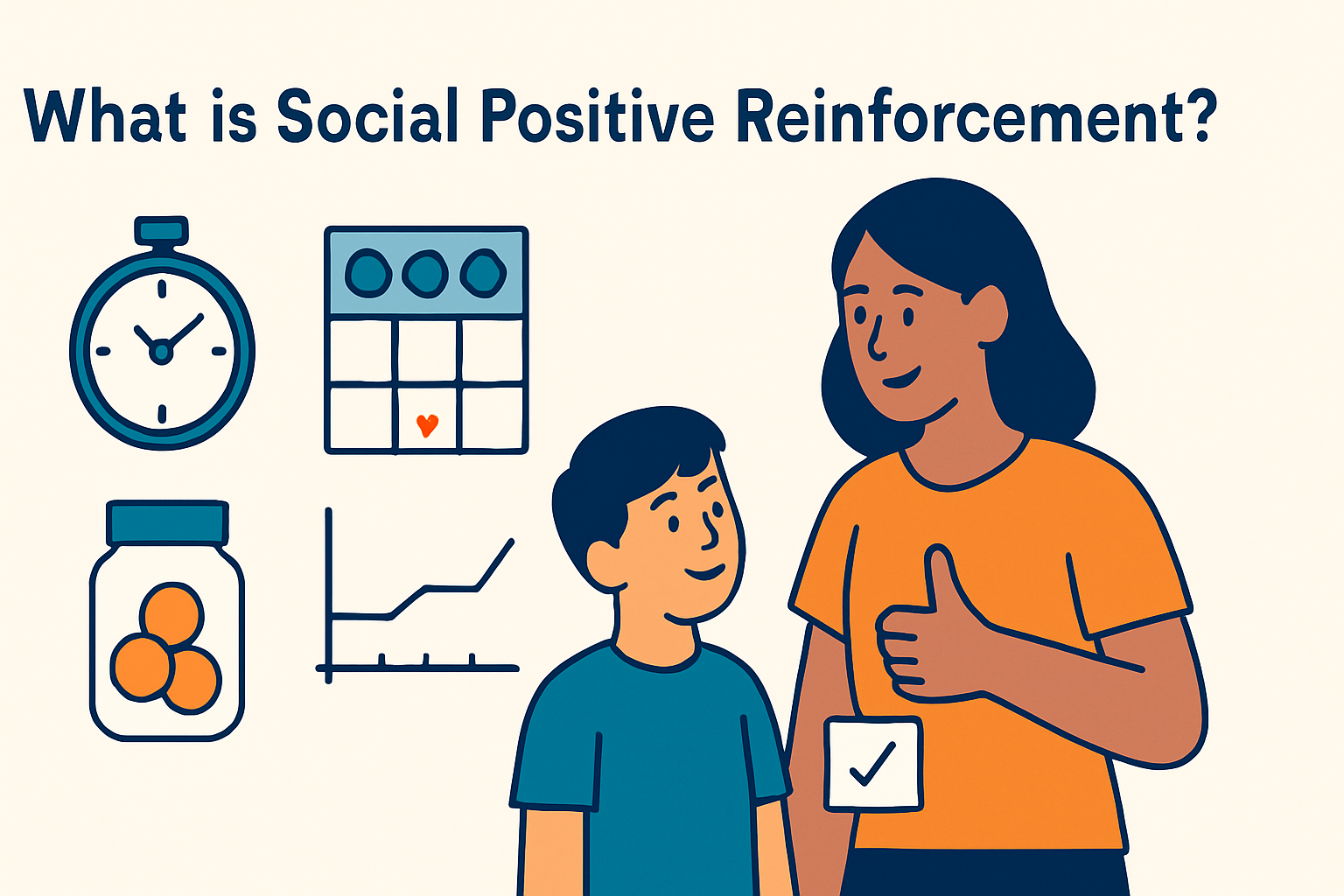
Social positive reinforcement occurs when a behavior is followed by the presentation of a social stimulus that increases the future frequency of that behavior. The key characteristic is that the reinforcing consequence must be delivered by another person, distinguishing it from other reinforcement types.
The Core Definition and Key Characteristics
In technical terms, social positive reinforcement is a type of positive reinforcement where the consequence involves adding a social stimulus. Common examples include verbal praise, smiles, high-fives, attention, or any form of social acknowledgment. The critical element is that the reinforcement comes from social interaction rather than tangible items or automatic sensory feedback.
This differs from automatic reinforcement, where the consequence is inherent to the behavior itself, and from tangible reinforcement, which involves physical items. Social reinforcement is particularly valuable because it’s naturally occurring and readily available in most environments.
Why It’s a Cornerstone of ABA Practice
Social positive reinforcement serves several crucial functions in ABA practice. First, it helps build therapeutic relationships between practitioners and clients. When used ethically, it respects client dignity while effectively shaping behavior. Second, it promotes generalization because social reinforcement occurs naturally across settings, unlike contrived reinforcement systems.
Third, social reinforcement aligns with the philosophical assumptions of behavior analysis by focusing on observable, measurable interactions. It supports the development of socially significant behaviors that improve quality of life. For more on the foundational principles, see our guide on philosophical assumptions in behavior analysis.
Social Positive Reinforcement in Action: Worked Examples
Let’s examine practical scenarios where social positive reinforcement operates effectively. These examples demonstrate how to identify the antecedent, behavior, and consequence components, along with the hypothesized function.
Example 1: Peer Attention in a Classroom Setting
Antecedent: A student completes a worksheet quietly during independent work time. Behavior: The student raises their hand and waits patiently. Consequence: The teacher approaches, smiles, and says, “Excellent work staying focused!” while giving a high-five.
Hypothesized Function: Access to social positive reinforcement in the form of adult attention and approval. The teacher’s verbal praise and physical acknowledgment serve as reinforcing consequences that increase the likelihood of the student raising their hand appropriately in the future.
Example 2: Social Engagement During Play
Antecedent: A child is playing alone with building blocks during recess. Behavior: The child says “Look!” and shows a completed tower to a nearby peer. Consequence: The peer smiles, makes eye contact, and responds, “Cool tower! Can I help build one?”
Hypothesized Function: Access to peer attention and social interaction. The peer’s positive response reinforces the child’s initiation of social communication, potentially increasing similar social bids in the future.
Example 3: Professional Feedback in Supervision
Antecedent: A supervisee submits a detailed behavior intervention plan before the deadline. Behavior: The supervisee includes a novel data tracking method that improves efficiency. Consequence: The BCBA provides specific, positive written feedback highlighting the innovation and its potential impact.
Hypothesized Function: Access to professional recognition and approval. The BCBA’s detailed acknowledgment reinforces the supervisee’s creative problem-solving and thorough preparation behaviors.
Social Positive Reinforcement and the BCBA Exam
This concept appears frequently on the BCBA exam, often in scenario-based questions that test your ability to identify reinforcement types and behavioral functions. Understanding the nuances can help you avoid common pitfalls.
Common Exam Traps and How to Avoid Them
Several traps consistently challenge candidates on exam questions about social positive reinforcement:
- Confusing social with automatic reinforcement: Remember that social reinforcement requires delivery by another person. If the consequence is sensory or self-generated, it’s likely automatic reinforcement.
- Overlooking paired reinforcement: When praise accompanies a tangible item, both may function as reinforcement. The exam often asks you to identify the primary or most likely function.
- Misidentifying conditioned reinforcers: Social stimuli often become conditioned reinforcers through pairing with other reinforcers, but you must still identify the social component.
- Ignoring the social delivery requirement: If no other person is involved in delivering the consequence, it cannot be social reinforcement, regardless of how “social” the behavior appears.
Practice Applying the Concept
Try analyzing this exam-style scenario: “A child says ‘please’ when requesting a preferred toy. The parent immediately gives the toy while saying ‘Great manners!’ Which best describes the reinforcement for saying ‘please’?”
The correct analysis recognizes that while the toy is tangible reinforcement, the parent’s verbal praise represents social positive reinforcement. Both may be functioning, but questions often ask you to identify the social component specifically. For more practice with reinforcement concepts, explore our guide to positive reinforcement.
Quick-Reference Checklist for Practitioners and Candidates
Use this checklist to ensure you’re correctly identifying and applying social positive reinforcement in practice and exam preparation:
- Verify social delivery: Confirm the reinforcing consequence comes from another person
- Identify the social stimulus: Specify whether it’s verbal praise, attention, smiles, or other social acknowledgment
- Check behavior increase: Ensure the behavior is actually increasing or likely to increase in frequency
- Distinguish from other types: Rule out automatic, tangible, and activity reinforcement
- Consider pairing effects: Recognize when social reinforcement is paired with other reinforcement types
- Assess generalization potential: Evaluate whether the social reinforcement occurs naturally in the environment
- Monitor ethical implementation: Ensure reinforcement respects client dignity and preferences
For comprehensive exam preparation covering all reinforcement concepts, review our BCBA exam prep guide. Additionally, the BACB Glossary provides official definitions of reinforcement types.
Mastering social positive reinforcement requires both conceptual understanding and practical application. By recognizing its distinctive features, avoiding common exam traps, and implementing it ethically in practice, you’ll be well-prepared for both the BCBA exam and effective behavior analysis practice. Remember that social reinforcement’s power lies in its natural occurrence and relationship-building potential, making it an essential tool for promoting meaningful, lasting behavior change.



