
discriminative stimulus SD: What is a Discriminative Stimulus (SD)? A Behavioral Definitio
A discriminative stimulus (SD) is an antecedent event that signals the availability of reinforcement for a specific behavior. This stimulus control develops through a history where responding in the presence of the SD has been reinforced, while responding in its absence has not been reinforced. The SD does not cause behavior but rather evokes it based on past consequences.
Table of Contents
- discriminative stimulus SD: What is a Discriminative Stimulus (SD)? A Behavioral Definitio
- Discriminative Stimulus Examples in ABA Practice
- SDs on the BCBA Exam: What to Watch For
- Quick-Study Checklist: Discriminative Stimulus Review
Understanding SDs is fundamental to grasping how stimulus control operates in everyday learning and behavior change programs. When you see a green traffic light, you step on the gas because that behavior has been reinforced (you get where you’re going) in the presence of that specific stimulus.
The SD vs. S-Delta Distinction
The critical distinction between an SD and an S-delta (SΔ) lies in their signaling functions. An SD signals that reinforcement is available for a particular response, while an S-delta signals that reinforcement is not available. This discrimination forms the basis of stimulus control in ABA programming.
- SD example: A teacher saying “What’s your name?” signals that saying your name will be reinforced with praise
- S-delta example: The same teacher looking at her phone signals that saying your name will not be reinforced at that moment
- The learner’s ability to respond differently to these stimuli demonstrates discrimination
- Failure to discriminate may indicate need for additional discrimination training
SDs and the Three-Term Contingency
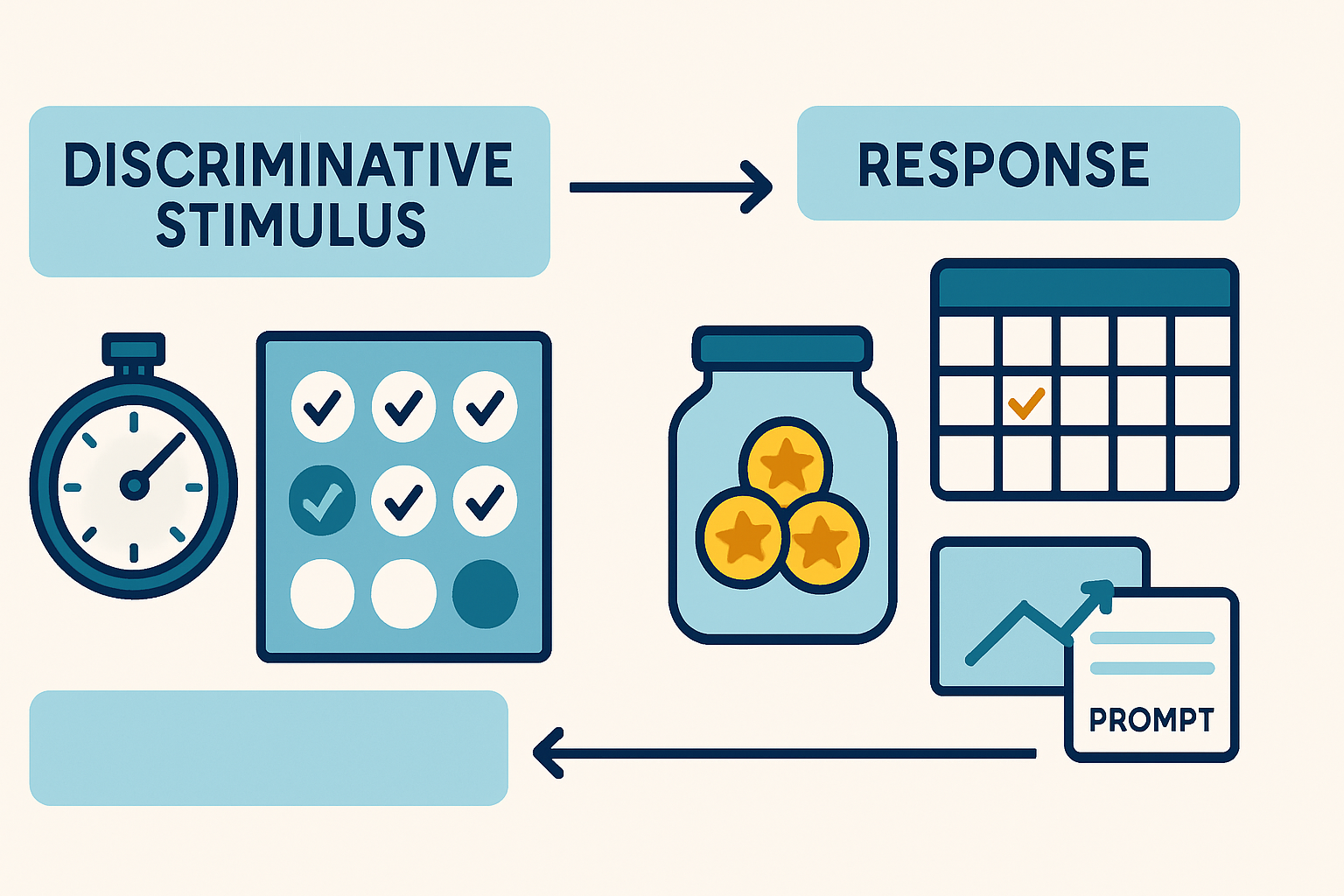
Within the three-term contingency (ABC model), the SD occupies the antecedent position. The complete sequence involves: SD (antecedent) → Behavior → Consequence (reinforcement). This framework helps practitioners analyze how environmental stimuli influence behavior through reinforcement histories.
Consider how this works in practice: When a child sees their favorite toy on a shelf (SD), they ask for it (behavior), and receive it (reinforcement). The toy’s presence evokes the request because asking has been reinforced in similar situations before.
Discriminative Stimulus Examples in ABA Practice
Real-world applications of SDs demonstrate their practical importance in skill acquisition and behavior reduction programs. These examples show how carefully designed antecedents can shape learning outcomes.
Example 1: SD in Skill Acquisition (Mand Training)
In mand training, the SD often involves presenting a preferred item. The sequence follows clear antecedent-behavior-consequence patterns that establish stimulus control.
- Antecedent: Therapist holds up a picture of bubbles
- Behavior: Child signs “more” or says “bubbles”
- Consequence: Therapist blows bubbles (positive reinforcement)
- Function: Access to tangible items
- SD role: The picture signals that the verbal response will be reinforced
Example 2: SD in Behavior Reduction (Classroom Management)
Teachers use SDs to establish classroom routines that reduce disruptive behaviors. These environmental cues signal when specific behaviors will be reinforced.
- Antecedent: Teacher raises hand and says “Quiet hands if you have a question”
- Behavior: Student raises hand quietly instead of blurting out
- Consequence: Teacher calls on student and provides attention
- Function: Access to adult attention
- SD role: Teacher’s raised hand signals that hand-raising will be reinforced
Example 3: SD in Daily Living (Community Skills)
Community safety skills rely heavily on discriminative stimuli that signal appropriate responses. These natural cues help individuals navigate everyday environments safely.
- Antecedent: Green “WALK” signal at crosswalk
- Behavior: Individual steps into crosswalk
- Consequence: Safely reaches other side (negative reinforcement via danger avoidance)
- Function: Avoidance of harm/access to destination
- SD role: The signal indicates it’s safe to cross
SDs on the BCBA Exam: What to Watch For
Exam questions about discriminative stimuli often test your ability to distinguish SDs from other antecedent variables and apply concepts to practical scenarios. Understanding common traps is essential for success.
Common Exam Traps and Misconceptions
Several recurring mistakes appear on BCBA exam questions about discriminative stimuli. Being aware of these traps can help you avoid them.
- Confusing SD with MO: An SD signals reinforcement availability, while a motivating operation (MO) changes the value of reinforcement
- Misidentifying S-delta: Remember that S-delta signals reinforcement is NOT available
- Overlooking reinforcement history: The SD’s power comes from past reinforcement, not innate properties
- Forgetting stimulus control: SDs establish stimulus control through discrimination training
- Mixing up SD and prompt: Prompts are supplemental stimuli to evoke correct responses
Practice Application Prompts
Test your understanding with these exam-style scenarios. Identify whether the described antecedent is an SD, S-delta, or MO.
Scenario 1: A child hasn’t eaten in 4 hours (antecedent), then asks for a snack (behavior), and receives it (consequence). This antecedent is a motivating operation because it establishes food as a reinforcer.
Scenario 2: A therapist presents a red card (antecedent), the child touches it (behavior), and receives praise (consequence). The red card is an SD because it signals reinforcement availability.
Scenario 3: During extinction, a previously reinforced stimulus no longer occasions responding. This stimulus has become an S-delta.
Quick-Study Checklist: Discriminative Stimulus Review
Use this checklist for last-minute review before your exam. Each item reinforces a critical concept about discriminative stimuli and their role in ABA practice.
- Define SD accurately: Antecedent that signals reinforcement availability
- Distinguish SD from S-delta: SD = reinforcement available, SΔ = reinforcement not available
- Place in three-term contingency: SD → Behavior → Reinforcement
- Identify reinforcement history: SD’s power comes from past reinforced responses
- Recognize stimulus control: Differential responding based on antecedent stimuli
- Differentiate from MO: SD signals availability, MO changes reinforcement value
- Apply to examples: Practice identifying SDs in various scenarios
- Connect to discrimination training: Teaching responses to specific stimuli
Mastering discriminative stimuli is essential for effective ABA practice and exam success. These concepts form the foundation of stimulus control procedures used in skill acquisition and behavior reduction programs. For more on related concepts, explore our guide on SD vs MO differences or learn about stimulus control procedures.
Remember that effective use of SDs requires careful programming and consistent reinforcement. The Behavior Analyst Certification Board provides additional resources on these fundamental concepts. As you prepare for your exam, focus on applying these principles to diverse scenarios and understanding how they interact with other behavioral concepts.



