
In applied behavior analysis, prompts are essential tools for teaching new skills. Understanding prompt levels in ABA is critical for effective intervention and exam success. This guide breaks down the hierarchy, implementation strategies, and ethical considerations.
Table of Contents
- What Are Prompt Levels in ABA? Defining the Hierarchy
- Selecting and Implementing Prompting Strategies
- The Essential Skill: Prompt Fading and Avoiding Dependency
- Prompt Levels on the BCBA® Exam: What to Know
What Are Prompt Levels in ABA? Defining the Hierarchy
Prompts are antecedent stimuli that help learners perform target behaviors. They bridge the gap between current ability and desired performance. The prompt hierarchy organizes these supports from most to least intrusive.
Prompt vs. Reinforcement: A Critical Distinction
Many exam questions test this distinction. A prompt occurs before the behavior to evoke it, while reinforcement follows the behavior to increase future probability. Prompts are teaching tools; reinforcement strengthens learning.
The Core Hierarchy: From Most Intrusive to Least
The standard hierarchy includes seven main levels:
- Full physical: Complete hand-over-hand assistance
- Partial physical: Gentle guidance or touch
- Model: Demonstrating the correct response
- Gestural: Pointing, nodding, or other gestures
- Verbal: Spoken instructions or hints
- Visual: Pictures, written cues, or visual schedules
- Positional: Placing materials to cue response
Each level provides different amounts of support, with full physical being most intrusive and positional being least.
Selecting and Implementing Prompting Strategies
Choosing the right prompting procedure depends on learner characteristics and skill complexity. Two main approaches guide clinical decision-making.
Most-to-Least vs. Least-to-Most Prompting
Most-to-least prompting begins with high support to ensure success, then systematically fades. This approach minimizes errors and builds confidence. Least-to-most prompting starts with minimal support, increasing only if needed. This encourages independence but may lead to more errors initially.
Worked Example 1: Teaching Handwashing (Most-to-Least)
For a learner new to handwashing, we might use this task analysis with most-to-least prompting:
- Step 1: Turn on water (full physical prompt)
- Step 2: Wet hands (partial physical prompt)
- Step 3: Apply soap (model prompt)
- Step 4: Rub hands (gestural prompt)
- Step 5: Rinse (verbal prompt)
- Step 6: Turn off water (visual prompt)
- Step 7: Dry hands (positional prompt)
The ABC data for step 1 shows: Antecedent=’Time to wash hands’, Behavior=No response, Consequence=Full physical prompt. The hypothesized function is skill deficit, not escape. The fading plan moves systematically through the hierarchy.
Worked Example 2: Answering a Social Question (Least-to-Most)
For responding to ‘How are you?’ we might use least-to-most prompting:
- First attempt: Natural cue only (question)
- If no response: Verbal prompt (‘Say I’m good’)
- If still no response: Model prompt (‘I’m good’)
- If needed: Partial physical prompt (touch shoulder)
The ABC analysis helps determine if the function is escape from social interaction or genuine skill deficit. Prompt thinning involves increasing response latency between question and prompt.
The Essential Skill: Prompt Fading and Avoiding Dependency
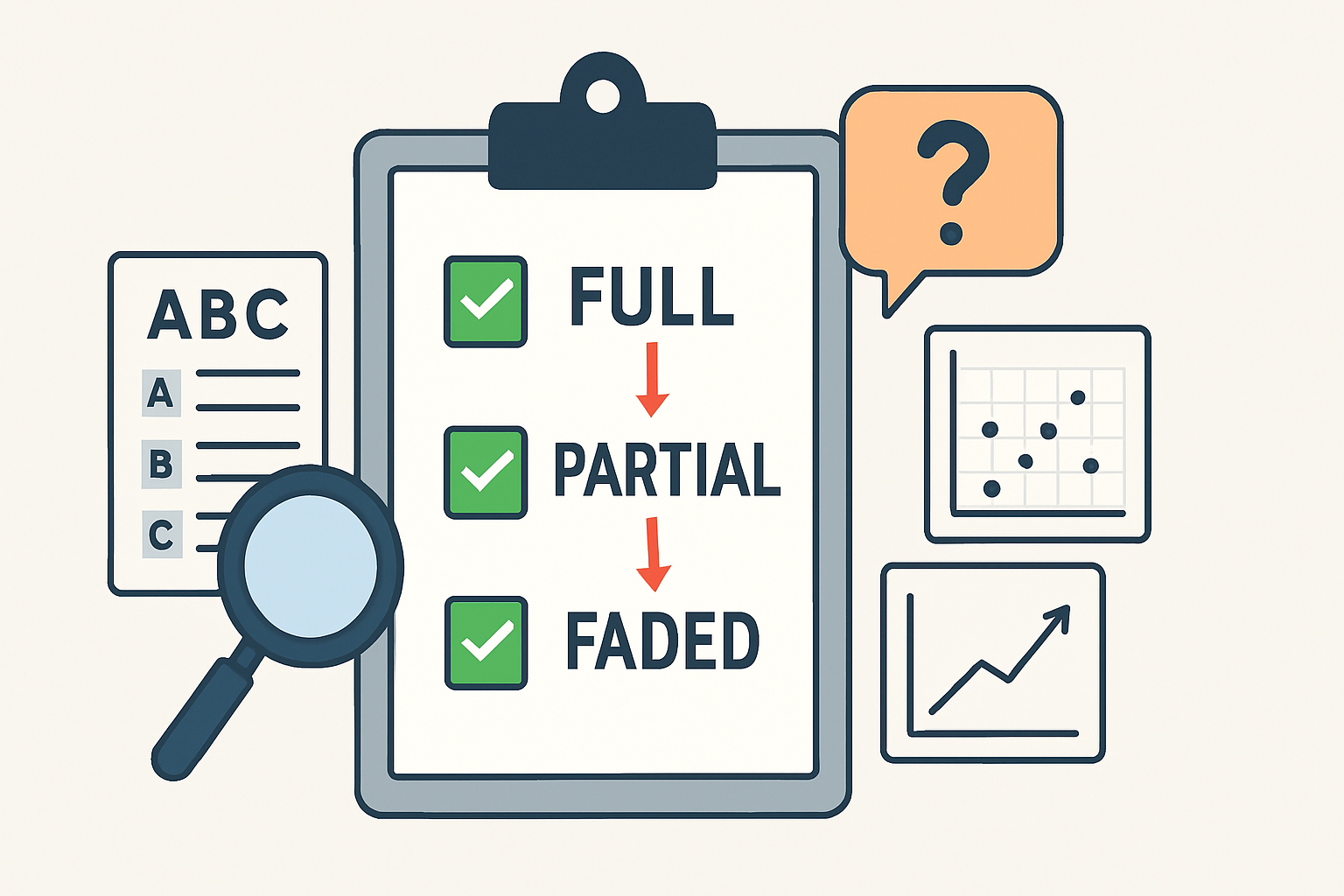
Prompt fading is the systematic reduction of support to promote independence. Without proper fading, learners may develop prompt dependency, relying on cues they no longer need.
Systematic Fading Procedures
Effective fading methods include:
- Time delay: Constant (same delay each trial) or progressive (increasing delay)
- Increasing latency: Gradually lengthening time between instruction and prompt
- Decreasing intensity: Reducing physical pressure or verbal volume
- Stimulus fading: Gradually changing prompt characteristics
Each method requires careful data collection to monitor progress and adjust as needed.
Ethical Pitfalls and Common Exam Traps
Creating prompt dependency violates ethical principles of promoting autonomy and dignity. Common exam traps include:
- Confusing prompt fading with shaping (which changes response topography)
- Misidentifying a prompt as a reinforcer
- Selecting wrong initial prompt level based on learner assessment
- Failing to pair prompts with reinforcement
For more on ethical considerations, see our guide on ethics in ABA practice.
Prompt Levels on the BCBA® Exam: What to Know
Exam questions often test hierarchy knowledge, procedure selection, and fading implementation. Understanding these concepts is essential for Domain D: Intervention.
Quick-Reference Checklist for Clinical Practice
- Always pair prompts with appropriate reinforcement
- Select initial prompt level based on thorough learner assessment
- Develop fading plan BEFORE intervention begins
- Collect data on prompt level required for each trial
- Fade prompts at first appropriate opportunity
- Monitor for prompt dependency signs
Sample Exam-Style Practice Prompts
1. Which prompt hierarchy order is correct from most to least intrusive?
- A) Verbal, Model, Gestural, Physical
- B) Physical, Model, Gestural, Verbal
- C) Gestural, Physical, Verbal, Model
- D) Model, Physical, Verbal, Gestural
2. When teaching a new motor skill to a learner with significant support needs, which prompting procedure is typically most appropriate?
- A) Least-to-most prompting
- B) Most-to-least prompting
- C) Simultaneous prompting
- D) No prompting needed
3. A practitioner notices a learner only responds when given a full verbal prompt, even after weeks of intervention. This likely indicates:
- A) Successful skill acquisition
- B) Need for stronger reinforcement
- C) Prompt dependency developing
- D) Natural maintenance occurring
For additional practice with behavior analytic concepts, explore our free BCBA mock exam questions.
Mastering prompt levels requires understanding both the hierarchy and implementation strategies. Effective practitioners select appropriate procedures, implement systematic fading, and avoid ethical pitfalls. For further study on related concepts, review errorless learning and stimulus control. The BACB provides additional resources on ethical implementation of prompting procedures.



