

In applied behavior analysis, effective teaching requires balancing support with independence. A prompt hierarchy provides a systematic framework for delivering assistance during skill acquisition. This structured approach ensures learners receive just enough support to succeed while gradually building independence.
Table of Contents
- prompt hierarchy ABA: What is a Prompt Hierarchy in ABA?
- Applying Prompt Hierarchies: Worked ABA Examples
- Prompt Hierarchy on the BCBA Exam
- Summary and Key Takeaways
Understanding prompt hierarchies is essential for both clinical practice and BCBA exam preparation. This guide breaks down the concept with practical examples and implementation strategies.
prompt hierarchy ABA: What is a Prompt Hierarchy in ABA?
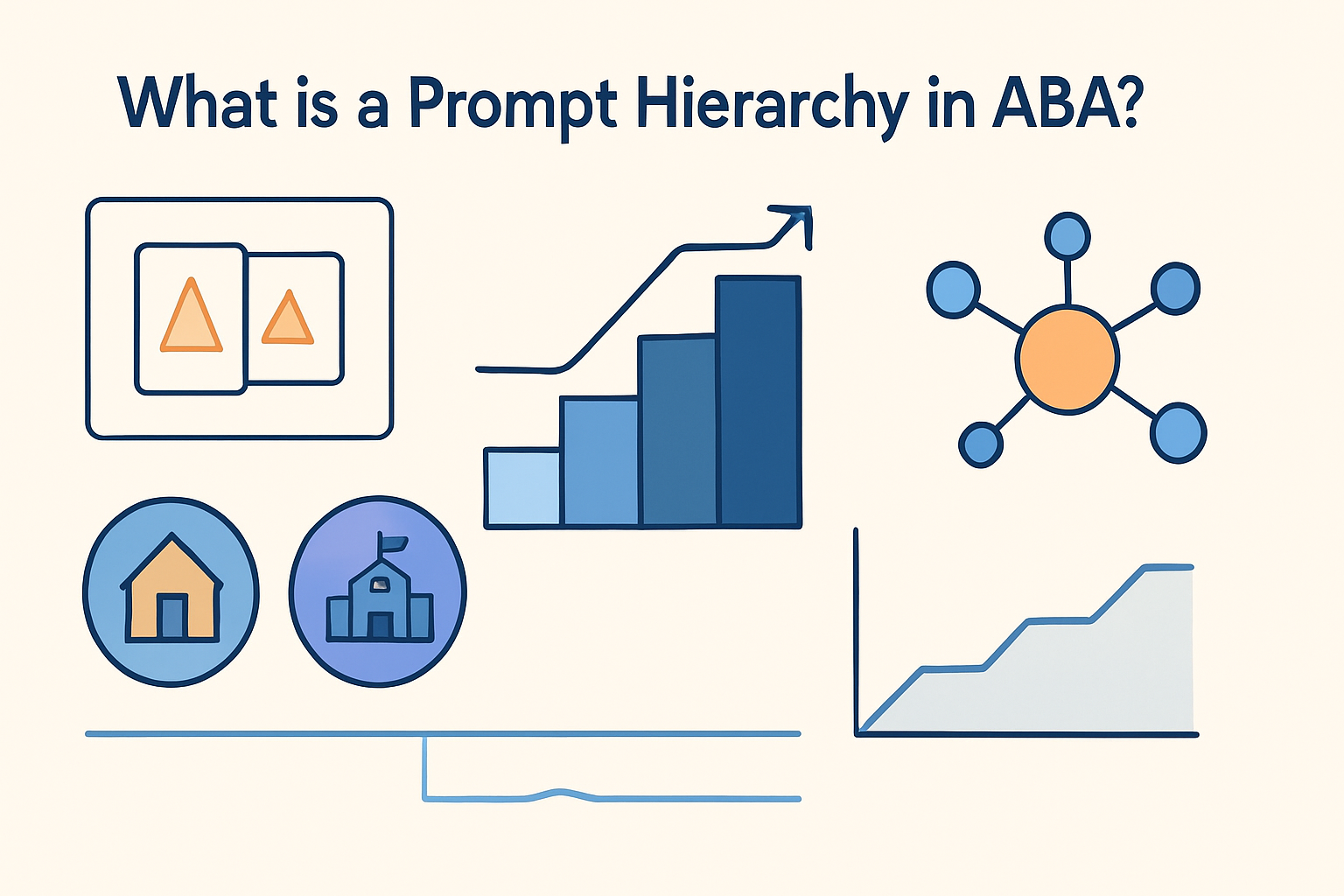
A prompt hierarchy organizes different types of assistance along a continuum from least to most intrusive. The fundamental principle is to use the least intrusive prompt necessary for the learner to complete the target behavior successfully.
This systematic approach prevents prompt dependence and promotes skill acquisition through gradual fading of support.
From Least to Most Intrusive: The Hierarchy Order
Prompt hierarchies typically follow this progression:
- Independence: No prompts needed; the learner performs the skill independently
- Gestural prompt: Nonverbal cues like pointing, nodding, or eye gaze
- Verbal prompt: Spoken instructions, questions, or hints
- Visual prompt: Pictures, written words, schedules, or other visual supports
- Model prompt: Demonstrating the correct behavior for imitation
- Partial physical prompt: Light touch or guidance on part of the movement
- Full physical prompt: Hand-over-hand assistance through the entire behavior
The goal is always to fade prompts systematically toward independence.
Why Hierarchy Matters: Autonomy and Effective Teaching
Proper prompt implementation respects learner autonomy while ensuring skill acquisition. Using least-to-most prompting minimizes unnecessary assistance and prevents prompt dependence.
This approach aligns with errorless learning principles and ethical practice standards. It also supports generalization by teaching skills in the most natural context possible.
Applying Prompt Hierarchies: Worked ABA Examples
Practical implementation requires careful planning and data collection. These examples demonstrate how to apply prompt hierarchies in different contexts.
Example 1: Teaching a Child to Wash Hands
This skill acquisition program targets a daily living skill with clear steps. The task analysis includes: turn on water, wet hands, get soap, rub hands, rinse, turn off water, dry hands.
Initial teaching begins with full physical prompts for each step. Data collection shows the learner needs hand-over-hand assistance for steps 3-5. After three successful trials, prompts fade to partial physical (light touch on wrist).
ABC data reveals: Antecedent = ‘Time to wash hands’, Behavior = Stands at sink without initiating, Consequence = Technician provides prompt. The hypothesized function is escape/avoidance of the task demand.
Prompt fading continues systematically: model prompt (technician demonstrates), then visual prompt (picture sequence), then gestural prompt (pointing to next step), finally independence. This gradual approach builds confidence while addressing the avoidance function.
Example 2: Teaching an Adult to Use a Coffee Maker
This vocational skill targets workplace independence. The task analysis includes: measure coffee, add water, place filter, start machine, wait for completion, pour coffee.
Initial assessment shows the learner can complete steps 1-3 independently but struggles with steps 4-6. Teaching begins with model + verbal prompts for the challenging steps.
ABC data pattern: Antecedent = Instruction to make coffee, Behavior = Completes first three steps then stops, Consequence = Supervisor provides verbal reminder. The function appears to be skill deficit rather than avoidance.
Prompt fading progresses from verbal prompts (‘Press the start button’) to gestural prompts (pointing to the button) to independence. Data collection tracks prompt levels needed across trials, with reinforcement provided for independent completion.

Prompt Hierarchy on the BCBA Exam
Exam questions often test your ability to select appropriate prompt types and implement fading procedures correctly. Understanding common traps can help you avoid mistakes.
Common Exam Traps and Misconceptions
Several areas frequently trip up candidates:
- Confusing prompt types: Mistaking model prompts (demonstration) for gestural prompts (pointing)
- Forgetting prompt fading: Failing to plan systematic reduction of assistance over time
- Inappropriate hierarchy selection: Using most-to-least prompting when least-to-most is more appropriate
- Ethical oversights: Not obtaining assent for physical prompts or using overly intrusive prompts unnecessarily
- Data collection errors: Not tracking prompt levels or confusing prompt level with independence criteria
These mistakes often stem from misunderstanding the fundamental purpose of prompting: to provide temporary support that fades as skills develop.
Quick-Reference Implementation Checklist
Use this checklist for exam recall and clinical implementation:
- Complete a task analysis of the target skill
- Select appropriate starting prompt level based on baseline data
- Plan fading steps in advance with clear criteria
- Collect data on prompt level needed for each trial
- Fade prompts systematically based on performance data
- Monitor for prompt dependence and adjust as needed
- Program for generalization across settings and people
- Ensure treatment integrity by training staff on prompt procedures
This systematic approach ensures effective skill acquisition while minimizing prompt dependence. For more on systematic teaching procedures, see our guide on errorless learning in ABA.
Summary and Key Takeaways
Prompt hierarchies provide a structured framework for skill acquisition in ABA. The core principle is using the least intrusive prompt necessary while planning systematic fading toward independence.
Key points to remember:
- Prompt hierarchies progress from least to most intrusive assistance
- Systematic fading prevents prompt dependence and promotes independence
- Data collection on prompt levels guides decision-making
- Ethical implementation requires assent and respect for learner autonomy
- Exam questions often test prompt type identification and fading procedures
Effective prompting balances support with independence, respecting the learner’s dignity while building essential skills. For comprehensive exam preparation, explore our BCBA exam prep guide and review the BACB Task List for prompt-related content areas.
Mastering prompt hierarchies enhances both clinical effectiveness and exam performance by demonstrating systematic, data-driven teaching approaches.


