
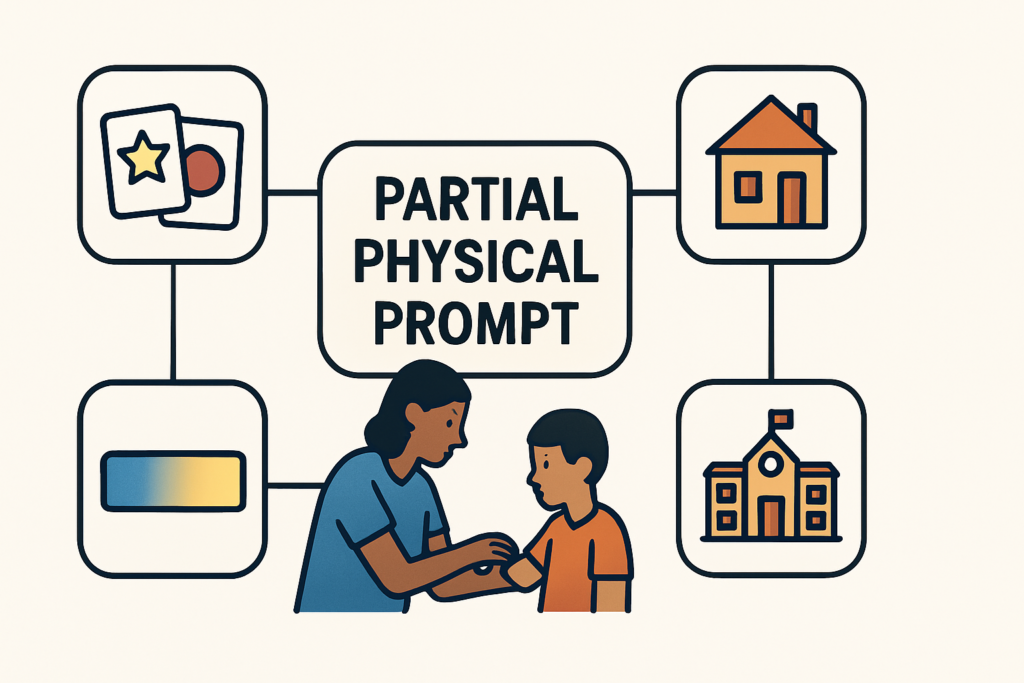
A partial physical prompt represents a crucial intervention tool in applied behavior analysis, bridging the gap between verbal guidance and full physical assistance. This specific prompting technique involves providing light physical guidance to initiate part of a motor response while allowing the learner to complete the remainder independently. Understanding when and how to use this prompt effectively requires both technical knowledge and ethical sensitivity.
Table of Contents
- Defining the Partial Physical Prompt in ABA
- Applying Partial Physical Prompts: Worked Examples
- Ethics, Dignity, and the Path to Fading
- BCBA Exam Focus: Common Traps and Practice
- Final Summary and Key Takeaways
Defining the Partial Physical Prompt in ABA
In ABA terminology, a partial physical prompt involves minimal physical contact to assist with the beginning of a motor response. Unlike full physical prompts that guide the entire movement, partial prompts provide just enough assistance to initiate the action. This distinction is critical for both clinical practice and exam preparation.
What Exactly is a Partial Physical Prompt?
A partial physical prompt is defined as a response prompt that uses light touch or minimal guidance to help initiate part of a motor behavior. The practitioner might gently touch the back of a hand, provide slight pressure at the elbow, or offer minimal guidance to start a movement sequence. This differs significantly from hand-over-hand assistance, which constitutes a full physical prompt where the practitioner guides the entire movement.
Common examples include a light tap on the wrist to initiate reaching, gentle pressure on the shoulder to begin sitting, or minimal guidance at the elbow to start a brushing motion. The key characteristic is that the learner completes most of the movement independently once initiated.
Its Role in Prompting Hierarchies
Partial physical prompts occupy a specific position within prompting hierarchies. In least-to-most prompting sequences, they typically follow gestural or model prompts but precede full physical assistance. This placement reflects their moderate level of intrusiveness while maintaining learner independence.
Within most-to-least prompting approaches, partial physical prompts serve as an intermediate step when fading from full physical assistance toward independence. Their strategic placement allows for systematic reduction of support while maintaining successful responding.
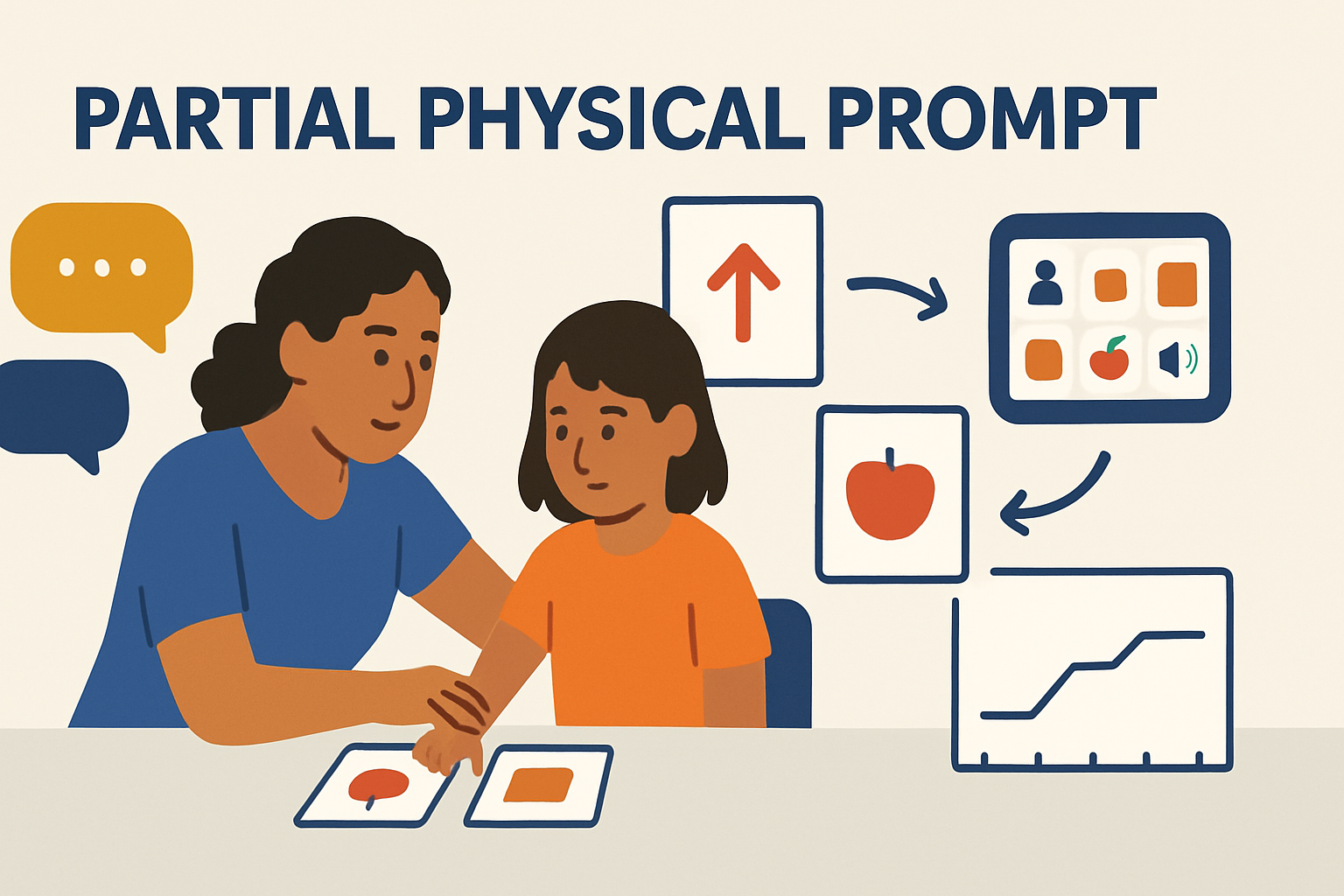
Applying Partial Physical Prompts: Worked Examples
Understanding partial physical prompts requires seeing them in action. These concrete examples demonstrate how this prompting technique functions within real therapeutic contexts.
Example 1: Teaching a Child to Use Scissors
Let’s examine a common teaching scenario using the ABC framework:
- Antecedent: The therapist presents scissors and paper with a dotted line, saying “Cut on the line.”
- Behavior: The child attempts to cut but struggles with the squeezing motion.
- Consequence: The therapist provides a partial physical prompt – a light touch on the back of the child’s hand to initiate the squeezing motion, followed by praise when the cut is completed.
The partial physical prompt here involves minimal contact to start the motor sequence. The child completes the cutting motion independently once initiated. This approach respects the learner’s autonomy while providing necessary support.
Example 2: Assisting an Adult with Toothbrushing
For chained tasks like toothbrushing, partial physical prompts can support independence while maintaining dignity:
- Antecedent: The client is at the sink with toothpaste applied to the brush.
- Behavior: The client needs to initiate the circular brushing motion.
- Consequence: The practitioner provides gentle guidance at the elbow to start the first few circular strokes, then fades the prompt as the client continues independently.
This example highlights how partial physical prompts can support functional independence while respecting client dignity. The prompt is faded quickly to avoid dependency.
Ethics, Dignity, and the Path to Fading
Using physical prompts requires careful ethical consideration. The BACB Ethics Code emphasizes client dignity and the importance of using the least intrusive effective interventions. Partial physical prompts must always be implemented with these principles in mind.
Prioritizing Client Assent and Autonomy
Before implementing any physical prompt, practitioners must obtain informed assent. This involves explaining what will happen, why it’s necessary, and obtaining agreement from the client when possible. For clients with communication challenges, assent should be monitored through ongoing observation of comfort signals and withdrawal behaviors.
The BACB Ethics Code specifically addresses physical guidance in Section 2.0, emphasizing that interventions must respect client rights and avoid harmful procedures. A partial physical prompt should never feel coercive or restrictive – it’s a teaching tool, not a control mechanism.
A Systematic Plan for Fading the Prompt
Failure to fade prompts constitutes an ethical concern. Effective fading strategies for partial physical prompts include:
- Reducing pressure intensity: Gradually decreasing the amount of physical contact
- Shifting to spatial prompts: Moving from physical touch to gestural guidance
- Implementing time delay: Increasing the wait time before providing the prompt
- Changing prompt location: Moving from direct contact to nearby guidance
Each fading strategy should be documented and monitored for effectiveness. The goal is always to move toward independent responding as quickly as possible.

BCBA Exam Focus: Common Traps and Practice
BCBA exam questions often test subtle distinctions between prompt types. Understanding these nuances is essential for exam success and clinical competence.
Key Distinctions Exam Writers Test
Common exam traps include:
- Confusing partial vs. full physical: Remember that partial involves minimal guidance to initiate, while full guides the entire movement
- Misidentifying model prompts: A demonstration without physical contact is a model, not a physical prompt
- Overlooking less intrusive options: According to least-to-most prompting principles, you should try gestural or verbal prompts first
- Ignoring prompt fading: Exam questions often test whether you recognize when prompts should be systematically reduced
These distinctions are crucial for both exam success and ethical practice. For more on ethical considerations in ABA, see our guide on ethics in ABA practice.
Quick-Reference Implementation Checklist
Use this checklist when considering partial physical prompts:
- Motor skill barrier? Is the primary challenge physical/motor rather than cognitive?
- Less intrusive attempts? Have gestural, model, or verbal prompts been tried and proven insufficient?
- Assent obtained? Has the client (or guardian) provided informed assent for physical guidance?
- Fading plan documented? Is there a clear, measurable plan to reduce and eliminate the prompt?
- Minimal force used? Are you using the least amount of physical contact necessary?
- Data collected? Are you tracking prompt levels and independence measures?
This checklist ensures both clinical effectiveness and ethical compliance. For additional study resources, consider our BCBA mock exam materials.
Final Summary and Key Takeaways
Partial physical prompts serve as valuable tools when used appropriately and ethically. They bridge the gap between verbal guidance and full physical assistance, supporting skill acquisition while respecting learner autonomy. The key to effective implementation lies in understanding their specific definition, applying them strategically within prompting hierarchies, and always planning for systematic fading.
Remember that ethical use requires ongoing assent monitoring, documentation of fading procedures, and regular evaluation of effectiveness. For authoritative guidance on physical prompting, consult the BACB Ethics Code and research on prompting procedures.
Mastering partial physical prompts requires both technical knowledge and clinical judgment. By understanding their proper application and ethical considerations, practitioners can effectively support skill development while maintaining the highest standards of care.


