
What is Partial Interval Recording? Definition and Core Concept
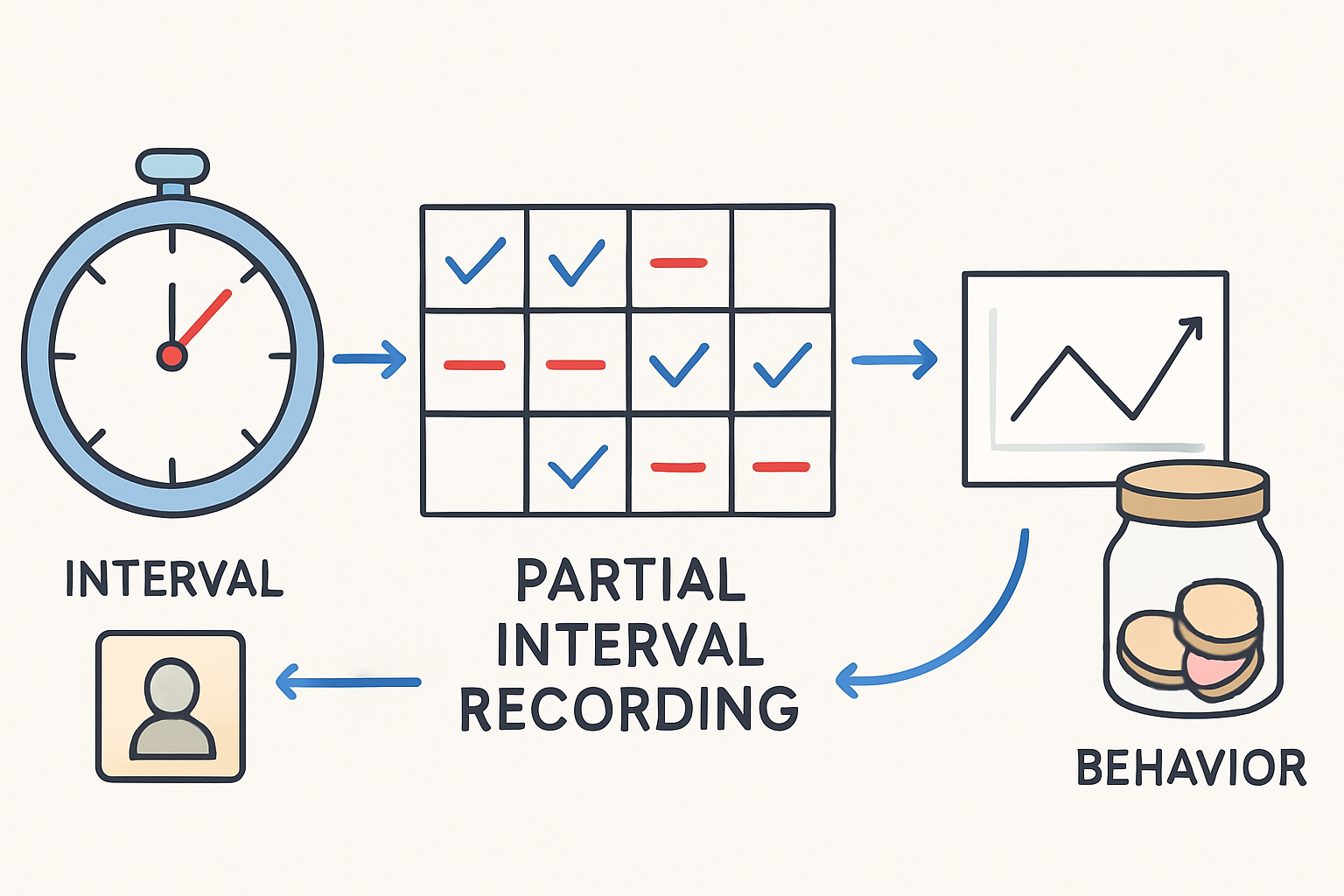
Partial interval recording is a time sampling measurement procedure where an interval is scored if the target behavior occurs at any point during that interval. This method provides an estimate of behavior occurrence rather than exact duration or frequency.
Table of Contents
- What is Partial Interval Recording? Definition and Core Concept
- Applying Partial Interval Recording: Worked ABA Examples
- BCBA Exam Focus: Common Traps and How to Avoid Them
- Quick Implementation Checklist for Practitioners
- Summary and Key Takeaways for Your Study Sheet
The core concept revolves around dividing observation periods into equal intervals and recording whether the behavior happened at least once during each interval.
The Basic Rule: Scoring an Interval
In partial interval recording, you score an interval as ‘occurred’ if the target behavior happens at any moment within that time segment. Even a brief, one-second occurrence during a 10-second interval means the entire interval gets marked.
Consider this timeline: A 5-minute session divided into 10-second intervals. If humming occurs for just 2 seconds during the third interval, that interval is scored. The final data shows percentage of intervals with behavior occurrence.
Partial vs. Whole Interval vs. Momentary Time Sampling
These three interval recording methods differ in their scoring criteria. Partial interval records if behavior occurs at any time during the interval. Whole interval requires the behavior to occur throughout the entire interval. Momentary time sampling checks only at specific moment endpoints.
Partial interval tends to overestimate duration because brief occurrences score entire intervals. Whole interval typically underestimates occurrence since continuous behavior is required. For low-frequency behaviors you want to decrease, partial interval offers sensitivity to small changes.
Applying Partial Interval Recording: Worked ABA Examples
Moving from theory to practice, let’s examine realistic scenarios where partial interval recording proves valuable. Each example includes ABC data collection and practical implementation details.
Example 1: Measuring Vocal Stereotypy During Seatwork
Scenario: A child engages in humming during independent seatwork. The behavior is defined as audible vocalizations not related to the task. Using 10-second intervals over a 5-minute session creates 30 intervals total.
During observation, humming occurs in intervals 2, 5, 8, 12, 15, 18, 22, 25, and 28. That’s 9 intervals scored. The calculation: (9 ÷ 30) × 100 = 30% of intervals. This percentage overestimates actual duration but shows occurrence pattern.
The hypothesized function is automatic reinforcement. The data helps track intervention effectiveness for this self-stimulatory behavior.
Example 2: Tracking Peer Attention-Seeking Behavior on the Playground
Scenario: A student calls out to peers during recess. The operational definition includes verbal initiations directed at peers without waiting for turn. Using 15-second intervals over 10 minutes yields 40 intervals.
Even one brief call-out scores an interval. If behavior occurs in 16 intervals, the result is 40% occurrence. This data informs social skills programming and helps measure progress in appropriate peer interactions.
The consequence is typically peer attention, confirming the social reinforcement function. This measurement approach captures even fleeting occurrences that might be missed with other methods.
BCBA Exam Focus: Common Traps and How to Avoid Them
The BCBA exam tests conceptual understanding beyond simple definitions. Recognizing these common exam traps will improve your performance.
Trap 1: Confusing It with Duration or Frequency
Partial interval recording measures occurrence percentage, not duration or rate. A behavior lasting 2 seconds per minute yields different data across measurement systems.
- Frequency: 1 occurrence per minute
- Duration: 2 seconds total per minute
- Partial interval: Could be 100% if it occurs in every interval
Remember: Partial interval provides an estimate of occurrence, not precise temporal measurements.
Trap 2: Misinterpreting the Data Outcome
A 50% score does NOT mean the behavior occurred for 50% of the observation time. It means the behavior occurred in 50% of intervals, which overestimates actual duration.
For accurate duration measurement, use duration recording instead. Partial interval data should be interpreted as occurrence estimates for tracking general trends and intervention effects.
Trap 3: Selecting the Wrong Measurement Procedure
Choosing between partial, whole, and momentary sampling requires understanding their different measurement purposes. Use this heuristic:
- Partial interval: Best for low-frequency behaviors targeted for decrease
- Whole interval: Appropriate for continuous behaviors you want to increase
- Momentary time sampling: Useful when continuous observation isn’t feasible
Partial interval’s sensitivity makes it valuable for detecting small changes in infrequent behaviors.
Quick Implementation Checklist for Practitioners
Use this procedural integrity checklist for accurate partial interval recording implementation:
- Define the target behavior with observable criteria
- Determine appropriate interval length (typically 10-30 seconds)
- Prepare data sheet with clear interval markings
- Score interval if behavior occurs at any point during it
- Calculate percentage of intervals with occurrence
- Interpret data as occurrence estimate, not exact duration
- Consider interobserver agreement procedures for reliability
For comprehensive data collection strategies, explore our guide on data collection methods in ABA.
Summary and Key Takeaways for Your Study Sheet
Mastering partial interval recording requires understanding both its applications and limitations. Here are the essential points:
- Scoring criterion: Behavior occurs at any time during interval
- Output data: Percentage of intervals with occurrence
- Key characteristic: Overestimates duration of behavior
- Best application: Low-frequency behaviors targeted for decrease
- Common confusion: Not interchangeable with duration recording
- Exam focus: Understanding when to select this measurement procedure
For additional study resources on measurement concepts, check our BCBA exam preparation guide. The BACB’s task list provides official guidance on measurement requirements.
Remember that effective measurement drives data-based decision making in ABA practice. Partial interval recording offers a practical balance between accuracy and feasibility for tracking behavior occurrence patterns.



