
What is Partial Interval Recording?
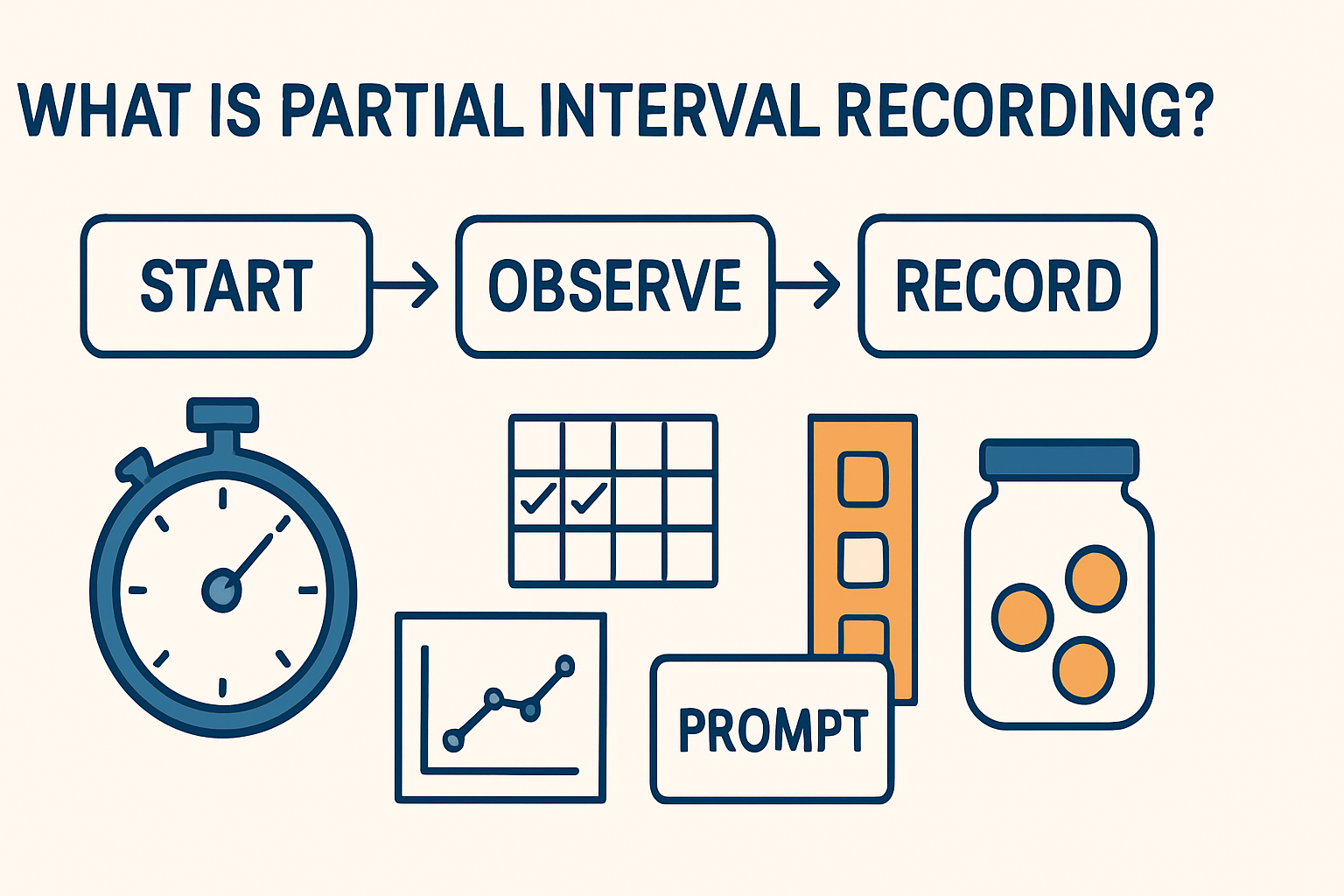
Partial interval recording is a discontinuous measurement system used in applied behavior analysis to track behavior occurrence. This method divides an observation period into brief, equal intervals and records whether the target behavior occurred at any point during each interval.
Table of Contents
- What is Partial Interval Recording?
- Applying Partial Interval Recording: Worked ABA Examples
- Partial Interval Recording and the BCBA Exam
- Summary and Key Takeaways
The core procedure involves marking an interval as ‘occurred’ if the behavior happens even briefly within that time segment. This approach tends to overestimate actual duration but provides practical data when continuous measurement isn’t feasible.
Definition and Core Procedure
In partial interval recording, observers divide the total observation time into short intervals (typically 10-60 seconds). They then record whether the target behavior occurred at any moment during each interval. The key differentiator is the ‘at any point‘ criterion – if the behavior happens even briefly, the entire interval counts as an occurrence.
This measurement system is particularly useful for behaviors with high frequency or those that occur in bursts. Since it only requires noting presence or absence within intervals, it’s less demanding than continuous recording methods. However, practitioners must recognize it provides an overestimation of actual behavior duration.
Partial Interval vs. Whole Interval vs. Momentary Time Sampling
Understanding how partial interval recording differs from other discontinuous measurement systems is crucial for proper application and exam success.
- Partial interval recording marks an interval if behavior occurs at any point during it. This method overestimates duration and is best for behaviors you want to decrease.
- Whole interval recording requires the behavior to occur throughout the entire interval. This approach underestimates duration and works well for behaviors you want to increase.
- Momentary time sampling records whether behavior is occurring at the exact moment each interval ends. This provides an estimation of occurrence and works for moderate-frequency behaviors.
The choice between these systems depends on your measurement goals, behavior frequency, and available observation resources. Partial interval recording’s tendency to overestimate makes it particularly suitable for tracking behaviors targeted for reduction.
Applying Partial Interval Recording: Worked ABA Examples
Practical application solidifies understanding of measurement systems. These examples demonstrate how partial interval recording works in real ABA scenarios.
Example 1: Tracking Vocal Stereotypy During Group Instruction
Scenario: A student engages in humming during independent seatwork. You conduct a 10-minute observation using 30-second intervals.
Data collection shows humming occurred in 8 out of 20 intervals. This yields a 40% occurrence rate. The ABC analysis reveals: Antecedent = independent seatwork, Behavior = humming, Consequence = sensory automatic reinforcement.
This data informs intervention planning. Since partial interval recording shows the behavior occurs frequently, you might implement alternative sensory activities or response interruption strategies. The measurement system’s overestimation bias is acceptable here because you’re tracking a behavior targeted for reduction.
Example 2: Measuring Attention-Seeking Interruptions
Scenario: A client makes off-topic comments during 1:1 therapy sessions. You observe for 15 minutes using 1-minute intervals.
The data sheet shows interruptions in 12 of 15 intervals. The ABC analysis indicates: Antecedent = therapist attending to sibling, Behavior = interruption, Consequence = therapist attention (social positive reinforcement).
Partial interval recording is particularly suitable here because the behavior has high frequency and you want to measure occurrence for intervention planning. The data supports implementing differential reinforcement strategies or teaching functional communication skills as alternatives to interruption behaviors.
Partial Interval Recording and the BCBA Exam
Understanding measurement systems is essential for BCBA exam success. Partial interval recording questions test your ability to select appropriate measurement procedures and interpret data correctly.
Common Exam Question Formats and Traps
BCBA exam questions often present scenarios requiring measurement system selection. Common traps include:
- Confusing measurement systems: Mixing up partial interval with whole interval or momentary time sampling criteria
- Misidentifying application contexts: Choosing partial interval for skill acquisition or duration measurement instead of behavior reduction
- Calculation errors: Miscalculating percentage of intervals or misinterpreting what the data represents
- Overlooking measurement limitations: Failing to recognize that partial interval recording overestimates actual behavior duration
Exam questions may describe a behavior with specific characteristics and ask which measurement system would be most appropriate. Remember that partial interval recording works best for high-frequency behaviors targeted for reduction when continuous measurement isn’t practical.
Quick Decision Checklist for Exam Scenarios
Use this checklist when encountering measurement system questions on the BCBA exam:
- Is the behavior high frequency or occurring in bursts?
- Is the primary goal to measure occurrence for a behavior targeted for decrease?
- Would continuous measurement be impractical due to observer constraints?
- Are you willing to accept some overestimation of actual duration?
- Do you need data on when the behavior occurs rather than exact duration?
If you answer ‘yes’ to most questions, partial interval recording may be appropriate. For contrasting scenarios, consider other data collection methods like whole interval recording for skill acquisition or momentary time sampling for moderate-frequency behaviors.
Summary and Key Takeaways
Partial interval recording serves as a valuable tool in ABA practice when used appropriately. Key points to remember include:
- It’s a discontinuous measurement system that divides observation time into intervals
- The system records behavior if it occurs at any point during each interval
- Partial interval recording tends to overestimate actual duration of behavior
- It’s most appropriate for high-frequency behaviors targeted for reduction
- On the BCBA exam, distinguish it clearly from whole interval recording and momentary time sampling
- Always consider the measurement goals and behavior characteristics when selecting systems
For further study on related ABA concepts, explore our guides on functional behavior assessment and differential reinforcement procedures. The BACB Task List provides additional guidance on measurement requirements for certification.



