
Understanding negative punishment is essential for any behavior analyst preparing for the BCBA exam. This operant conditioning principle involves the removal of a stimulus following a behavior, which decreases the likelihood of that behavior occurring again in the future. Mastering this concept requires distinguishing it from similar procedures like positive punishment and extinction.
Table of Contents
- negative punishment definition: What is Negative Punishment? A Core ABA Definition
- Negative Punishment in Practice: Worked ABA Examples
- Negative Punishment on the BCBA Exam: What to Watch For
- Summary and Key Takeaways
negative punishment definition: What is Negative Punishment? A Core ABA Definition
Negative punishment occurs when a stimulus is removed after a behavior, resulting in a future decrease in that behavior’s frequency. The term ‘negative’ refers to the removal aspect, while ‘punishment’ indicates the behavior-reducing effect.
The Key Components: Removal and Decrease
The definition contains two critical elements. First, there must be stimulus removal – something is taken away from the environment. Second, this removal must lead to a behavior reduction over time. The basic formula is: Behavior → Removal of Stimulus → Decreased Future Behavior.
Negative Punishment vs. Other Operant Contingencies
Students often confuse negative punishment with similar concepts. Here’s a clear comparison:
- Negative Punishment: Removing a stimulus to decrease behavior
- Positive Punishment: Adding a stimulus to decrease behavior
- Negative Reinforcement: Removing a stimulus to increase behavior
- Extinction: Withholding reinforcement (not removing) to decrease behavior
The key distinction lies in both the operation performed (add vs. remove) and the behavioral effect (increase vs. decrease).
Negative Punishment in Practice: Worked ABA Examples
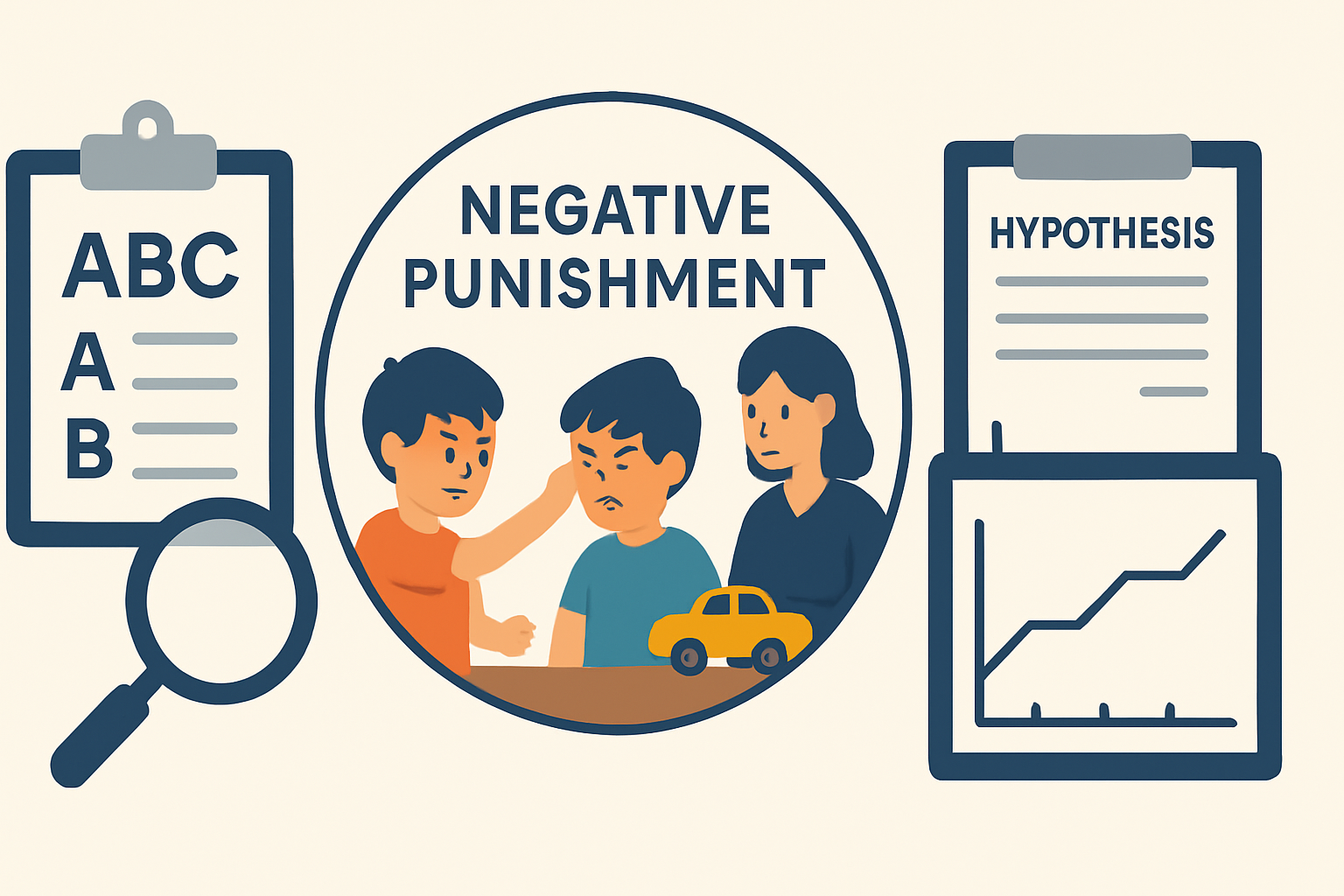
Real-world applications help solidify understanding. Each example includes ABC data and the hypothesized behavioral function.
Example 1: Time-Out from Positive Reinforcement (Toy Removal)
A child hits peers during playtime to access preferred toys. The behavior analyst implements a time-out procedure where the toy is removed for two minutes following hitting.
- Antecedent: Preferred toy present, peers playing
- Behavior: Hitting peer
- Consequence: Toy removed (time-out)
- Function: Tangible access
- Result: Future hitting decreases due to toy removal
This demonstrates negative punishment because removal of the toy (a positive reinforcer) decreases the hitting behavior.
Example 2: Response Cost (Loss of Token or Privilege)
In a classroom token economy, a student calls out without raising their hand. The teacher removes one token from the student’s board.
- Antecedent: Teacher asking questions, peers present
- Behavior: Calling out without raising hand
- Consequence: Token removed from board
- Function: Peer attention
- Result: Future calling out decreases due to token loss
This represents response cost, a common negative punishment procedure where a generalized conditioned reinforcer is removed.
Example 3: A Common Misapplication (Is This Really Negative Punishment?)
A parent turns off a loud TV because their child is screaming. The screaming stops immediately. Many would incorrectly label this as negative punishment for the child.
Actually, this is negative reinforcement for the parent. The parent’s behavior (turning off TV) increases because it removes the aversive screaming sound. For the child, if screaming decreases because TV removal was punishing, that would require demonstrating a future decrease in screaming when similar situations occur.
Negative Punishment on the BCBA Exam: What to Watch For
The BACB frequently tests this concept through scenario-based questions. Understanding common traps is crucial for exam success.
Common Exam Traps and Misleading Distractors
Several patterns appear repeatedly on the exam:
- Confusing extinction with negative punishment: Extinction withholds reinforcement; negative punishment removes a stimulus
- Misidentifying the ‘negative’ component: Focusing on the aversive quality rather than the removal operation
- Overlooking behavioral function: Failing to consider what maintains the behavior before classifying consequences
- Timing errors: Not recognizing that punishment effects are defined by future behavior changes
For more on distinguishing behavioral procedures, see our guide on positive vs. negative punishment.
A Quick-Reference Checklist for Identification
Use this step-by-step approach for exam questions:
- Identify the target behavior that occurred
- Determine if a stimulus was removed following the behavior
- Check if this removal leads to decreased future occurrence of the behavior
- Verify it’s not negative reinforcement (which increases behavior)
- Confirm it’s not extinction (which withholds rather than removes)
If all criteria are met, you’re dealing with negative punishment. For additional exam strategies, explore our BCBA exam prep guide.
Summary and Key Takeaways
Negative punishment remains a fundamental concept in applied behavior analysis. Remember these essential points:
- Negative punishment involves stimulus removal to decrease behavior
- Common procedures include time-out and response cost
- The effect is defined by future behavior reduction, not immediate stopping
- Always consider the behavioral function before selecting interventions
- Ethical implementation requires considering side effects and alternatives
When using negative punishment in practice, behavior analysts must follow ethical guidelines and consider less restrictive alternatives first. The BACB’s Ethics Code for Behavior Analysts provides essential guidance on punishment procedures.
For comprehensive understanding of related concepts, review negative reinforcement and punishment ethics to build a complete conceptual framework.



