
What is Generalization in ABA? Beyond the Textbook Definition
Generalization in ABA refers to the transfer of learned behavior to new situations, people, or settings beyond the original teaching context. This concept is fundamental because skills that don’t generalize aren’t truly functional in a client’s daily life.
Table of Contents
- What is Generalization in ABA? Beyond the Textbook Definition
- Programming for Generalization: From Theory to Practice
- Generalization on the BCBA Exam: Common Traps and How to Avoid Them
- Final Summary: Making Generalization Work in Practice
Many BCBA exam questions test your ability to distinguish generalization from related concepts like maintenance. Understanding this distinction is crucial for both clinical practice and exam success.
Key Types of Generalization for the BCBA Exam
You’ll encounter three main types of generalization on the exam, each with distinct characteristics:
- Stimulus generalization: The behavior occurs in the presence of different stimuli than those present during training. For example, a child who learns to say ‘please’ with their therapist also says it with parents and teachers.
- Response generalization: The learner emits different but functionally equivalent responses to achieve the same outcome. A student might ask for help by raising their hand, saying ‘I need assistance,’ or using a help card.
- Maintenance: The behavior persists over time under the same conditions where it was originally taught. This is often confused with generalization but involves no change in environmental variables.
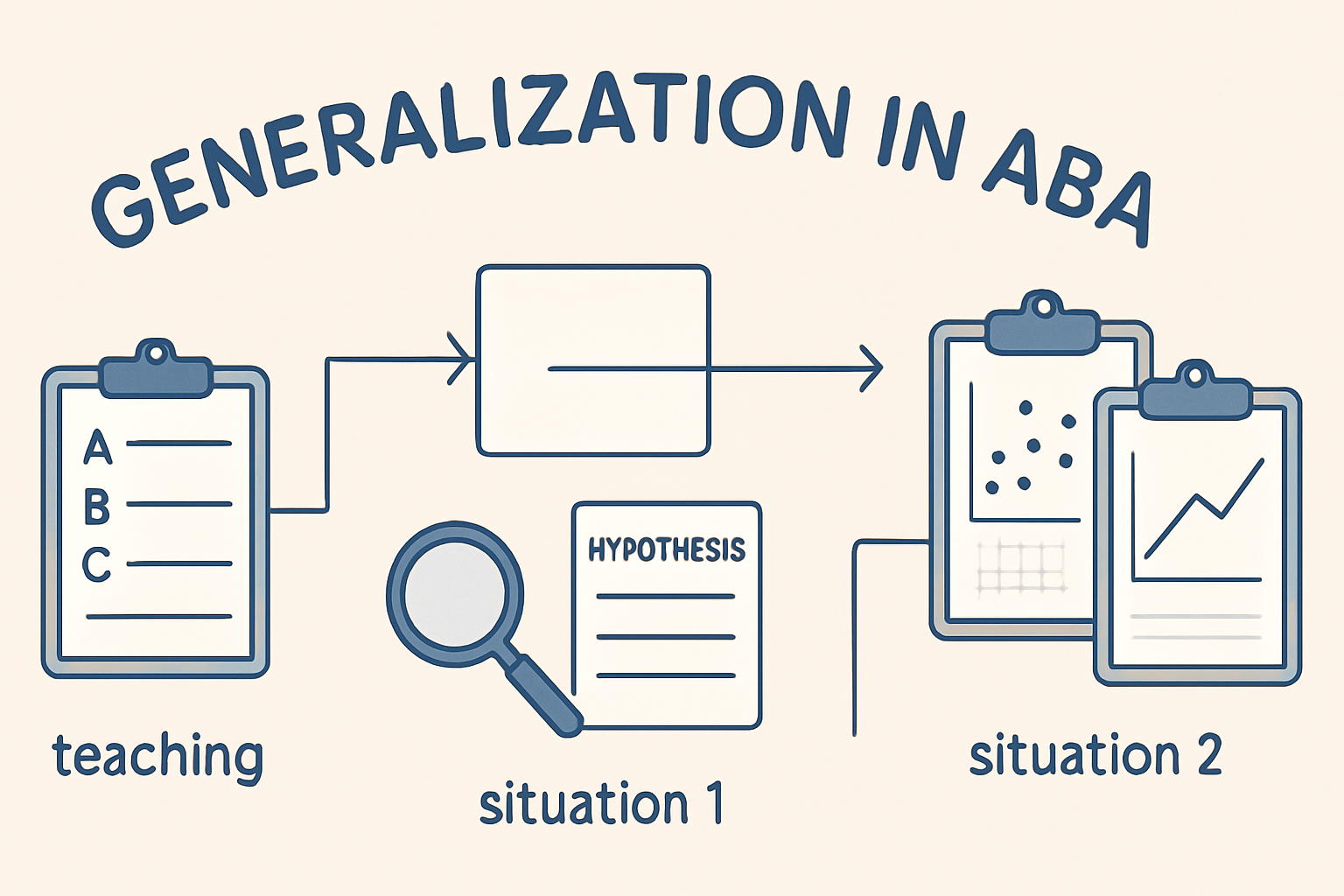
Why Generalization is the Measure of True Behavior Change
The BACB emphasizes that meaningful outcomes require behaviors to occur across relevant contexts. Without generalization, skills remain limited to artificial teaching environments.
Consider this ethical imperative: If a child only follows instructions with their primary therapist, the intervention hasn’t achieved its social significance. True mastery requires the behavior to transfer naturally to everyday situations.
Programming for Generalization: From Theory to Practice
Effective practitioners don’t hope for generalization—they program for it systematically. This proactive approach distinguishes competent behavior analysts from those who merely teach discrete skills.
Generalization programming involves strategic planning from the beginning of intervention, not as an afterthought. Let’s examine concrete examples that mirror real clinical scenarios.
Worked Example 1: Teaching Greetings Across People and Settings
A client learns to say ‘Hi’ during discrete trial training with their therapist (R1). The initial ABC analysis shows:
- Antecedent: Therapist says ‘Say hi’ while making eye contact
- Behavior: Client says ‘Hi’
- Consequence: Therapist provides praise and a high-five
The hypothesized function is social reinforcement. To program for generalization:
- Stimulus generalization: Teach greetings with parents, siblings, and peers
- Response generalization: Accept ‘Hello,’ ‘Hey,’ or a wave as equivalent responses
- Setting generalization: Practice at the park, in the car, and during community outings
Worked Example 2: Functional Communication Training (FCT) in the Classroom
A student engages in disruptive behavior during difficult math work. Through functional communication training, they learn to hand a ‘break’ card to the teacher.
The initial ABC analysis reveals:
- Antecedent: Difficult math worksheet presented
- Behavior: Hands break card to teacher
- Consequence: Teacher removes worksheet for 2-minute break
The function is clearly escape from demands. Generalization programming includes:
- Teaching the student to hand the card to a paraprofessional or different staff member
- Using different colored cards or a verbal request as alternative responses
- Applying the skill during reading time or other challenging academic tasks
A Proactive Checklist for Promoting Generalization
Use this clinical tool to ensure you’re systematically programming for generalization:
- Teach loosely: Vary your instructional materials, tone, and positioning
- Use multiple exemplars: Teach with different examples of the same concept
- Program common stimuli: Include elements from natural environments in teaching
- Train sufficient exemplars: Continue teaching until generalization occurs
- Incorporate naturally maintaining contingencies: Ensure the behavior contacts reinforcement in natural settings
Generalization on the BCBA Exam: Common Traps and How to Avoid Them
The exam frequently tests your ability to apply generalization concepts correctly. Understanding common pitfalls can help you avoid costly mistakes.
Many candidates lose points by confusing related concepts or making incorrect assumptions about how generalization occurs.
Trap #1: Confusing Generalization with Maintenance (and Vice Versa)
This is the most frequent error on generalization questions. Remember this critical distinction:
- Generalization involves behavior occurring under different conditions (new people, settings, or materials)
- Maintenance involves behavior persisting over time under the same conditions
Exam-style question: ‘A child who learned to tie shoes in therapy continues to tie shoes at home three months later.’ This describes both generalization and maintenance—generalization to the home setting and maintenance over time.
Trap #2: Overlooking the Need to Program for Generalization
The exam tests whether you understand that generalization is often not automatic. You must actively plan for it rather than assume it will occur spontaneously.
Consider this scenario: A student learns to raise their hand to ask questions during one-on-one sessions. If they don’t raise their hand in the classroom, the BCBA should have programmed for generalization by teaching in group settings from the beginning.
Practice Applying Your Knowledge
Test your understanding with these scenario-based questions:
- A child uses a picture exchange for ‘cookie’ at home with mom. What step would best promote generalization to using it with grandparents?
- A client learns to wash hands with liquid soap in the clinic bathroom. They don’t wash hands with bar soap at home. Is this a stimulus generalization or response generalization issue?
For more practice with these concepts, explore our BCBA mock exam resources that include detailed explanations of generalization scenarios.
Final Summary: Making Generalization Work in Practice
Generalization represents the ultimate goal of ABA intervention—meaningful behavior change that transfers to real-world contexts. As a behavior analyst, your responsibility extends beyond teaching discrete skills to ensuring those skills function across relevant environments.
Remember these key takeaways for both clinical practice and exam preparation:
- Always distinguish between stimulus generalization, response generalization, and maintenance
- Program for generalization proactively from the beginning of intervention
- Use systematic strategies like multiple exemplars and common stimuli
- Monitor generalization as a measure of treatment effectiveness
For further study on related concepts, review stimulus and response generalization and the seven dimensions of ABA, particularly the dimension of generality. The BACB Ethics Code also emphasizes the importance of achieving meaningful outcomes through generalization.



