
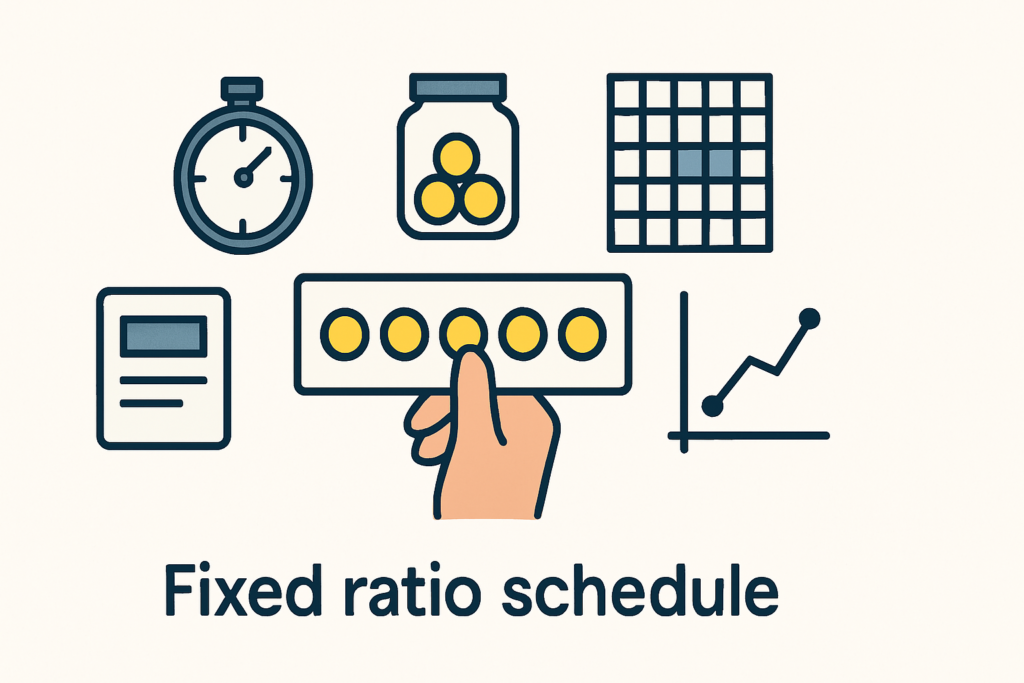
What is a Fixed Ratio Schedule of Reinforcement?
A fixed ratio schedule (FR) delivers reinforcement after a predetermined, unchanging number of responses. This schedule creates a predictable pattern where the learner knows exactly how many responses are required to earn the reinforcer.
Table of Contents
- What is a Fixed Ratio Schedule of Reinforcement?
- Fixed Ratio Schedules in Practice: Applied ABA Examples
- Fixed Ratio on the BCBA® Exam: Relevance and Common Traps
- Quick-Reference Study Checklist
- Summary and Key Takeaways
The ‘fixed’ aspect means the requirement stays constant, while ‘ratio’ indicates it’s based on response count rather than time.
The Formal Definition and Key Characteristics
According to the BACB Task List (Section B-5), a fixed ratio schedule is defined by reinforcement contingent upon a fixed number of responses. The most distinctive behavioral pattern is the post-reinforcement pause—a brief cessation of responding immediately after reinforcement delivery.
This pause occurs because the learner has just received reinforcement and must complete the entire fixed requirement again before the next opportunity.
How It Differs From Other Simple Schedules
Understanding schedule distinctions is crucial for accurate application and exam success. Here are key differences:
- Fixed Ratio vs. Variable Ratio: FR has a predictable requirement; VR varies unpredictably around an average.
- Fixed Ratio vs. Fixed Interval: FR is response-based; FI is time-based (first response after a fixed time interval).
- Fixed Ratio vs. Variable Interval: Both differ in predictability and response requirements.
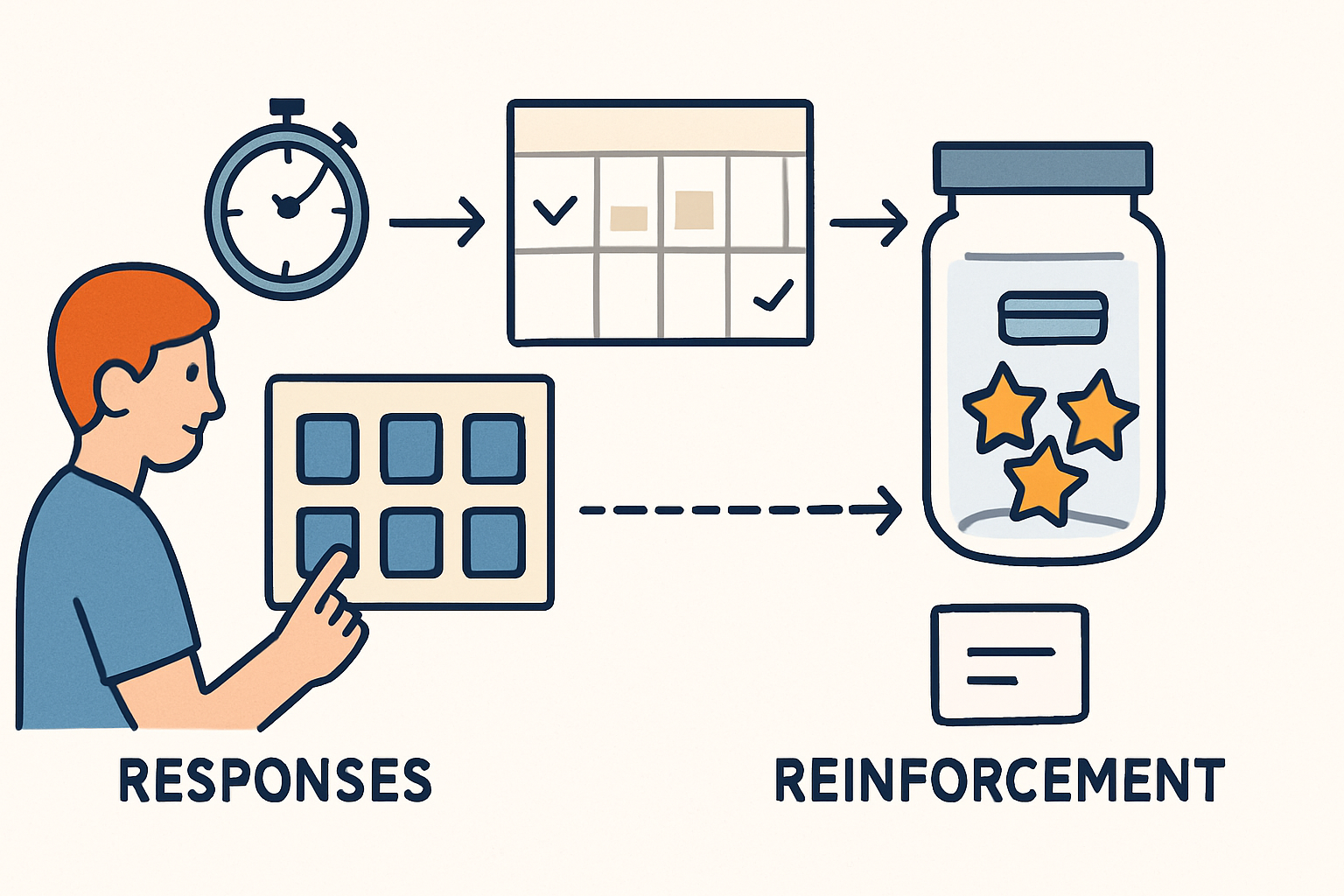
Fixed Ratio Schedules in Practice: Applied ABA Examples
Moving from theory to application, these examples demonstrate how fixed ratio schedules work in real intervention settings. Each includes ABC data and hypothesized function.
Example 1: Academic Task Completion (FR5)
A student earns a 3-minute break after completing 5 math problems independently. The antecedent is the worksheet presentation, the behavior is completing 5 problems, and the consequence is immediate break access.
The maintaining function is access to escape from academic demands, making the break a powerful negative reinforcer.
Example 2: Vocational Skill Training (FR10)
An employee receives a token after packaging 10 items correctly. This builds work endurance and links to a token economy system where tokens exchange for preferred items.
The schedule promotes consistent responding and prepares learners for natural work contingencies where payment often follows task completion.
Example 3: Behavior Reduction via DRA (FR1 to FR3)
Initially reinforcing an alternative communication response every time (FR1), then gradually moving to FR3 to promote maintenance. This schedule thinning procedure increases response persistence while reducing reinforcement density.
The process demonstrates effective use of differential reinforcement combined with schedule manipulation.
Fixed Ratio on the BCBA® Exam: Relevance and Common Traps
Understanding how fixed ratio schedules appear on the exam is essential for preparation. Questions test both identification and application knowledge.
How the Exam Tests Your Understanding
The BCBA exam assesses this content through several question types:
- Scenario identification: Recognizing FR schedules from descriptive vignettes
- Pattern prediction: Anticipating high steady rates with post-reinforcement pauses
- Application selection: Choosing FR when designing behavior plans for specific goals
- Comparative analysis: Differentiating FR from other schedules of reinforcement
Frequent Misconceptions and Exam Pitfalls
Candidates often stumble on these common misunderstandings:
- Confusing FR with VR: Mistaking ‘average’ numbers for fixed requirements
- Interval vs. Ratio confusion: Forgetting FR is response-based, not time-based
- Overlooking the pause: Missing the characteristic post-reinforcement pause pattern
- Application errors: Selecting FR when variable schedules would better maintain behavior
Quick-Reference Study Checklist
Use this checklist to ensure you’ve mastered all essential aspects of fixed ratio schedules:
- ✓ Define FR schedule using BACB Task List terminology
- ✓ Identify the characteristic response pattern (high rate + pause)
- ✓ Distinguish FR from VR, FI, and VI schedules
- ✓ Create at least two practical ABA examples with ABC data
- ✓ Explain when to use FR vs. other schedules in intervention planning
- ✓ Recognize common exam traps and how to avoid them
- ✓ Practice identifying FR in BCBA mock exam questions
Summary and Key Takeaways
Fixed ratio schedules deliver reinforcement after a predetermined number of responses, producing high steady rates with characteristic post-reinforcement pauses. These schedules are particularly useful for building response persistence and work endurance in applied settings.
For exam success, remember that FR differs from variable schedules in predictability and from interval schedules in being response-based rather than time-based. Practical application requires careful consideration of when predictable reinforcement is appropriate versus when variable schedules might better maintain behavior.
Mastering this content contributes to your understanding of reinforcement principles and prepares you for both exam questions and effective clinical practice. For further study, consult the BCBA Test Course Outline and peer-reviewed literature on reinforcement schedules.


