

What is Duration Recording? Definition and Core Concepts
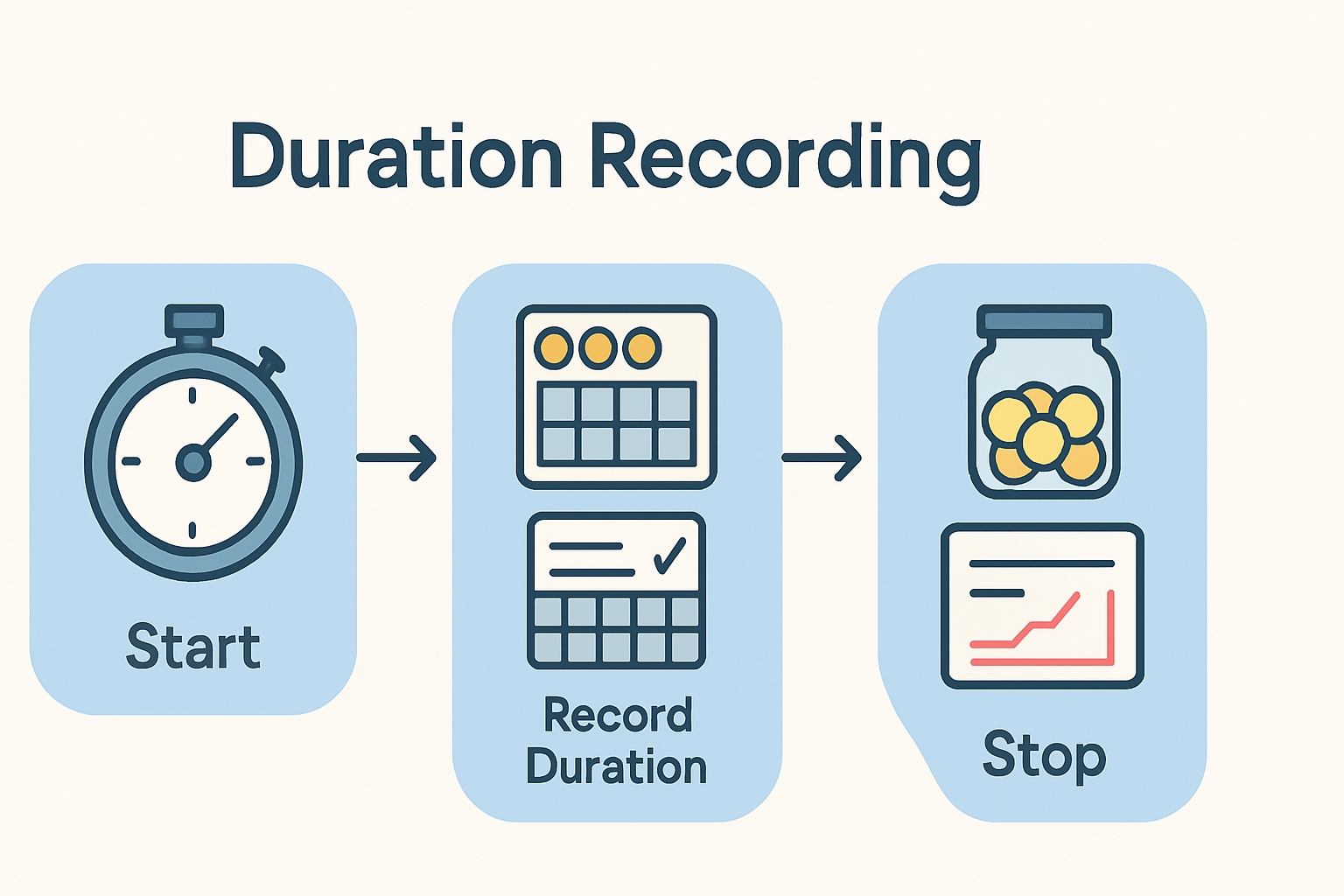
Duration recording is a continuous measurement procedure that tracks the total time a behavior occurs during an observation period. This method is essential for behaviors where how long the behavior lasts is more clinically significant than how often it happens.
Table of Contents
- What is Duration Recording? Definition and Core Concepts
- Applying Duration Recording: Worked ABA Examples
- Duration Recording and the BCBA Exam: Relevance and Common Traps
- Your Duration Recording Implementation Checklist
- Summary and Key Takeaways
Unlike momentary time sampling or partial interval recording, duration recording requires continuous observation and precise timing of both the start and stop of each behavioral episode.
The Formal Definition and Key Characteristics
Duration recording measures the elapsed time from behavior onset to termination. This measurement system is appropriate for behaviors with distinct start and stop points that can be clearly observed.
- Records total duration of behavior occurrence
- Requires continuous observation throughout the session
- Best for behaviors with variable durations that matter clinically
- Provides data on temporal patterns of behavior
- Can be converted to percentage of time engaged in behavior
When to Choose Duration Over Other Measurement Procedures
Select duration recording when the length of time a behavior persists is the critical dimension for assessment or intervention planning.
- Use for tantrums, crying, or emotional outbursts
- Measure on-task behavior during academic work
- Track social engagement during play sessions
- Monitor self-stimulatory behaviors with clear boundaries
- Avoid for high-frequency, brief behaviors better measured by rate
Applying Duration Recording: Worked ABA Examples
Understanding duration recording requires seeing it applied to real clinical scenarios. These examples demonstrate how to operationally define behaviors, collect ABC data, and calculate duration measurements.
Example 1: Measuring Tantrum Duration
Scenario: A 6-year-old child engages in tantrums when preferred toys are removed during transitions.
Operational definition: Tantrum includes loud crying above conversational volume, flopping to the floor, and hitting surfaces with hands.
ABC analysis: Antecedent – toy removed; Behavior – crying and flopping; Consequence – toy returned after 3 minutes.
Data collection: Record start time when crying begins, stop time when crying ceases and child stands up. Calculate total daily duration by summing all episodes.
Example 2: Tracking On-Task Behavior During Independent Work
Scenario: A student frequently engages in off-task behavior during independent math work.
Operational definition: On-task behavior includes eyes on worksheet, pencil moving, and no verbalizations unrelated to task.
ABC analysis: Antecedent – difficult math problem; Behavior – looking around room, playing with pencil; Consequence – teacher provides assistance.
Data collection: Use a stopwatch to time intervals of on-task behavior. Record duration of each on-task episode, then calculate percentage of session on-task.
Example 3: Duration of Social Interaction in a Play Setting
Scenario: A client with limited peer interaction skills participates in structured play sessions.
Operational definition: Social interaction includes verbal exchange, shared toy manipulation, and reciprocal eye contact lasting at least 3 seconds.
ABC analysis: Antecedent – peer initiates play; Behavior – parallel play without verbal exchange; Consequence – peer walks away after 2 minutes.
Data collection: Time each social interaction episode from initiation to termination. Calculate total interaction time per session and compare across sessions.
Duration Recording and the BCBA Exam: Relevance and Common Traps
The BCBA exam frequently tests your understanding of when and how to use different measurement procedures. Duration recording questions often appear in scenario-based items requiring clinical decision-making.

How the BCBA Exam Tests This Concept
Exam questions typically assess four key areas related to duration recording.
- Procedure selection: Choosing duration over other measurement systems
- Data interpretation: Reading and analyzing duration data from graphs
- Calculation skills: Computing total duration from start/stop times
- Limitation identification: Recognizing when duration recording is inappropriate
Frequent Exam Pitfalls and How to Avoid Them
Many candidates lose points on duration recording questions due to common misunderstandings.
- Confusing duration with latency: Duration measures total time behavior occurs; latency measures time until behavior starts
- Forgetting frequency limitations: Duration doesn’t tell you how often behavior occurs
- Misapplying to brief behaviors: Duration is inefficient for high-rate, momentary behaviors
- Overlooking practicality: Duration requires constant observation, which may not be feasible
- Ignoring interobserver agreement: Duration data requires clear operational definitions for reliability
Your Duration Recording Implementation Checklist
Use this practical checklist to ensure proper implementation of duration recording in clinical practice and to prepare for exam questions.
- Define behavior with clear start and stop criteria
- Select appropriate timing device (stopwatch, timer, app)
- Train observers on operational definitions and timing procedures
- Record start time immediately when behavior begins
- Record stop time when behavior clearly terminates
- Calculate total duration for each observation session
- Consider converting to percentage of time for comparison
- Assess interobserver agreement regularly
- Graph data to visualize temporal patterns and trends
Summary and Key Takeaways
Duration recording is a fundamental measurement procedure in ABA that provides critical information about how long behaviors persist. Mastering this concept requires understanding both its appropriate applications and limitations.
For the BCBA exam, focus on scenario-based decision making and avoid common traps like confusing duration with other measurement systems. In practice, ensure you have clear operational definitions and reliable timing procedures.
Remember that duration recording is most valuable for behaviors where temporal dimensions are clinically significant. When implemented correctly, it provides powerful data for assessment and intervention planning. For more on measurement procedures, see our guide on data collection methods in ABA.
To deepen your understanding of behavioral measurement, review the seven dimensions of ABA, particularly the dimension of technological procedures. For authoritative guidance on measurement standards, consult the BCBA Test Content Outline and relevant peer-reviewed literature on behavioral measurement.



