

Duration recording is a fundamental measurement procedure in applied behavior analysis that tracks how long a behavior lasts. This continuous measurement method provides crucial data about behaviors that vary in length, helping behavior analysts make informed decisions about interventions. Understanding duration recording ABA applications is essential for both clinical practice and exam preparation.
Table of Contents
- duration recording ABA: What is Duration Recording? Definition and Core Concepts
- Applying Duration Recording: Worked ABA Examples
- Duration Recording on the BCBA Exam: Relevance and Common Traps
- Your Duration Recording Implementation Checklist
- Summary and Key Takeaways
duration recording ABA: What is Duration Recording? Definition and Core Concepts
Duration recording measures the total time a behavior occurs from start to finish. This measurement system is particularly useful for behaviors with clear onset and offset points that vary in how long they last.
The Official Definition and When to Use It
In technical terms, duration recording involves timing the elapsed time between the initiation and termination of a target behavior. You should use this method when the behavior’s length matters more than how many times it occurs. Common applications include measuring tantrums, engagement in academic tasks, or time spent in social interactions.
This differs from frequency recording, which simply counts occurrences, and latency measurement, which tracks time until behavior starts. For a deeper understanding of measurement systems, explore our guide on data collection methods in ABA.
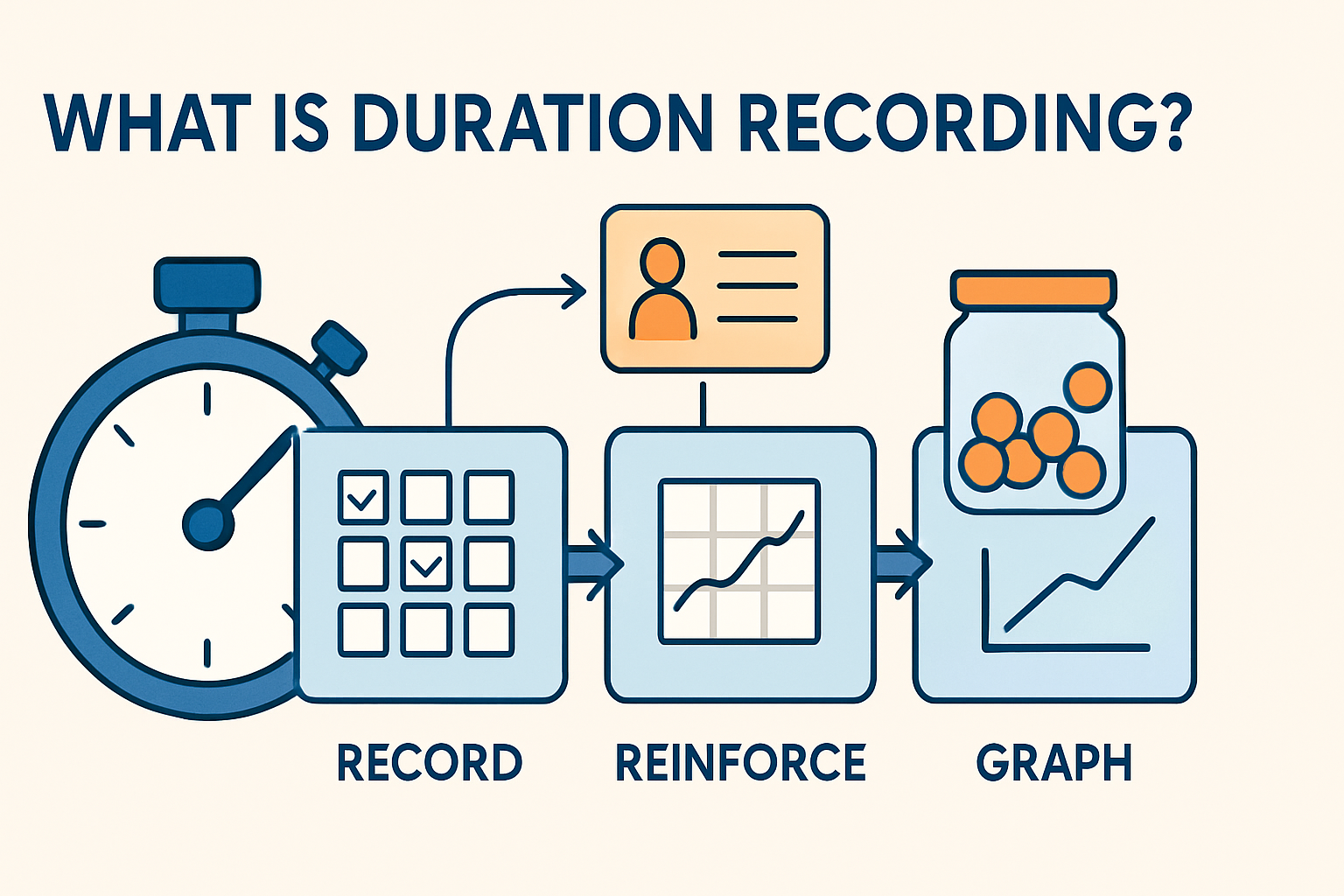
Key Terminology: Total Duration vs. Percentage of Session
Behavior analysts typically report duration data in two formats. Total duration represents the sum of all time the behavior occurred during an observation period. Percentage of session calculates (total duration ÷ session time) × 100, providing a standardized metric for comparison across sessions of different lengths.
- Total duration is reported in minutes and seconds (e.g., “tantrum lasted 8 minutes, 45 seconds”)
- Percentage of session is used when session lengths vary (e.g., “on-task behavior occurred 75% of the 20-minute session”)
- Choose total duration when session time is consistent across observations
- Use percentage when comparing data from sessions of different lengths
Applying Duration Recording: Worked ABA Examples
Practical application clarifies how duration recording informs clinical decisions. These examples demonstrate measurement procedures and data interpretation.
Example 1: Measuring Tantrum Duration to Inform Function
Consider a child who engages in tantrum behavior when preferred toys are removed. The behavior analyst defines tantrum operationally as crying, screaming, or throwing objects that begins when the toy is taken and ends after 30 seconds of calm behavior.
ABC data shows: Antecedent – toy removal, Behavior – tantrum, Consequence – toy returned. Duration recording starts a stopwatch at first cry and stops after 30 seconds of calm. Over three sessions, durations are 5:15, 8:30, and 6:45 minutes. This pattern suggests a tangible access function, as longer durations correlate with delayed toy return.
Example 2: Duration of On-Task Behavior During Academic Work
A student displays off-task behavior during independent math work. On-task is defined as eyes on materials, writing, or asking relevant questions. The analyst uses momentary time sampling at 1-minute intervals to estimate duration, recording whether the student is on-task at each interval.
Data shows on-task behavior occurs 40% of a 20-minute session. The hypothesized function is escape from demands. This duration data guides intervention planning, suggesting shorter work periods with more frequent breaks. For related concepts, see our article on negative reinforcement in ABA.
Duration Recording on the BCBA Exam: Relevance and Common Traps
The BCBA exam frequently tests your ability to select appropriate measurement procedures and interpret duration data. Understanding common pitfalls improves exam performance.
How the BCBA Exam Tests This Concept
Exam questions typically present scenarios requiring you to choose the most appropriate measurement system. You might need to interpret duration data from graphs, calculate percentages, or identify when duration recording is preferable to other methods like frequency or latency measurement.
- Scenario-based questions describing behaviors with varying lengths
- Graph interpretation showing duration data trends over time
- Calculation questions requiring conversion between total duration and percentage
- Comparative questions asking why duration is better than frequency for specific behaviors
Frequent Exam Pitfalls and How to Avoid Them
Several common mistakes trip up candidates on duration recording questions. The most frequent error is confusing duration with latency – remember duration measures how long a behavior lasts, while latency measures time until it starts.
- Misapplying to discrete behaviors: Duration recording works poorly for brief, high-frequency behaviors better measured by count
- Forgetting session length variations: Failing to convert to percentage when comparing sessions of different durations
- Confusing with inter-response time: Duration measures behavior occurrence; IRT measures time between behaviors
- Overlooking operational definitions: Clear start/stop criteria are essential for accurate duration measurement
Your Duration Recording Implementation Checklist
This practical checklist ensures proper application of duration recording in both clinical settings and exam preparation.
- Define clear onset/offset criteria for the target behavior before data collection begins
- Select appropriate timing tools – stopwatch, timer app, or data collection software with duration features
- Determine reporting format – will you use total duration or percentage of session based on consistency of observation periods?
- Train observers thoroughly on operational definitions and timing procedures to ensure reliability
- Consider partial interval recording as an alternative when continuous timing isn’t feasible
- Graph data appropriately – use cumulative records for total duration or line graphs for percentages
- Analyze trends in duration data to inform intervention decisions and measure progress
For comprehensive exam preparation strategies, review our BCBA exam study framework.
Summary and Key Takeaways
Duration recording provides essential data about behaviors that vary in length, offering insights that simple frequency counts cannot capture. This measurement system is particularly valuable for behaviors with clear beginning and ending points where duration matters clinically.
Key points to remember include the distinction between total duration and percentage calculations, the importance of operational definitions for accurate measurement, and recognizing when duration recording is the most appropriate choice. On the BCBA exam, watch for scenarios involving behaviors that last varying amounts of time, and avoid common traps like confusing duration with latency or misapplying it to discrete behaviors.
For authoritative guidance on measurement procedures, consult the BACB Ethics Code and Standards and Cooper, Heron, and Heward’s Applied Behavior Analysis textbook.


