

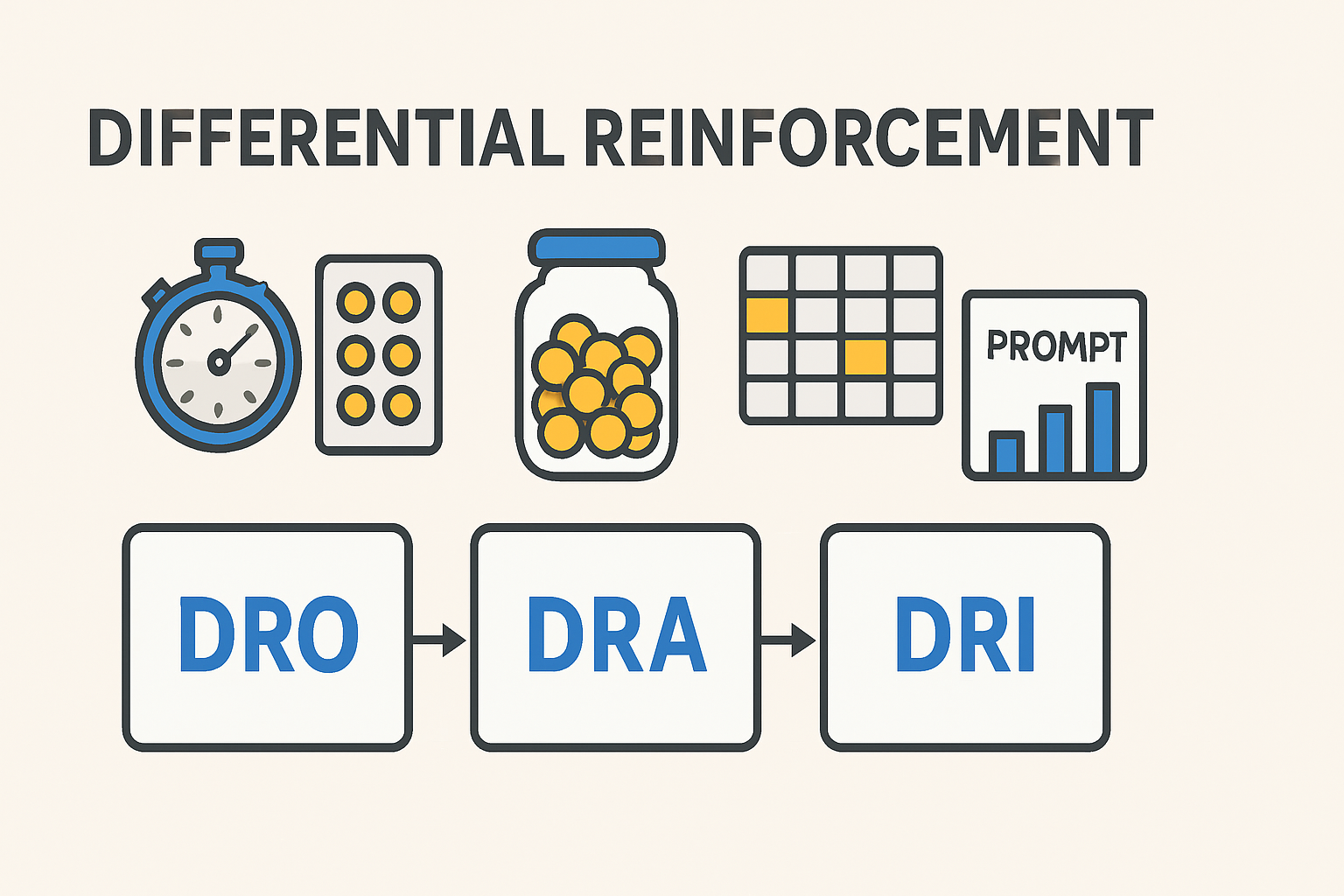
Differential reinforcement procedures are essential tools in applied behavior analysis, offering effective alternatives to punishment-based interventions. Understanding the distinctions between DRO, DRA, and DRI is crucial for both clinical practice and BCBA exam success. These procedures share a common principle: reinforcing one class of behavior while withholding reinforcement for another.
Table of Contents
- DRO DRA DRI: Defining Differential Reinforcement: DRO, DRA, and DRI
- Applied Examples: From ABC Data to Intervention
- BCBA Exam Focus: Distinctions and Common Pitfalls
- Quick-Reference Checklist for Procedure Selection
DRO DRA DRI: Defining Differential Reinforcement: DRO, DRA, and DRI
Each differential reinforcement procedure serves a specific purpose in behavior reduction plans. The core distinction lies in what behavior receives reinforcement.
What is DRO (Differential Reinforcement of Other Behavior)?
DRO involves delivering reinforcement when a target behavior does not occur during a specified interval. This procedure is defined by what is absent rather than what is present. Reinforcement is contingent on the non-occurrence of the target behavior.
What is DRA (Differential Reinforcement of Alternative Behavior)?
DRA reinforces a specific alternative behavior that serves the same function as the target behavior. The alternative must be functionally equivalent, meaning it accesses the same reinforcer through a more appropriate response.
What is DRI (Differential Reinforcement of Incompatible Behavior)?
DRI is a specialized form of DRA where the reinforced behavior is physically incompatible with the target behavior. The two behaviors cannot occur simultaneously due to physical constraints.
Applied Examples: From ABC Data to Intervention
These practical scenarios demonstrate how to implement each procedure based on functional assessment data.
Example 1: Using DRO for Attention-Maintained Vocal Stereotypy
A child engages in vocal stereotypy (humming) maintained by attention. ABC data shows humming increases when adults are present but not attending. The intervention uses a fixed-time DRO schedule: after 2-minute intervals with no humming, the therapist delivers praise and brief attention.
Example 2: Implementing DRA for Escape-Maintained Elopement
A student runs from the classroom during difficult academic tasks. Functional analysis confirms escape-maintained elopement. The DRA intervention teaches the student to use a break card instead. When the student presents the card appropriately, they receive a brief break from work demands.
Example 3: Selecting DRI for Automatically Maintained Hand Mouthing
A child mouths their hands during unstructured time, maintained by automatic reinforcement. The DRI intervention reinforces keeping hands engaged with a manipulative puzzle. Since puzzle manipulation is physically incompatible with hand mouthing, this qualifies as DRI.
BCBA Exam Focus: Distinctions and Common Pitfalls
Exam questions often test subtle differences between these procedures. Understanding these distinctions prevents common errors.
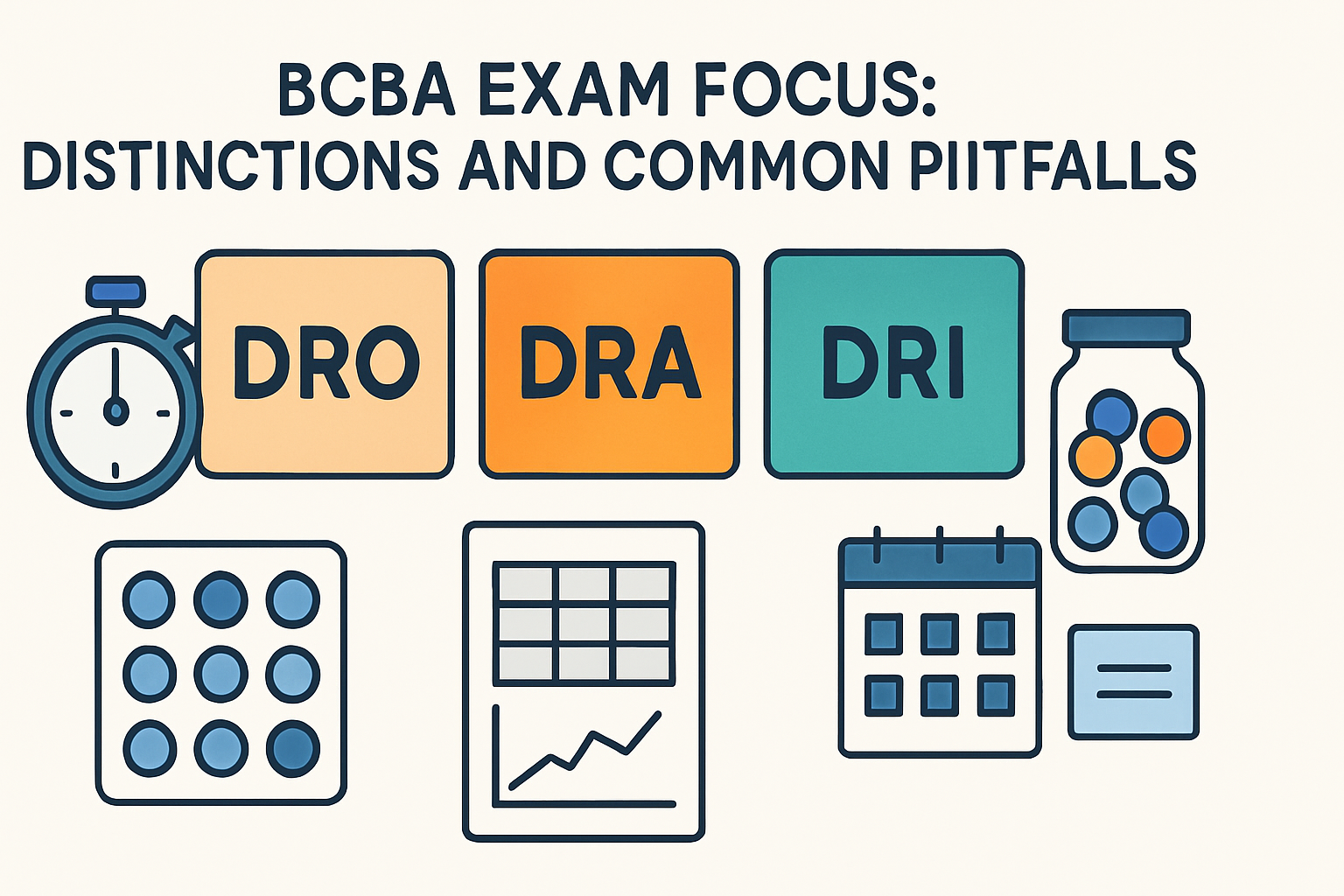
Key Exam Differentiators: DRA vs. DRI
All DRI procedures are DRA, but not all DRA procedures are DRI. The critical distinction is physical incompatibility. For DRI, the alternative behavior must make the target behavior physically impossible to perform simultaneously.
- DRO: Reinforces absence of target behavior
- DRA: Reinforces functionally equivalent alternative
- DRI: Reinforces physically incompatible alternative
Frequent Exam Traps and How to Avoid Them
Several common mistakes appear repeatedly on BCBA exams. Being aware of these traps improves accuracy.
- Confusing DRO with NCR: DRO requires contingent reinforcement for non-occurrence, while NCR delivers reinforcement noncontingently
- Misidentifying ‘other’ behavior: DRO reinforces any behavior except the target, not a specified alternative
- Overlooking functional equivalence: DRA requires the alternative behavior to serve the same function
- Forgetting physical incompatibility: DRI requires behaviors that cannot co-occur
Quick-Reference Checklist for Procedure Selection
Use this checklist when designing interventions or answering exam questions about differential reinforcement procedures.
- Identify the function through functional assessment or analysis
- Determine if extinction can be safely implemented for the target behavior
- Select DRO when you want to reinforce any behavior except the target
- Choose DRA when teaching a specific, functionally equivalent alternative
- Opt for DRI when a physically incompatible alternative exists
- Ensure reinforcement is delivered consistently for appropriate behaviors
- Monitor treatment integrity and social validity throughout implementation
- Consider combining procedures with other evidence-based strategies
Mastering DRO, DRA, and DRI requires understanding both theoretical distinctions and practical applications. These procedures represent effective alternatives to punishment while promoting skill development. For more information on related concepts, explore our guide to differential reinforcement or learn about functional assessment methods.



