What is a DRH Schedule of Reinforcement?
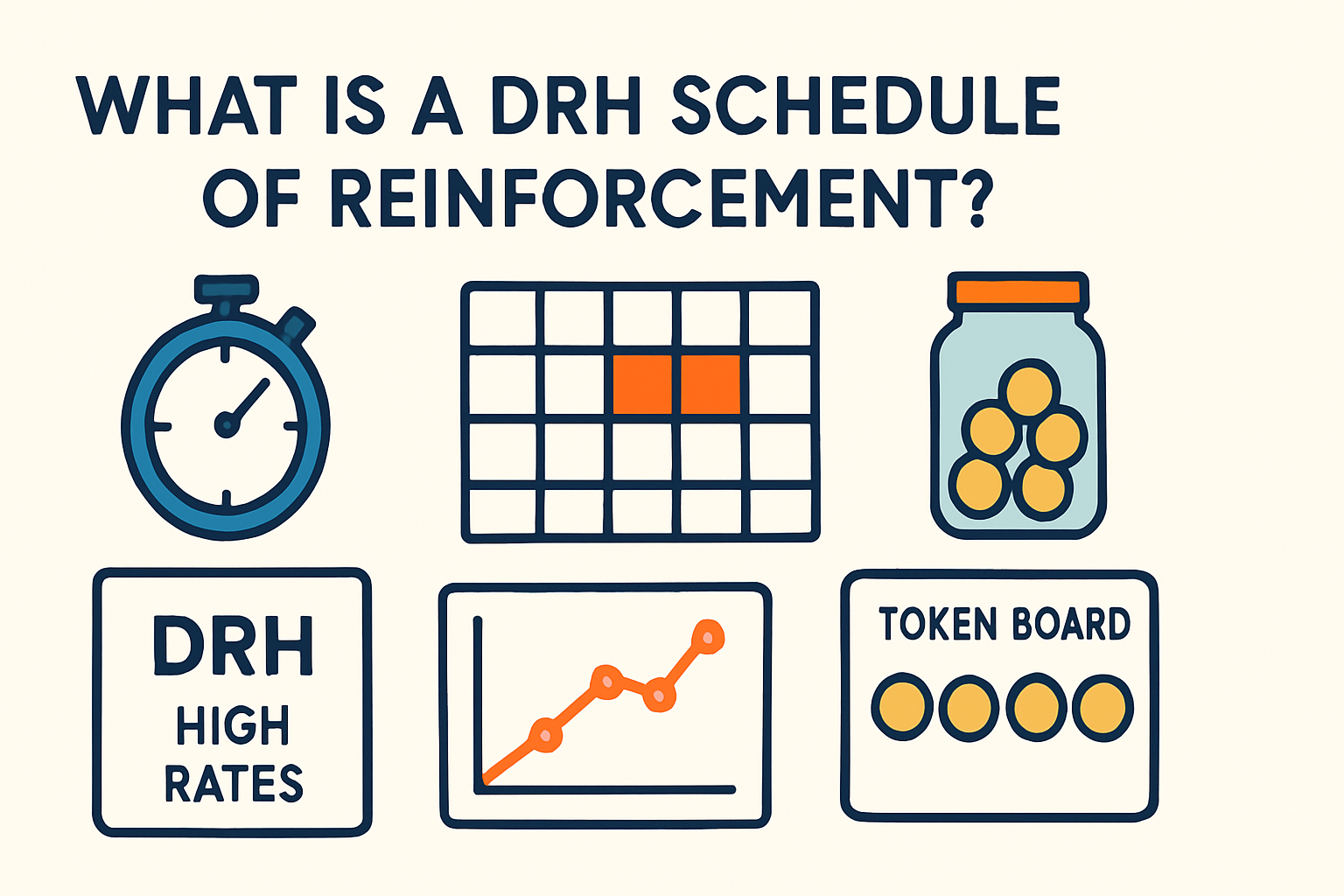
Differential reinforcement of high rates (DRH) is a behavioral procedure where reinforcement is delivered only when a behavior occurs at or above a predetermined high rate criterion within a specified time period. Unlike other differential reinforcement schedules, DRH specifically targets increasing the frequency of an already-existing behavior to a more functional or desirable level.
Table of Contents
- What is a DRH Schedule of Reinforcement?
- Applying DRH: Worked Examples for BCBA Preparation
- DRH on the BCBA Exam: Relevance and Common Traps
- Quick Checklist: Implementing a DRH Schedule
- Summary and Key Takeaways
- References
The core goal is to accelerate behavior that’s already in the individual’s repertoire but occurs too infrequently for practical purposes. This makes DRH particularly useful for building behavioral fluency and improving efficiency in academic, vocational, or daily living skills.
The Core Definition and Goal
In technical terms, DRH involves setting a minimum response requirement that must be met within a time window. For example, if a student correctly answers 3 math problems per minute, you might set a DRH criterion of 5+ correct answers per minute. Only responses meeting or exceeding this threshold receive reinforcement.
The fundamental objective is to increase response rate rather than teach new behaviors. This distinction is crucial for both clinical application and BCBA exam questions. DRH assumes the target behavior already exists in the individual’s repertoire at some baseline level.
DRH vs. DRL, DRO, and DRA
Understanding how DRH differs from other differential reinforcement procedures is essential for proper application and exam success:
- DRL (Differential Reinforcement of Low Rates): Decreases behavior frequency by reinforcing only when responses occur below a set criterion
- DRO (Differential Reinforcement of Other Behavior): Reinforces the absence of target behavior during specified intervals
- DRA (Differential Reinforcement of Alternative Behavior): Reinforces a specific alternative behavior that serves the same function
- DRH (Differential Reinforcement of High Rates): Increases behavior frequency by reinforcing only when responses meet or exceed a high rate criterion
The key distinction lies in the direction of change and the specific behavioral target. While DRL reduces frequency and DRO targets absence, DRH systematically increases an existing behavior’s rate to a predetermined standard.
Applying DRH: Worked Examples for BCBA Preparation
Moving from theory to practice, let’s examine concrete scenarios that illustrate DRH implementation. These examples include ABC data and hypothesized functions, mirroring the type of analysis you’ll encounter on the BCBA exam.
Example 1: Increasing Academic Engagement
Scenario: A student with autism spectrum disorder answers math facts correctly but responds too slowly for classroom participation. Baseline data shows 2-3 correct responses per minute. The goal is to increase this to 5+ correct responses per minute to improve academic engagement.
DRH Implementation:
- Antecedent: Teacher presents flashcard with math fact
- Behavior: Student provides verbal answer within 3 seconds
- Consequence: Token delivered if 5+ correct responses occur within 1-minute timing
- Criterion: 5 correct responses per minute minimum
- Hypothesized Function: Access to tokens (tangible reinforcement) leading to preferred activities
This example demonstrates how DRH can build academic fluency by systematically increasing response rates while maintaining accuracy. The time-based criterion ensures reinforcement is contingent on both correct responding and adequate speed.
Example 2: Building Fluency in a Vocational Skill
Scenario: An adult client in a vocational training program packages items correctly but below the functional speed required for competitive employment. Current rate: 6 packages completed in a 5-minute work block. Target rate: 10+ packages per 5-minute block.
DRH Implementation:
- Antecedent: Work materials presented at packaging station
- Behavior: Complete packaging sequence (item placement, sealing, labeling)
- Consequence: 2-minute break earned if 10+ packages completed within 5-minute timing
- Criterion: 10 completed packages per 5-minute work interval
- Hypothesized Function: Access to break (negative reinforcement/escape from work demands)
This vocational application shows how DRH can increase work productivity to meet employment standards. The reinforcement schedule directly links performance to natural workplace contingencies, promoting skill generalization to real job settings.
DRH on the BCBA Exam: Relevance and Common Traps
Understanding how DRH appears on the BCBA exam can significantly improve your test performance. This section addresses typical question formats and common mistakes to avoid.
How DRH Appears in Questions
Exam questions typically present scenarios where a behavior occurs at a moderate rate but needs acceleration for functional purposes. You might encounter:
- Scenario-based items asking to ‘select the appropriate procedure’ from multiple differential reinforcement options
- Data interpretation questions showing baseline and intervention phases with rate increases
- Ethical considerations about setting appropriate rate criteria for individual clients
- Questions distinguishing DRH from other schedules like compound reinforcement schedules
The key is recognizing when the goal is specifically to increase response rate of an existing behavior, not to teach new skills or reduce problem behavior.
Pitfalls to Avoid
Common mistakes on DRH-related exam questions include:
- Confusing DRH with DRL: Misidentifying the direction of change (increase vs. decrease)
- Applying DRH to novel behaviors: Using DRH when shaping or other acquisition procedures are needed first
- Forgetting measurable criteria: Failing to establish clear, objective rate requirements
- Overlooking client appropriateness: Setting unrealistic rates that don’t consider individual capabilities
- Missing functional considerations: Not analyzing whether the high rate serves a practical purpose
Remember that ethical implementation requires the target rate to be both achievable and meaningful for the client’s context, aligning with the seven dimensions of ABA.
Quick Checklist: Implementing a DRH Schedule
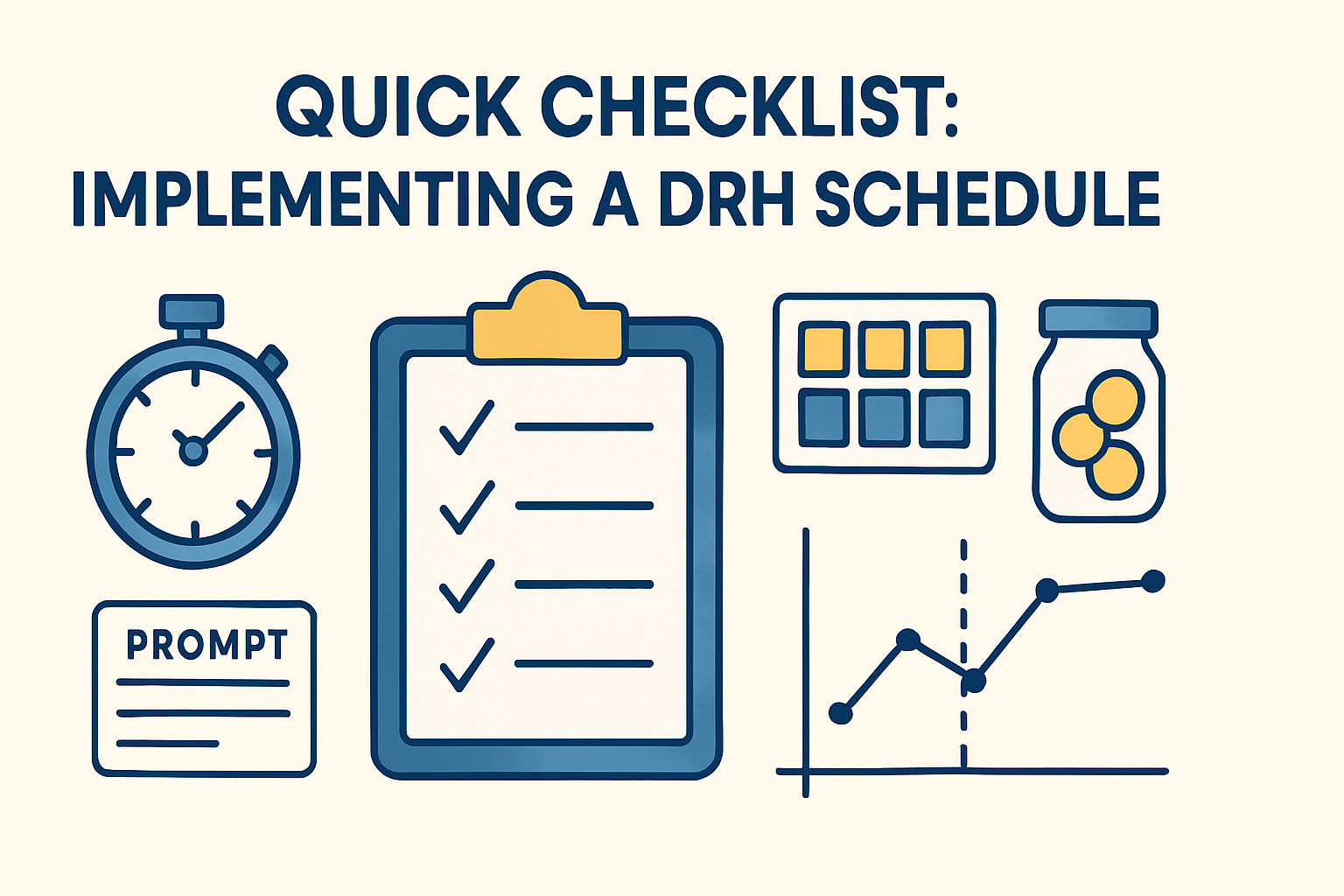
Use this actionable checklist for both exam preparation and clinical application:
- Identify existing behavior that occurs at moderate but insufficient rate
- Establish baseline data on current response frequency
- Set realistic criterion slightly above current performance
- Define time window for measuring response rate
- Select potent reinforcer contingent on meeting criterion
- Monitor and adjust criteria as performance improves
- Program for generalization to natural environments
- Ensure ethical appropriateness of target rate for client
Summary and Key Takeaways
The DRH schedule of reinforcement is a specialized procedure for increasing the rate of behaviors already in an individual’s repertoire. Key points to remember:
- DRH targets rate acceleration, not skill acquisition
- Requires setting clear minimum response criteria within time limits
- Differs fundamentally from DRL, DRO, and DRA in direction and purpose
- Most effective for building behavioral fluency in academic, vocational, or daily living skills
- Ethical implementation considers individual capabilities and functional outcomes
For comprehensive preparation on related topics, explore our guide on differential reinforcement procedures. Understanding these distinctions will help you select appropriate interventions based on specific behavioral goals and client needs.