

What is Differential Reinforcement of Low Rate Behavior (DRL)?
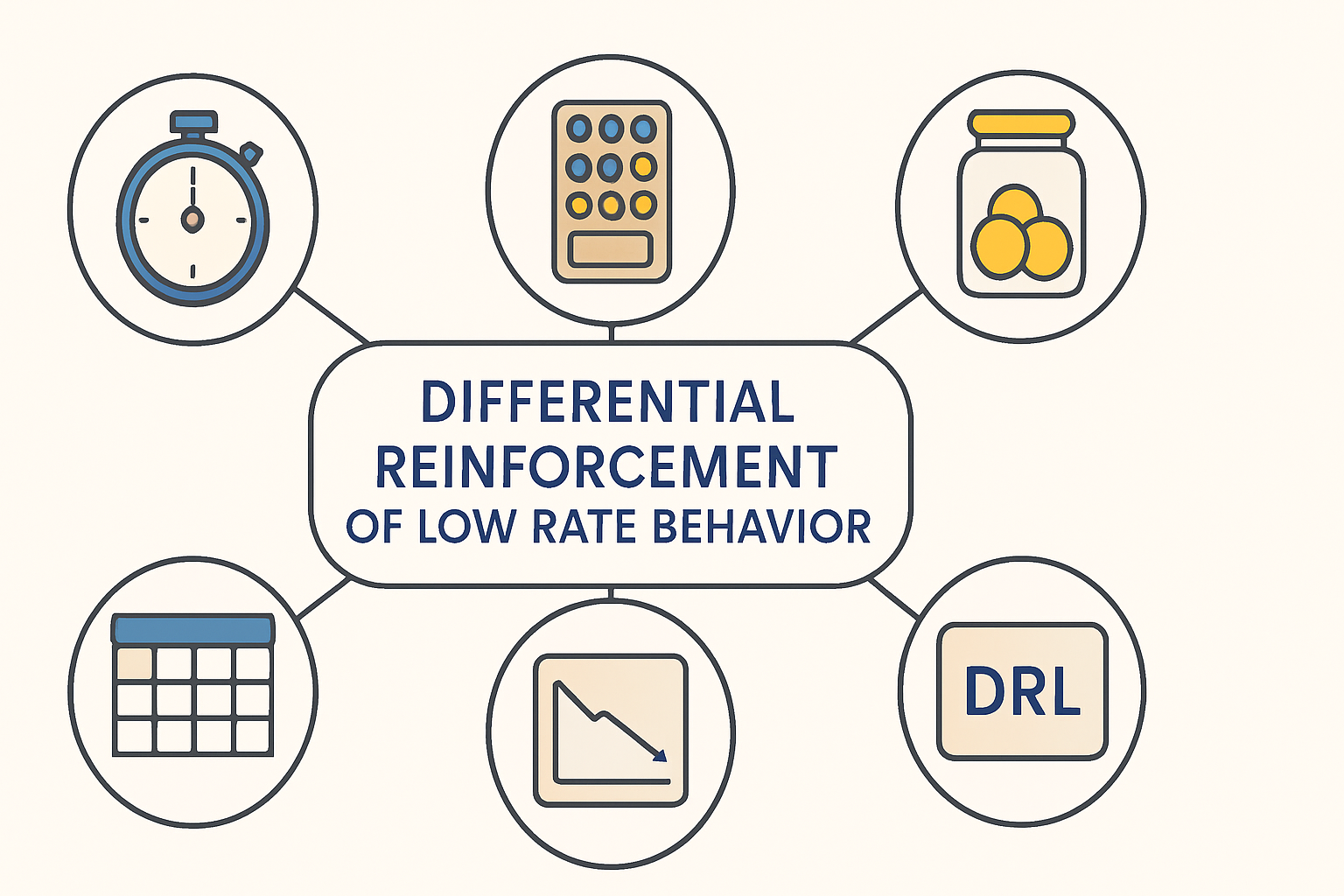
Differential reinforcement of low rate behavior is a behavior reduction procedure that reinforces a target behavior only when it occurs at a rate below a predetermined criterion. The primary goal is to decrease, but not eliminate, a behavior by making reinforcement contingent on lower rates of responding.
Table of Contents
- What is Differential Reinforcement of Low Rate Behavior (DRL)?
- Applying DRL: Worked Examples with ABC Data
- DRL on the BCBA Exam: Relevance and Common Traps
- DRL Implementation Checklist and Summary
This approach is particularly useful for behaviors that are socially acceptable at lower frequencies but problematic when they occur too often.
The Core Definition and Goal
DRL involves setting a specific criterion for acceptable response rates and delivering reinforcement only when behavior occurs below that threshold. The procedure has two main types: spaced-responding DRL and full-session DRL. Spaced-responding requires a minimum time between responses, while full-session sets a maximum number of responses per session.
The fundamental objective is behavior reduction through reinforcement of lower rates, not extinction of the behavior entirely.
DRL vs. Other Differential Reinforcement Procedures
Understanding how DRL differs from other differential reinforcement procedures is crucial for both clinical practice and exam success. Here’s a quick comparison:
- DRL (Differential Reinforcement of Low Rate): Reinforces behavior only when it occurs at a low rate; goal is to reduce frequency
- DRA (Differential Reinforcement of Alternative Behavior): Reinforces an alternative behavior while placing the target behavior on extinction
- DRO (Differential Reinforcement of Other Behavior): Reinforces the absence of the target behavior during specific time intervals
- DRI (Differential Reinforcement of Incompatible Behavior): Reinforces a behavior that cannot occur simultaneously with the target behavior
This distinction is a common exam discriminator that requires careful attention to the specific reinforcement contingency described.
Applying DRL: Worked Examples with ABC Data
Practical application of DRL requires careful analysis of baseline data and systematic implementation. These examples demonstrate how to apply both types of DRL procedures in real-world scenarios.
Example 1: Spaced-Responding DRL for Classroom Call-Outs
Scenario: A student frequently calls out answers without raising their hand, disrupting classroom instruction. Baseline data shows an average of 15 call-outs per 30-minute period.
- Antecedent: Teacher asks a question to the class
- Behavior: Student calls out answer without raising hand
- Consequence: Teacher responds to the answer (attention reinforcement)
- Hypothesized Function: Access to adult attention/teacher response
Implementation: Establish a spaced-responding DRL with a minimum inter-response time of 5 minutes. The student receives reinforcement (teacher acknowledgment, points toward preferred activity) only when they wait at least 5 minutes between call-outs. Data collection focuses on inter-response time (IRT) measurement.
Example 2: Full-Session DRL for Repetitive Question Asking
Scenario: A client asks “What time is it?” excessively during therapy sessions, averaging 25 times per hour. This behavior interferes with instructional activities.
- Antecedent: Downtime between activities or transitions
- Behavior: Client asks “What time is it?” repeatedly
- Consequence: Therapist provides the time (tangible information)
- Hypothesized Function: Access to tangible information or attention during transitions
Implementation: Use full-session DRL with a criterion of no more than 3 questions per hour. The client earns access to a preferred item at session end if they stay within this limit. Data is collected via frequency recording throughout the session, with reinforcement delivered contingently based on the session total.
DRL on the BCBA Exam: Relevance and Common Traps
DRL questions frequently appear on the BCBA exam, testing both conceptual understanding and practical application skills. Recognizing question patterns and avoiding common mistakes is essential for success.
Key Exam Scenarios and Question Stems
Exam questions about DRL often include specific language that signals this is the correct answer choice. Watch for these phrases:
- “Reduce but not eliminate the behavior”
- “Decrease the rate of responding”
- “Space out responses over time”
- “Reinforce only if behavior occurs less than X times in a period”
- “Thin the schedule of reinforcement for an existing behavior”
These question stems typically describe situations where the behavior itself is not problematic, but its frequency needs reduction.
Pitfalls to Avoid
Several common traps can lead to incorrect answers on DRL-related questions:
- Confusing DRL with DRO: DRO reinforces the omission of all target behavior, while DRL reinforces lower rates of the same behavior
- Selecting DRL for dangerous behaviors: DRL is inappropriate for behaviors that must be eliminated entirely for safety reasons
- Misidentifying the reinforcement contingency: Failing to recognize that reinforcement is contingent on low rates, not alternative behaviors
- Overlooking baseline data requirements: DRL requires establishing a clear baseline rate before setting criteria
Understanding these distinctions is crucial for both exam success and ethical practice. For more on differential reinforcement strategies, see our comprehensive differential reinforcement guide.
DRL Implementation Checklist and Summary
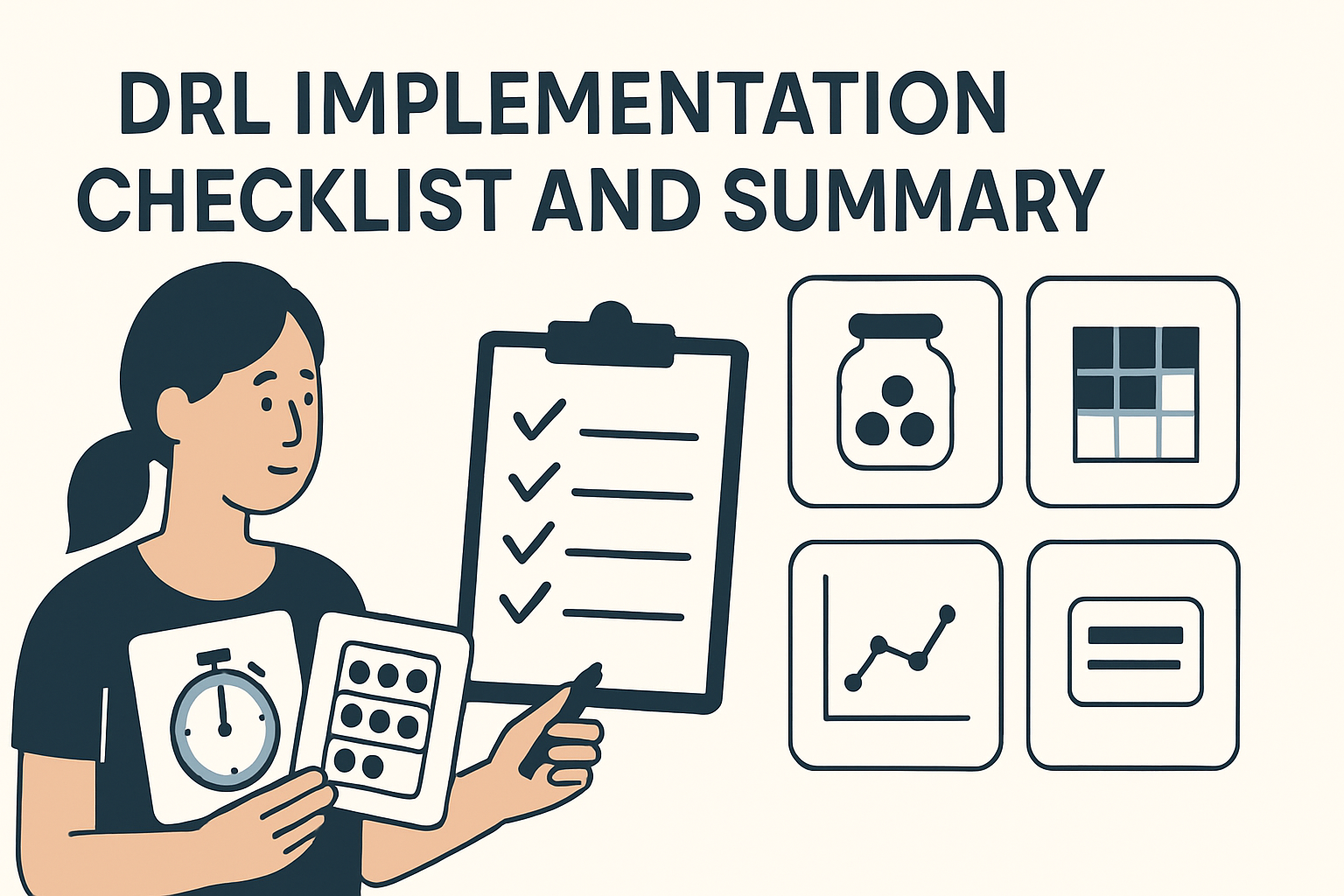
Effective DRL implementation requires systematic planning and consistent application. This checklist provides a practical framework for clinical use and study review.
Quick-Reference Implementation Checklist
- Define the target behavior operationally and measure baseline rate
- Set a realistic, gradually decreasing criterion based on baseline data
- Choose between spaced-responding or full-session DRL based on the behavior pattern
- Plan measurement procedures (IRT recording or session frequency count)
- Select potent reinforcers through preference assessment
- Apply the reinforcement contingency consistently and immediately
- Graph data regularly to monitor progress and adjust criteria as needed
- Consider ethical implications and obtain appropriate consent
Each step requires careful consideration of the individual’s needs and the behavior’s function.
Core Takeaways for Your Study Notes
DRL reduces behavior rate while maintaining the behavior’s topography. It’s specifically designed for behaviors you want to thin rather than eliminate. Ethical implementation requires conducting a functional behavior assessment first to ensure appropriate intervention selection.
On the BCBA exam, DRL serves as a key discriminator from other differential reinforcement procedures. Mastery requires understanding both the conceptual framework and practical application details. For additional study resources on related topics, explore our guide to functional behavior assessment and behavior intervention planning.
Remember that DRL represents just one component of a comprehensive behavior analytic approach. For authoritative information on behavior analytic procedures, consult the Behavior Analyst Certification Board resources and peer-reviewed literature on differential reinforcement applications.


