
What is Automatic Reinforcement?
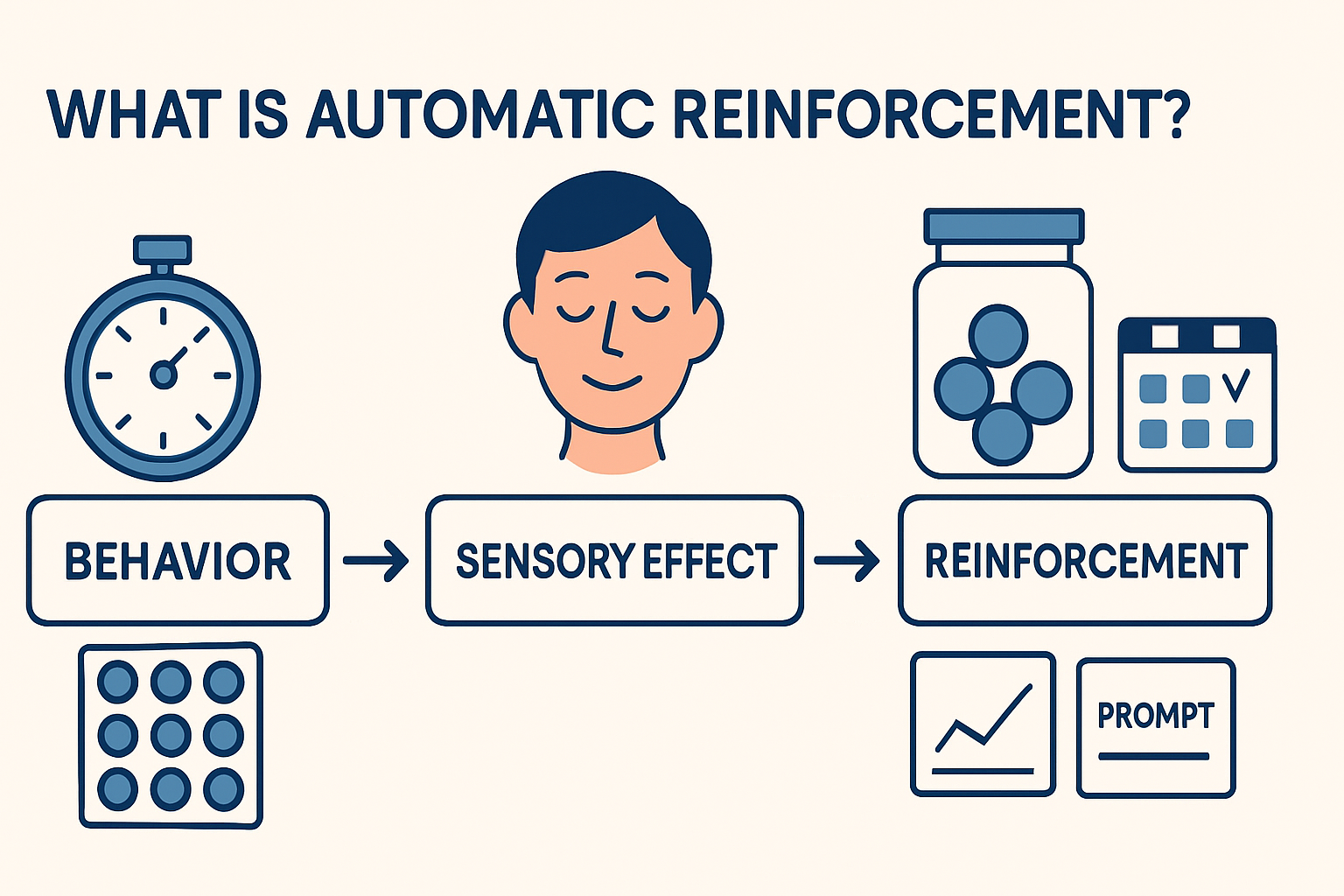
In applied behavior analysis, automatic reinforcement refers to behavior that produces its own reinforcing consequences through direct sensory or internal effects. This means the reinforcement occurs without mediation by another person. According to Cooper, Heron, and Heward, this function involves consequences that are directly produced by the behavior itself, rather than delivered by someone else.
Table of Contents
- What is Automatic Reinforcement?
- Identifying Automatic Reinforcement in Practice
- Automatic Reinforcement and the BCBA Exam
- Quick-Reference Checklist for Candidates
- Summary and Key Takeaways
Defining the Self-Stimulating Function
The self-stimulating function distinguishes itself from socially-mediated reinforcement, where consequences depend on another person’s actions. With automatic reinforcement, the behavior itself creates the reinforcing stimulus. This concept is crucial for understanding why certain behaviors persist even when social consequences are absent.
Automatic Positive vs. Automatic Negative Reinforcement
Automatic reinforcement has two distinct subtypes that often appear on the BCBA exam. Automatic positive reinforcement occurs when behavior adds a sensory stimulus, like scratching an itch or rocking for vestibular input. Automatic negative reinforcement happens when behavior removes an aversive internal stimulus, such as tensing muscles to relieve pain or picking at skin to reduce itching sensations.
Identifying Automatic Reinforcement in Practice
Moving from theory to application requires careful observation and analysis. The Functional Behavior Assessment process helps identify when behaviors serve automatic functions. Look for patterns where behaviors occur across various social contexts without apparent social consequences.
Example 1: Stereotypy and Sensory Consequences
Consider hand-flapping behavior observed during independent work time. The antecedent might be boredom or alone time, with the behavior producing proprioceptive stimulation and visual feedback. In a functional analysis, this behavior would likely show high rates in the alone condition with minimal change when social consequences are absent, confirming the automatic positive reinforcement hypothesis.
Example 2: Skin Picking and Attenuation of Pain
Skin picking at a healing scab demonstrates automatic negative reinforcement. The antecedent is an itching sensation, the behavior is picking, and the consequence is removal of the uncomfortable feeling. This internal, biological consequence maintains the behavior independently of social factors, making it a classic example of automatic negative reinforcement.
Example 3: Humming for Auditory Feedback
Humming during quiet work periods serves automatic positive reinforcement through auditory self-stimulation. The behavior produces its own reinforcing consequence through the sound it generates. This pattern often appears in various settings where individuals engage in vocal stereotypy for sensory feedback.
Automatic Reinforcement and the BCBA Exam
Understanding automatic reinforcement is essential for exam success, particularly in questions about functional analysis and behavior function identification. Many exam questions test your ability to distinguish between socially-mediated and automatic functions.
Common Exam Traps and Misconceptions
Several pitfalls frequently appear on the BCBA exam:
- Confusing automatic reinforcement with reflexive behavior or assuming all self-stimulation is uncontrollable
- Assuming all self-injury is automatically reinforced when some cases involve socially-mediated functions
- Overlooking automatic negative reinforcement in favor of more obvious positive reinforcement explanations
- Mistaking behaviors that appear social but are actually maintained by sensory feedback

Key Questions to Ask During Functional Analysis
When analyzing exam questions describing functional analysis data, use this mental checklist:
- Does the behavior persist in the alone condition?
- Is it high across all conditions with minimal differentiation?
- Are social consequences like attention or escape demonstrably ineffective?
- If yes to these questions, automatic reinforcement becomes the strongest hypothesis
Quick-Reference Checklist for Candidates
Use this concise summary for last-minute review and application during your exam preparation:
- Remember that automatic reinforcement involves self-produced consequences
- Distinguish between automatic positive (adds stimulus) and automatic negative (removes stimulus)
- Look for behaviors occurring across multiple social contexts without social mediation
- In functional analysis, high rates in alone conditions suggest automatic function
- Consider sensory consequences like visual, auditory, tactile, or proprioceptive feedback
- Review functional analysis methods to strengthen your understanding
Summary and Key Takeaways
Automatic reinforcement represents a critical concept for BCBA candidates to master. The self-stimulating function explains why behaviors persist without social consequences. Key distinctions include understanding both automatic positive and negative reinforcement subtypes.
For exam success, focus on identifying patterns in functional analysis data and recognizing common traps. Remember that behaviors maintained by automatic reinforcement often show consistent rates across different conditions. Practice analyzing ABC data to strengthen your skills in function identification.
To deepen your understanding of related concepts, explore our guide on the four functions of behavior. For authoritative information, consult the Behavior Analyst Certification Board resources and peer-reviewed literature on functional analysis methodology.



