

What is Attention Extinction? A Procedural Definition
Attention extinction is a specific behavior reduction procedure where socially-mediated attention is systematically withheld following a target behavior. This intervention targets behaviors maintained by access to attention as their primary function.
Table of Contents
- What is Attention Extinction? A Procedural Definition
- Attention Extinction in Practice: 3 Worked Examples
- Exam Relevance and Common Traps for BCBA Candidates
- Quick Implementation Checklist for Clinicians
- Summary and Key Takeaways
- References
The procedure involves identifying attention as the maintaining consequence and then preventing that consequence from occurring after the behavior. It’s crucial to distinguish this from other extinction types based on behavioral function.
Core Components and Key Distinctions
Understanding attention extinction requires recognizing its specific components and how it differs from other extinction procedures.
- Withholding socially-mediated attention: The practitioner intentionally avoids providing any form of attention (verbal, physical, visual) contingent on the target behavior
- Function-based approach: The procedure targets the behavioral function, not the topography – different behaviors with the same attention function receive the same treatment
- Contrast with escape extinction: Escape extinction withholds removal of aversive stimuli, while attention extinction withholds social interaction
- Different from tangible extinction: Tangible extinction involves withholding access to preferred items or activities, not social attention
- Distinct from automatic extinction: Automatic extinction addresses behaviors maintained by automatic reinforcement through sensory consequences
Attention Extinction in Practice: 3 Worked Examples
These concrete examples illustrate how attention extinction operates in real-world scenarios, mapping directly to exam-style case presentations.
Example 1: Classroom Disruption for Teacher Proximity
This scenario demonstrates attention extinction in an educational setting with clear ABC components.
- Antecedent: Independent work time during math instruction
- Behavior: Student taps pencil loudly on desk at increasing volume
- Consequence: Teacher walks over, makes eye contact, and says “Please stop tapping”
- Function: Access to adult attention and proximity
- Extinction Plan: Teacher continues instruction and scans room without approaching, making eye contact, or verbally responding to tapping
Example 2: Negative Statements During Social Play
This peer interaction example shows attention extinction applied in social contexts.
- Antecedent: Peers initiate a board game during recess
- Behavior: Child says “This game is boring” and “I don’t want to play”
- Consequence: Peers stop playing and try to convince child to join, offering alternative games
- Function: Peer attention and social engagement
- Extinction Plan: Peers are coached to continue playing without responding verbally or physically to negative statements
Example 3: Minor Self-Injury During Caregiver Phone Use
This home-based example illustrates attention extinction with safety considerations.
- Antecedent: Caregiver answers phone call during playtime
- Behavior: Child engages in light hand-to-head hitting
- Consequence: Caregiver says “Oh no, honey!” and immediately puts phone down
- Function: Parental attention and interruption of phone use
- Extinction Plan: Caregiver ensures safety through blocking if needed but provides no concerned attention; may complete brief phone task before delivering attention for appropriate behavior
Exam Relevance and Common Traps for BCBA Candidates
Understanding how attention extinction appears on the BCBA exam helps avoid common mistakes and improves test performance.
Spotting the Function in Vignettes
Accurate function identification is essential for selecting appropriate interventions like attention extinction.
- Look for social reactions: Exam questions often include subtle attention consequences like brief glances, sighs, or proximity changes
- Common misidentification trap: Behaviors that appear escape-motivated may actually function for attention if the escape attempt itself garners social reactions
- Multiple control considerations: Some behaviors may have multiple functions requiring combined intervention approaches
- Contextual analysis: Consider the social environment and typical reinforcement history when determining function
Predicting and Managing Extinction Bursts
Extinction bursts are a predictable phenomenon that candidates must understand and anticipate.
- Initial increase expected: A temporary escalation in behavior frequency, duration, or intensity is normal and indicates the procedure is working
- Not procedure failure: This burst should not be mistaken for intervention ineffectiveness
- Contrast with misidentification: True failure occurs when behavior decreases then returns to baseline, suggesting wrong function identification
- Spontaneous recovery awareness: Brief reappearance of extinguished behavior after periods of absence is another expected phenomenon
Ethical Contraindications and Safety
Ethical implementation requires recognizing when attention extinction is inappropriate or requires modification.
- Severe behavior contraindication: Attention extinction is contraindicated for severe aggression or self-injurious behavior where attention is the function due to safety risks during bursts
- Alternative procedures: For high-risk behaviors, consider noncontingent reinforcement (NCR) or differential reinforcement alternatives
- Safety planning necessity: When using attention extinction, comprehensive safety measures and staff training are essential
- Client dignity considerations: Procedures must respect client dignity while effectively reducing problematic behavior
Quick Implementation Checklist for Clinicians
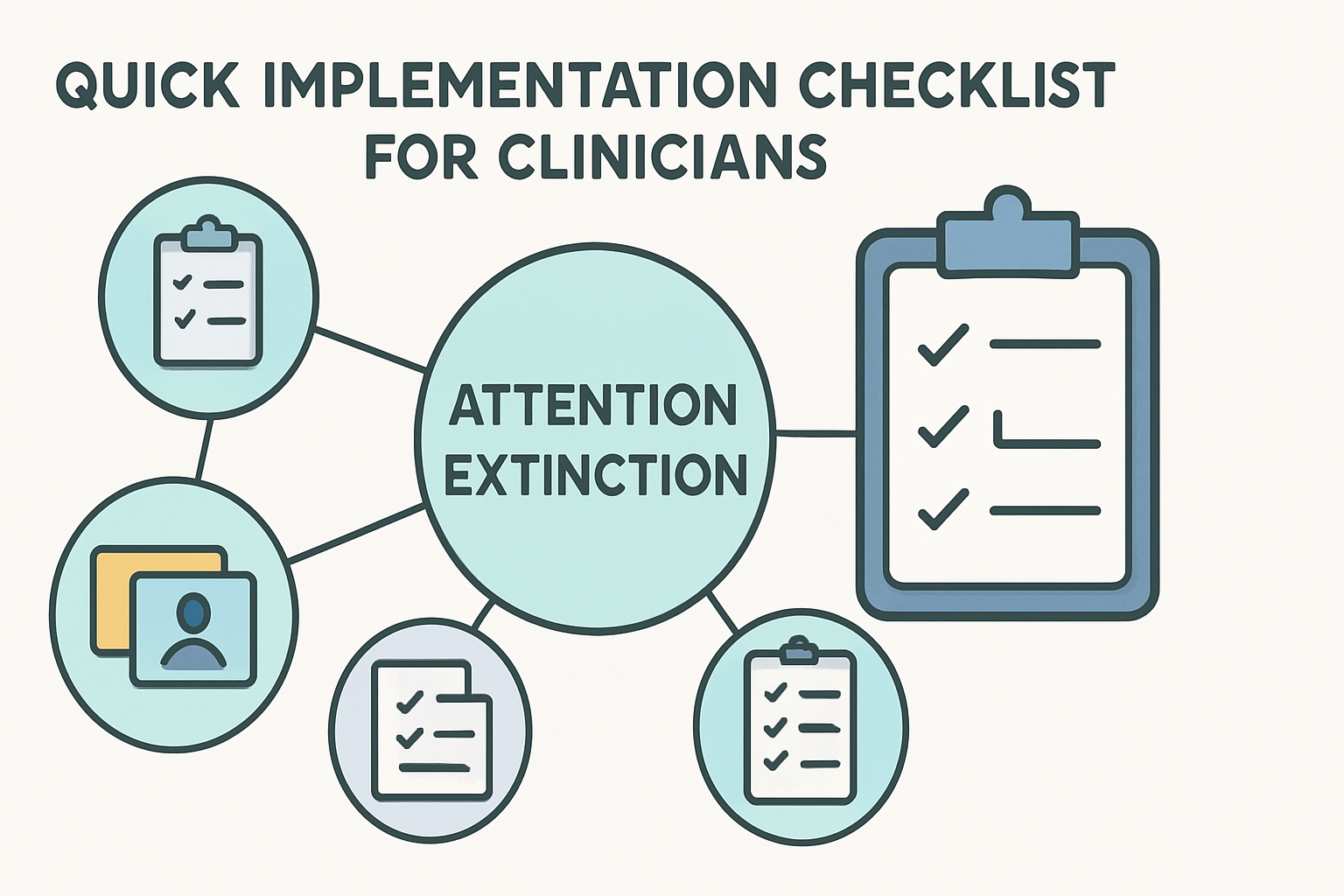
This actionable checklist ensures proper attention extinction implementation in clinical practice.
- Conduct functional assessment: Verify attention as the maintaining consequence through functional analysis or descriptive assessment
- Define target behavior: Create operational definitions with clear examples and non-examples
- Train all implementers: Ensure consistency across caregivers, teachers, and staff through behavior skills training
- Plan for extinction burst: Prepare staff for temporary behavior escalation with safety protocols
- Implement reinforcement alternatives: Teach and reinforce appropriate attention-seeking behaviors
- Monitor treatment integrity: Regularly check procedural adherence through direct observation
- Collect ongoing data: Track behavior frequency, duration, and intensity to evaluate effectiveness
- Assess social validity: Evaluate acceptability and practicality with stakeholders
Summary and Key Takeaways
Attention extinction is a powerful but nuanced intervention requiring careful implementation and ethical consideration.
- Function-based procedure: Targets behaviors maintained by access to social attention as reinforcement
- Requires accurate assessment: Proper implementation depends on correct function identification through comprehensive assessment
- Expect extinction phenomena: Initial bursts and spontaneous recovery are predictable, not indicative of failure
- Ethical implementation essential: Safety considerations and client dignity must guide all procedural decisions
- Combine with reinforcement: Always pair with reinforcement of alternative behaviors for comprehensive intervention
- Exam relevance high: Understanding attention extinction helps answer questions about extinction procedures, behavioral function, and ethical implementation
For additional study resources on related topics, explore our comprehensive guides on behavioral functions and intervention strategies.



