
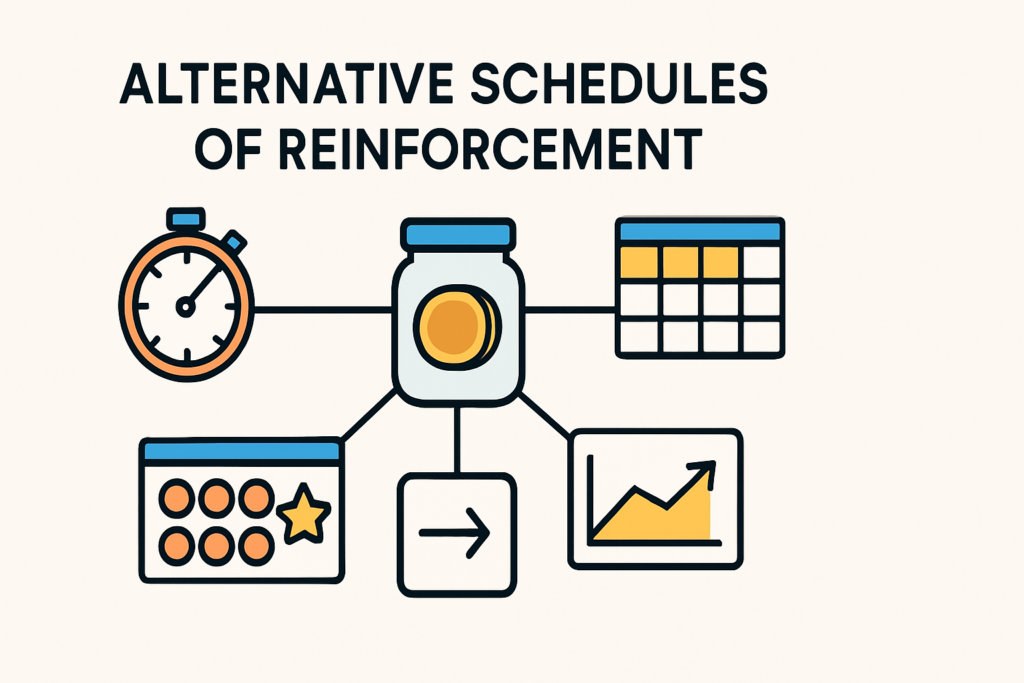
Quick answer: An alternative schedule of reinforcement delivers reinforcement whenever either of two schedule requirements is met — whichever comes first. For example, on an alt FR50 VI 2-min, reinforcement follows the 50th response or the first response after 2 minutes, whichever happens sooner.
An alternative schedule of reinforcement represents a specific type of compound schedule that often appears on the BCBA exam. Understanding this concept requires moving beyond simple schedules like FR or FI to grasp how multiple requirements can operate simultaneously for a single reinforcer.
Table of Contents
- alternative schedules of reinforcement: What is an Alternative Schedule of Reinforcement?
- Applied Examples of Alternative Schedules in ABA
- Alternative Schedules on the BCBA Exam: What to Know
- Quick Reference and Summary
alternative schedules of reinforcement: What is an Alternative Schedule of Reinforcement?
An alternative schedule delivers reinforcement when a response meets the requirement of either of two or more simple schedules that are in effect independently and simultaneously. The key distinction is that only one target behavior and one specific reinforcer are involved, but multiple schedule requirements operate at the same time.
The Basic Rule and How It Differs
Alternative schedules differ from other compound schedules in specific ways. The schedules operate independently, meaning each requirement tracks separately, but reinforcement occurs when either requirement is met first.
- Alternative vs. Concurrent: Concurrent schedules involve choice between two different behaviors for different reinforcers, while alternative schedules involve one behavior with multiple paths to the same reinforcer.
- Alternative vs. Multiple/Mixed: Multiple and mixed schedules involve signaled or unsignaled changes between schedules, not simultaneous operation.
- Alternative vs. Tandem: Tandem schedules require meeting requirements in sequence, not as alternatives.
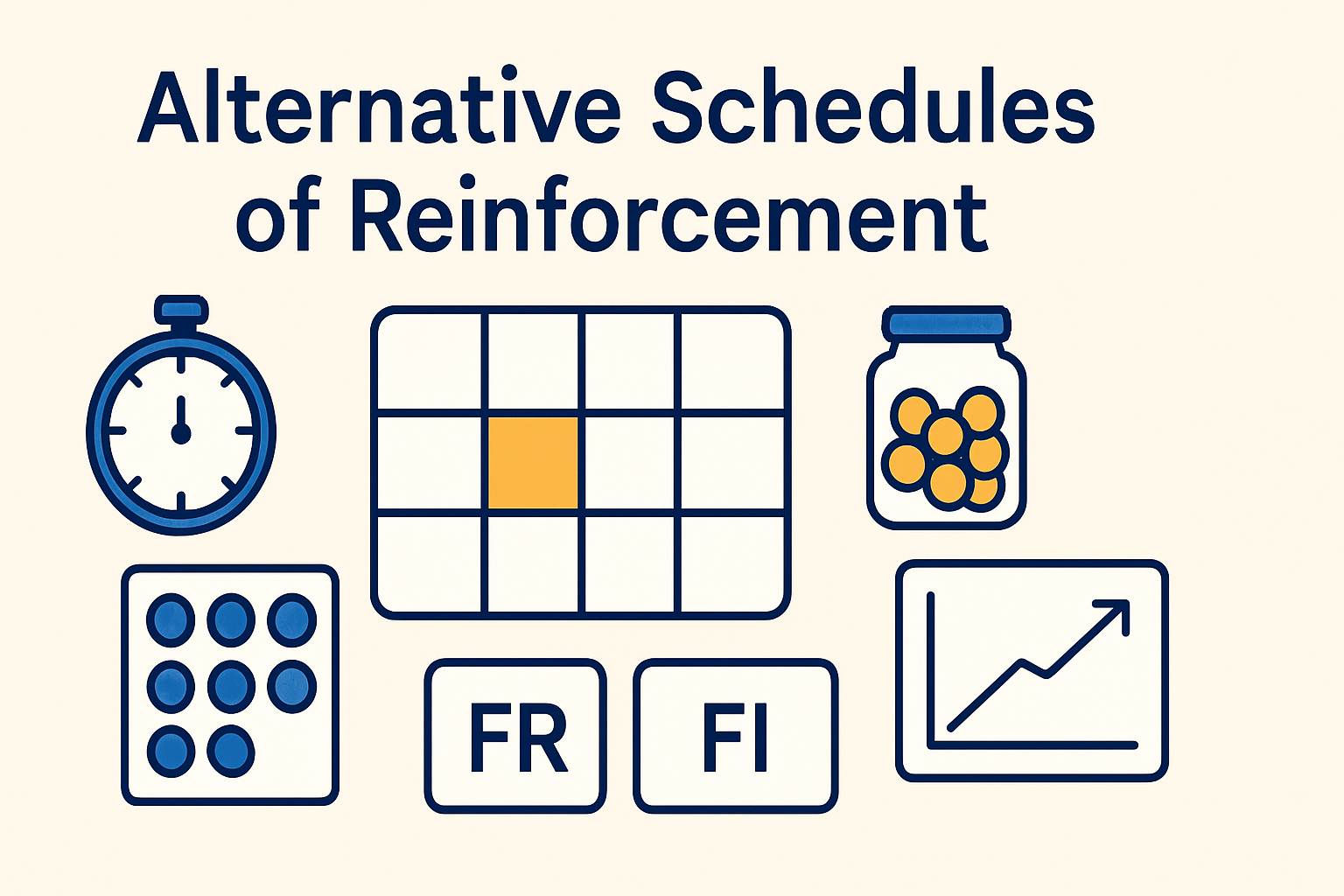
Applied Examples of Alternative Schedules in ABA
Real-world applications help clarify how alternative schedules function in practice. These examples demonstrate the behavioral effects and practical implementation of this schedule type.
Example 1: Academic Engagement with VR or FI
A student can earn a 5-minute break after completing either 10 math problems (VR 10) OR after working continuously for 5 minutes (FI 5-min), whichever comes first. The antecedent is difficult math work, the behavior is either completing problems or persisting through time, and the consequence is escape from work via a break.
The hypothesized function is negative reinforcement (escape from aversive academic demands). Data patterns might show bursts of rapid problem-solving followed by periods of minimal responding as the time requirement approaches.
Example 2: Vocational Task Completion with FR or DRO
An adult in a vocational setting earns a token (exchangeable for a preferred item) for either assembling 5 widgets (FR 5) OR for going 2 minutes without engaging in hand-mouthing (DRO 2-min). The target behavior is either productive work or absence of stereotypy.
The hand-mouthing likely serves automatic reinforcement functions. This alternative schedule might increase vocational productivity while simultaneously reducing stereotypy, as both paths lead to the same reinforcer. For more on reinforcement fundamentals, see our guide on reinforcement in ABA.
Alternative Schedules on the BCBA Exam: What to Know
Exam questions often test your ability to distinguish alternative schedules from other compound schedules. Common question formats present scenarios where multiple schedule requirements exist for a single behavior and reinforcer.
Common Exam Traps and How to Avoid Them
Several pitfalls consistently trip up candidates on this topic. Being aware of these common errors can improve your exam performance.
- Confusing alternative with concurrent: Remember that concurrent schedules involve choice between different behaviors for different reinforcers, while alternative involves one behavior with multiple paths to one reinforcer.
- Missing simultaneous operation: Both schedule requirements must be active at the same time, not sequentially.
- Overlooking single reinforcer: Alternative schedules always involve one specific reinforcer, not multiple different ones.
- Forgetting independent tracking: Each requirement tracks separately until either is met.
Practice Application Prompts
Test your understanding with these exam-style scenarios. For each, determine if it describes an alternative schedule and explain why.
Scenario 1: A child earns screen time after either completing 3 worksheets OR sitting appropriately for 10 minutes during circle time. This is an alternative schedule because one reinforcer (screen time) follows either of two simultaneously operating requirements.
Scenario 2: A client can choose between completing sorting tasks for tokens or completing assembly tasks for the same tokens. This describes a concurrent schedule, not alternative, because different behaviors lead to the same reinforcer through choice.
Alternative vs Conjunctive Schedules
- Alternative — reinforcement when either requirement is met (whichever is first).
- Conjunctive — reinforcement only when both requirements are met.
Both are compound schedules — combinations of two or more basic schedules. They differ from concurrent schedules (two schedules available at the same time for two different responses) and from chained/mixed/multiple schedules. For the full family, see our compound schedules guide and the schedules of reinforcement overview.
Put this to the test
Practice items like this under real exam conditions with our free BCBA mock exam — instant scoring and rationales.
Quick Reference and Summary
Mastering alternative schedules requires systematic identification. Use this checklist to quickly determine if a scenario involves this schedule type.
Alternative Schedule Identification Checklist
- One target behavior or response class is specified
- One specific reinforcer follows meeting requirements
- Two or more schedule requirements (e.g., FR X, FI Y) are active simultaneously
- Meeting either requirement produces reinforcement
- Requirements operate independently but concurrently
Alternative schedules represent a powerful tool for behavior analysts, allowing flexible reinforcement pathways while maintaining clear contingencies. Understanding this concept is essential for both exam success and effective practice. For more on related concepts, explore our guide on compound vs. simple schedules and the official BACB glossary for standardized definitions.



