

Integrating Cultural Variables ABA: What Does ‘Integrating Cultural Variables’ Really Mean
Task F.2 requires BCBAs to integrate cultural variables throughout the assessment process. This goes beyond ethical checkboxes to become a core analytical skill that shapes every assessment decision.
Table of Contents
- Integrating Cultural Variables ABA: What Does ‘Integrating Cultural Variables’ Really Mean
- Putting Theory into Practice: Worked Examples for Task F.2
- Task F.2 on the BCBA Exam: What They’re Really Testing
- Your Action Plan: The Cultural Variables Integration Checklist
- Summary and Key Takeaways
When we talk about cultural variables in ABA, we’re referring to observable and measurable factors that influence behavior. These aren’t abstract concepts but functional variables that can serve as antecedents, setting events, or motivating operations.
Defining Cultural Variables in an ABA Context
Cultural variables include family structure norms, communication styles, values regarding help-seeking, religious practices, and community expectations. These factors can function as setting events that alter the value of consequences or as discriminative stimuli that signal available reinforcement.
The BACB Ethics Code explicitly addresses this in Code 1.07 (Cultural Responsiveness and Diversity) and Code 4.07 (Incorporating and Addressing Contextual Variables). These codes require behavior analysts to consider how cultural factors influence assessment validity and intervention effectiveness.
Why F.2 is Non-Negotiable for Accurate Assessment
Ignoring cultural variables leads to faulty functional hypotheses and ineffective interventions. A culturally blind approach assumes universal behavioral principles apply identically across all contexts, while a culturally responsive assessment recognizes how cultural variables modify behavioral functions.
Consider these critical differences:
- Culturally blind assessment uses standardized procedures without adaptation
- Culturally responsive assessment modifies methods based on cultural variables
- Ignoring culture leads to misidentified behavioral functions
- Integrating culture enhances assessment validity and social validity

Putting Theory into Practice: Worked Examples for Task F.2
Let’s examine concrete scenarios showing how cultural variables impact assessment steps from interviews to functional analysis.
Example 1: Family Hierarchy and Functional Interview Data
Scenario: A child shows ‘non-compliance’ during therapy sessions. Standard interview questions might ask about parental responses to behavior, but miss the cultural variable of extended family authority.
In many cultures, grandparents hold significant decision-making power. A revised, culturally-informed interview would include questions about:
- Who makes decisions about the child’s daily routine?
- How are behavioral expectations communicated across generations?
- What role do extended family members play in discipline?
The functional hypothesis might reveal that deference to grandparents serves as a setting event for escape-maintained behavior when therapists don’t acknowledge this hierarchy. This understanding transforms assessment from ‘non-compliance’ to culturally-mediated escape behavior.
Example 2: Communication Styles and ABC Observation
Scenario: A client avoids eye contact during sessions. Without cultural awareness, a BCBA might interpret this as non-engagement or disrespect, potentially leading to incorrect functional hypotheses about escape or attention functions.
In many cultures, direct eye contact with authority figures is considered disrespectful. The cultural variable here functions as a motivating operation that alters the reinforcing value of different consequences.
Reframing the ABC data:
- Antecedent: Therapist requests eye contact (culturally inappropriate demand)
- Behavior: Client looks away (culturally appropriate response)
- Consequence: Therapist persists (inadvertent punishment of appropriate behavior)
The true function may be avoidance of perceived disrespect rather than escape from task demands. This distinction dramatically changes assessment conclusions and intervention planning.
Task F.2 on the BCBA Exam: What They’re Really Testing
The exam tests your ability to recognize when cultural variables should influence assessment decisions and how to modify procedures accordingly.
Common Exam Traps and How to Avoid Them
Watch for these common mistakes:
- Choosing efficiency over cultural fit: Selecting standardized assessments that ignore client values
- Confusing variables with products: Mistaking cultural variables for permanent product measures
- Assuming assimilation: Thinking ‘integration’ means changing the client’s culture
- Overgeneralizing: Applying cultural knowledge without individual assessment
To identify correct answers, look for options that demonstrate cultural humility, adaptation of methods, and consideration of how cultural factors might alter behavioral functions.
Sample Practice Prompts
1. During a functional assessment interview, a family mentions that multiple generations live together and decisions are made collectively. How should the BCBA modify the assessment?
A. Proceed with standard interview questions about parental responses only
B. Include questions about decision-making across all household members
C. Recommend the family adopt nuclear family structure for consistency
D. Focus only on the primary caregiver’s observations
Correct answer: B. This demonstrates integration of the cultural variable of collective decision-making into assessment procedures.
2. A client from a culture where direct eye contact is discouraged shows this pattern during sessions. The BCBA’s initial hypothesis is escape-maintained behavior. What should they consider?
A. The cultural variable may be functioning as a motivating operation
B. Eye contact avoidance is always escape behavior
C. Cultural factors are irrelevant to functional assessment
D. The client needs training in appropriate social skills
Correct answer: A. The cultural norm alters the motivating operation and should be considered in functional analysis.
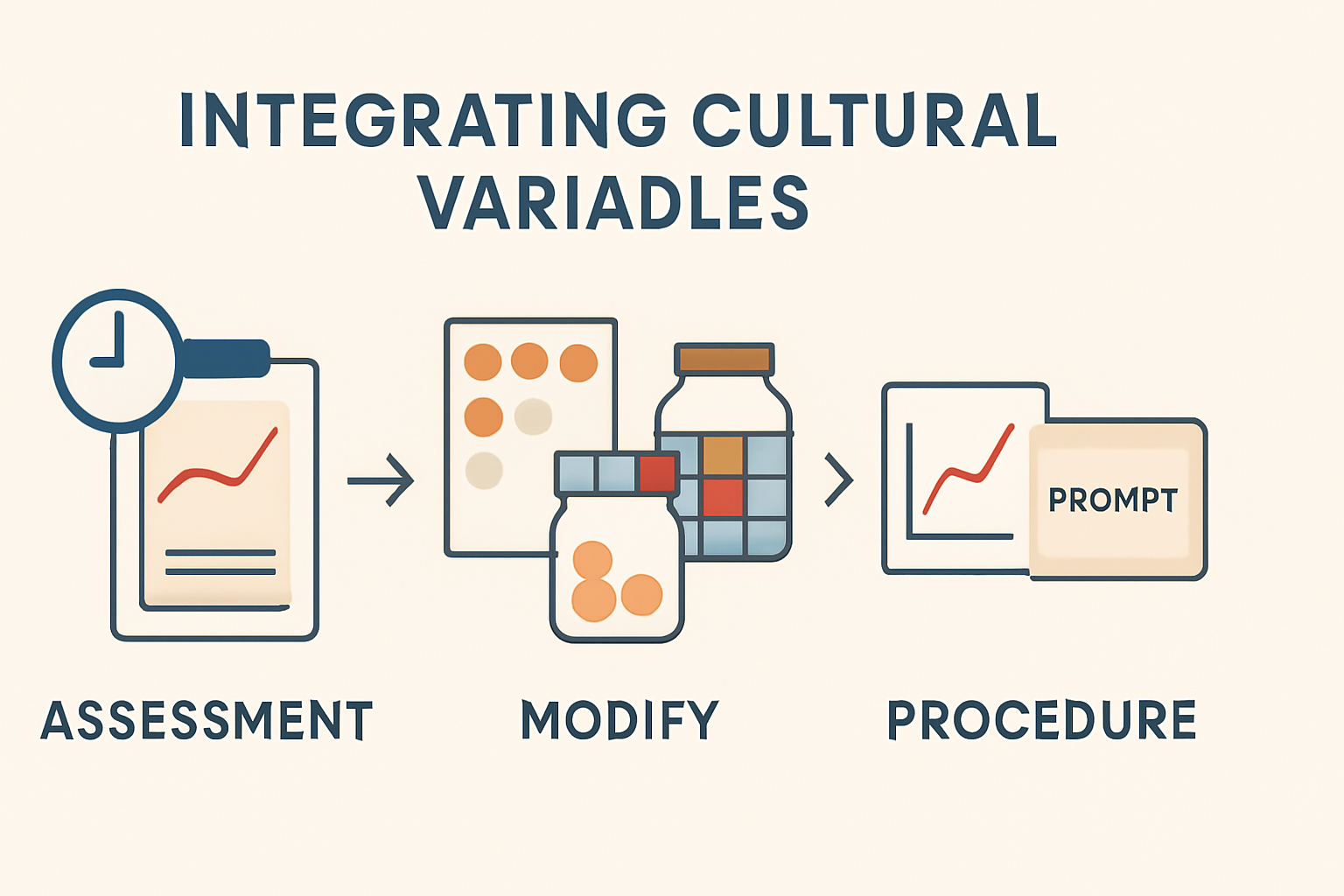
Your Action Plan: The Cultural Variables Integration Checklist
Use this practical checklist to ensure you’re addressing Task F.2 in every assessment:
- Conduct cultural interviews before formal assessment begins
- Identify potential cultural variables that might function as setting events
- Modify assessment questions to include extended family and community influences
- Consider how cultural norms might alter behavioral function hypotheses
- Validate assessment methods with the client and family for social validity
- Document cultural considerations in assessment reports and hypotheses
- Seek consultation when cultural variables present assessment challenges
- Continuously evaluate how cultural factors influence assessment data interpretation
This checklist helps operationalize the abstract concept of cultural integration into measurable assessment practices. For more on assessment fundamentals, see our guide on assessment in ABA.
Summary and Key Takeaways
Integrating cultural variables in ABA assessment is not optional—it’s essential for ethical practice and accurate behavioral analysis. Task F.2 requires BCBAs to move beyond awareness to active integration of cultural factors throughout assessment.
Key points to remember:
- Cultural variables are functional, measurable factors that influence behavior
- These variables can serve as setting events, motivating operations, or discriminative stimuli
- Failure to integrate culture leads to invalid assessments and ineffective interventions
- The BCBA exam tests practical application, not just theoretical knowledge
- Use systematic approaches like the checklist above to ensure cultural responsiveness
By mastering Task F.2, you enhance both your exam performance and your clinical effectiveness. For additional exam preparation strategies, explore our BCBA exam study framework and review the ethics in ABA practice guide.
Remember that cultural integration is an ongoing process of learning and adaptation. The BACB provides additional resources on cultural responsiveness in their ethics codes, and peer-reviewed literature offers evidence-based approaches to culturally responsive assessment.



