

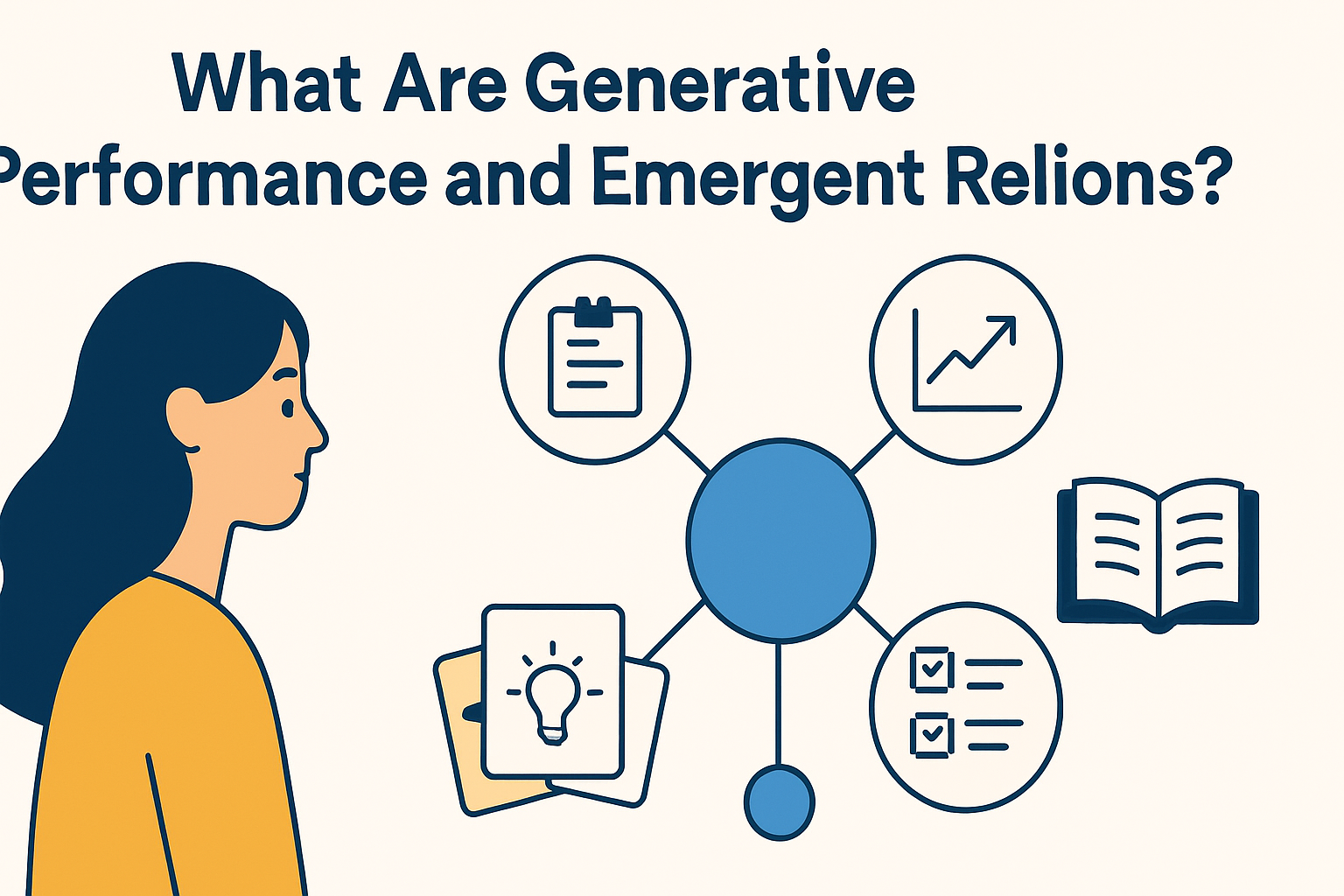
Generative Performance Emergent Relations: What Are Generative Performance and Emergent Re
Understanding generative performance and emergent relations is essential for BCBA candidates tackling Domain B content. These concepts represent advanced behavioral phenomena where learning extends beyond direct training.
Table of Contents
- Generative Performance Emergent Relations: What Are Generative Performance and Emergent Re
- Generative Performance and Emergent Relations in Practice: ABA Examples
- BCBA Exam Relevance and Common Traps
- Quick-Study Checklist and Summary
- References
They demonstrate how behavior can become flexible and creative rather than just rote repetition of taught responses.
Defining Generative Performance in Behavior Analysis
Generative performance occurs when a learner combines previously mastered skills to produce novel, untrained behaviors. This isn’t simple generalization—it’s the recombination of elements to create something new.
Think of language development: a child taught individual words later combines them into original sentences they’ve never heard before. This behavioral creativity shows true mastery beyond direct instruction.
Key characteristics include:
- Novel combinations of learned elements
- Untrained applications in new contexts
- Evidence of conceptual understanding rather than rote memorization
- Spontaneous emergence without additional teaching
Understanding Emergent Relations and Stimulus Equivalence
Emergent relations refer to untrained relationships between stimuli that develop after teaching other relationships. This forms the basis of stimulus equivalence, a fundamental concept in relational frame theory.
When you establish certain trained relations, other relations emerge without direct teaching. This occurs through three properties:
- Reflexivity: Matching a stimulus to itself (A=A)
- Symmetry: If A→B is taught, B→A emerges (bidirectional)
- Transitivity: If A→B and B→C are taught, A→C emerges
These properties combine to form equivalence classes where stimuli become functionally interchangeable. This differs from derived relational responding, which involves more complex contextual control.
Generative Performance and Emergent Relations in Practice: ABA Examples
Seeing these concepts in action makes them much clearer. Here are practical examples from real ABA scenarios.
Example 1: Generative Play Skills
A child was taught discrete play actions: pushing a toy car and making a figure jump. During free play, they independently combined these to create a novel narrative: “The superhero jumps over the moving car.”
ABC analysis shows:
- Antecedent: Access to toys and no specific instructions
- Behavior: Novel combination of taught actions into story
- Consequence: Automatic reinforcement from novel sensory experience
This demonstrates generative performance—the child wasn’t taught this specific sequence but created it from mastered components.
Example 2: Emergent Math Relations
A learner was taught to match quantity ‘3’ to numeral ‘3’ (A-B) and quantity ‘3’ to a set of three dots (A-C). Without additional teaching, they demonstrated matching between numeral ‘3’ and the three dots (B-C).
This shows stimulus equivalence through transitivity. The trained relations created an equivalence class where all three stimuli became functionally equivalent.
The emergent relation demonstrates true conceptual understanding of ‘threeness’ rather than rote matching skills.
Example 3: Generative Social Communication
A client was taught specific mands (“I want juice”) and tacts (“That’s red”). During a peer interaction, they spontaneously commented: “Your red shirt looks nice with your blue pants.”
Analysis reveals:
- Antecedent: Peer wearing red shirt and blue pants
- Behavior: Novel, socially appropriate comment combining color tacts
- Consequence: Social attention and peer smile
This generative language shows how separate verbal operants can combine to create novel, functional communication. For more on verbal behavior concepts, see our guide to verbal operants.
BCBA Exam Relevance and Common Traps
Domain B content represents approximately 8-10% of the BCBA exam. Questions test your ability to identify, analyze, and apply these concepts in various scenarios.
How Domain B is Tested
Exam questions typically fall into these categories:
- Identification questions: Recognizing examples of generative performance vs. emergent relations
- Application questions: Selecting interventions that promote generativity
- Analysis questions: Determining which emergent relation property is demonstrated
- Differentiation questions: Distinguishing these concepts from generalization or maintenance
You’ll need to understand how these concepts relate to other areas like stimulus and response generalization.
Pitfalls to Avoid on Test Day
Common mistakes include:
- Confusing generativity with generalization: Generalization involves performing learned behavior in new contexts; generativity creates new behaviors
- Misidentifying relation types: Mixing up symmetry (bidirectional) and transitivity (chaining)
- Over-applying terms: Calling simple mastered performance “generative” when no novel combination occurs
- Missing contextual cues: Failing to notice when stimuli are in different modalities or contexts
- Ignoring prerequisite skills: Forgetting that strong component skills are needed for generativity
Remember that true emergent relations require no additional teaching—they should appear spontaneously after establishing the trained relations.
Quick-Study Checklist and Summary
Use this checklist to review your understanding before the exam:
- Define generative performance as novel combination of learned skills
- Identify three properties of stimulus equivalence: reflexivity, symmetry, transitivity
- Differentiate emergent relations from derived relational responding
- Recognize real-world examples in play, academic, and social domains
- Apply correct terminology when analyzing behavioral scenarios
- Avoid common confusions with generalization and simple mastery
- Connect to broader concepts like equivalence classes and relational frames
Generative performance and emergent relations represent advanced learning outcomes in ABA. They demonstrate true conceptual understanding and behavioral flexibility beyond rote memorization.
Mastering these concepts requires recognizing when novel behaviors emerge from component skills and understanding how stimulus relationships can become bidirectional and transitive. For comprehensive exam preparation, explore our BCBA exam prep guide.
These principles show the power of behavior analysis to create flexible, adaptive behavior rather than just teaching specific responses. They’re essential for designing effective interventions that promote independence and problem-solving skills.



