

Understanding the BCBA 6th Edition Concepts and Principles is essential for any candidate preparing for certification. This foundational section of the Task List represents the language of behavior analysis, and mastery here directly impacts your performance across all exam domains. Without a solid grasp of these core principles, you’ll struggle to analyze scenarios, select appropriate interventions, and demonstrate the analytical thinking required for certification.
Table of Contents
- BCBA 6th Edition Concepts and Principles: Why Concepts and Principles Are the Foundation o
- Key Concepts and Principles Demystified
- Seeing the Principles in Action: Worked ABA Examples
- Exam Relevance and Common Candidate Traps
- Your Quick-Review Checklist for Concepts and Principles
- Summary: Building Your Analytical Foundation
BCBA 6th Edition Concepts and Principles: Why Concepts and Principles Are the Foundation o
Section A of the 6th Edition Task List serves as the bedrock upon which all other applied knowledge is built. These concepts aren’t just isolated terms to memorize—they form the analytical framework you’ll use throughout your career.
The Role of Section A in the 6th Edition Task List
This section carries significant weight in exam construction. Questions derived from these fundamental principles appear throughout the test, often disguised within complex scenarios. A shaky foundation here creates cascading difficulties in later sections like assessment and intervention.
From Jargon to Application: What You Really Need to Know
Memorizing definitions isn’t enough. You must develop the skill to identify principles in action within real-world scenarios. The exam tests your ability to recognize how these concepts manifest in behavior patterns and treatment decisions.
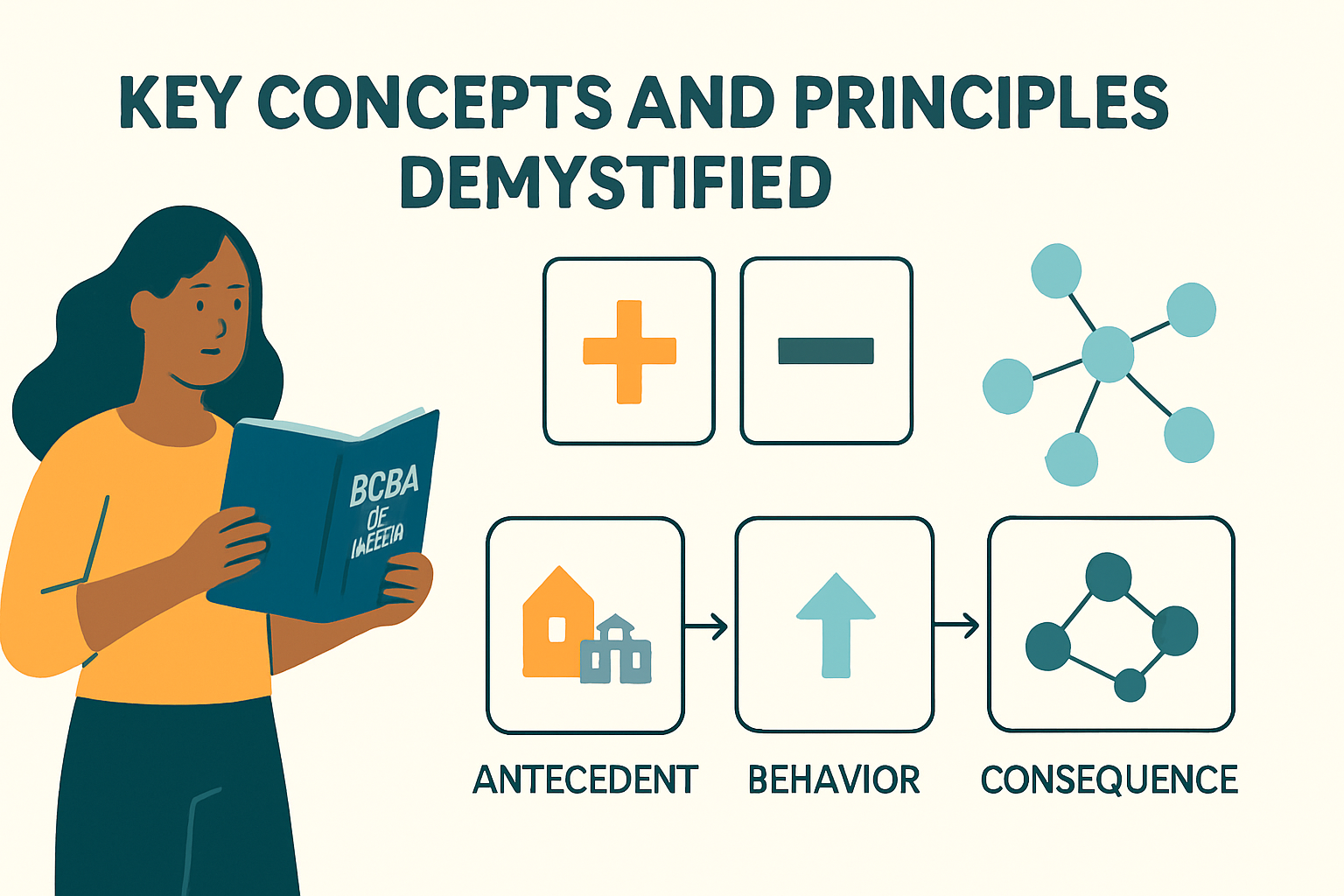
Key Concepts and Principles Demystified
Let’s break down the most frequently tested principles with clear, exam-focused definitions.
The Reinforcement and Punishment Quadrant: Beyond the Basics
The four-term contingency forms the core of behavioral analysis. Remember that positive and negative refer to stimulus addition or removal, not value judgments.
- Positive reinforcement: Adding a stimulus to increase future behavior
- Negative reinforcement: Removing a stimulus to increase future behavior
- Positive punishment: Adding a stimulus to decrease future behavior
- Negative punishment: Removing a stimulus to decrease future behavior
The critical element is always the future effect on behavior. For more detailed examples of these principles, see our guide on positive vs negative punishment.
Stimulus Control, Generalization, and Discrimination
These interrelated concepts govern how behavior transfers across contexts. Stimulus control occurs when behavior is more likely in the presence of specific antecedents. Generalization refers to behavior occurring under similar but not identical conditions, while discrimination involves responding differently to distinct stimuli.
Motivating Operations: The Game Changer
Motivating operations alter the effectiveness of reinforcers and change behavior frequency. Distinguish between establishing operations (EOs) that increase reinforcer value and abolishing operations (AOs) that decrease it. Remember that MOs affect value, while discriminative stimuli (SDs) signal availability. For a deeper dive into this critical distinction, explore our SD vs MO comparison guide.
Seeing the Principles in Action: Worked ABA Examples
Applying concepts to realistic scenarios develops the analytical skills you need for exam success.
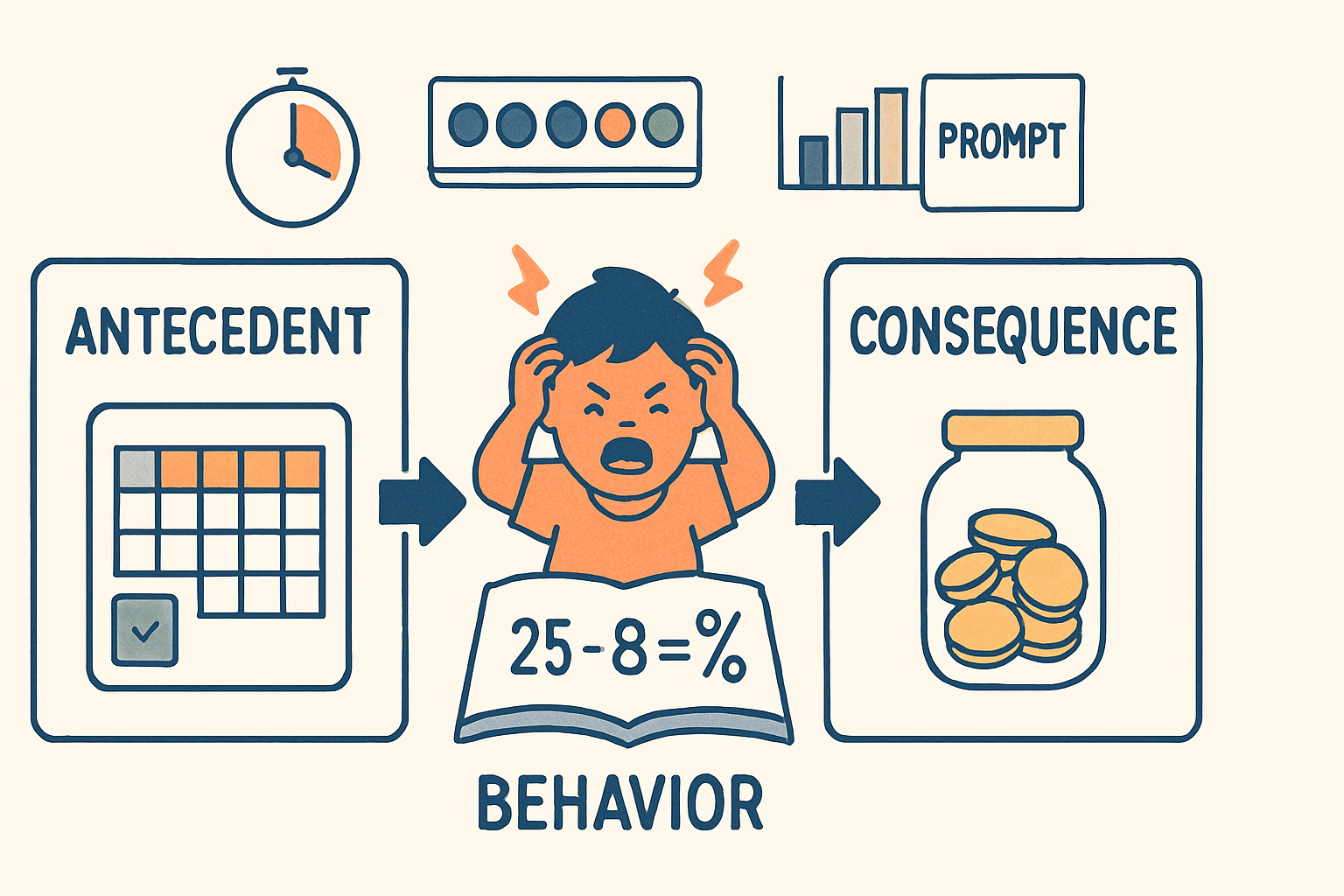
Example 1: Escape-Maintained Behavior and Negative Reinforcement
Consider a child who engages in tantrums during difficult math work. The antecedent is the challenging task (an EO for escape). The behavior is the tantrum, and the consequence is task removal. This demonstrates negative reinforcement—removing an aversive stimulus increases future tantrum behavior.
Example 2: Attention-Seeking and Stimulus Control
A student calls out answers only when the teacher is nearby. The teacher’s presence serves as an SD signaling that attention is available. The calling-out behavior is reinforced by teacher attention, demonstrating stimulus control. This pattern shows how behavior becomes specific to certain environmental conditions.
Exam Relevance and Common Candidate Traps
Understanding how these concepts are tested helps you avoid common pitfalls.
Trap 1: Confusing the ‘Positive/Negative’ with ‘Good/Bad’
This fundamental error costs candidates valuable points. Remember that positive means addition and negative means removal, regardless of whether the consequence seems desirable. Reinforcement always increases behavior; punishment always decreases it.
Trap 2: Misidentifying Motivating Operations
Candidates often confuse MOs with discriminative stimuli. An EO changes reinforcer value (makes you want something more), while an SD signals availability (tells you something is available if you act). Both are antecedents but serve different functions.
How These Concepts Are Tested
Expect questions that require you to identify operative principles in brief scenarios. Common stems include: “Which principle is demonstrated?” “What is the most likely function?” and “Identify the MO in this situation.” These test your analytical application rather than rote memorization.
Your Quick-Review Checklist for Concepts and Principles
Use this checklist to ensure you’ve covered all essential elements before exam day.
- Define all four reinforcement/punishment types without hesitation
- Distinguish between MOs and SDs in any given scenario
- Identify stimulus control patterns in behavior examples
- Explain generalization and discrimination with clear examples
- Recognize establishing vs abolishing operations
- Apply the ABC framework to analyze behavioral functions
- Connect principles to real-world intervention strategies
For additional practice with these concepts, consider using our BCBA mock exam resources to test your understanding.
Summary: Building Your Analytical Foundation
Mastery of Section A concepts provides the analytical lens through which you’ll view all subsequent applied work. These principles form the language of behavior analysis, enabling you to communicate precisely, analyze effectively, and intervene appropriately. Your investment in understanding these fundamentals pays dividends not only on exam day but throughout your career as a behavior analyst.
Remember that the BACB Task List organizes these concepts deliberately, building from basic principles to complex applications. By mastering this foundation, you create a stable platform for all advanced study and practice. For official information about these concepts, refer to the BACB 6th Edition Task List and supporting resources from ABAI.



