
Time-Based Reinforcement Schedules vs NCR ABA is explained with practical steps and examples.
Time-Based Reinforcement Schedules vs NCR ABA: Core Definitions: Contingency, Time, and Noncontingency
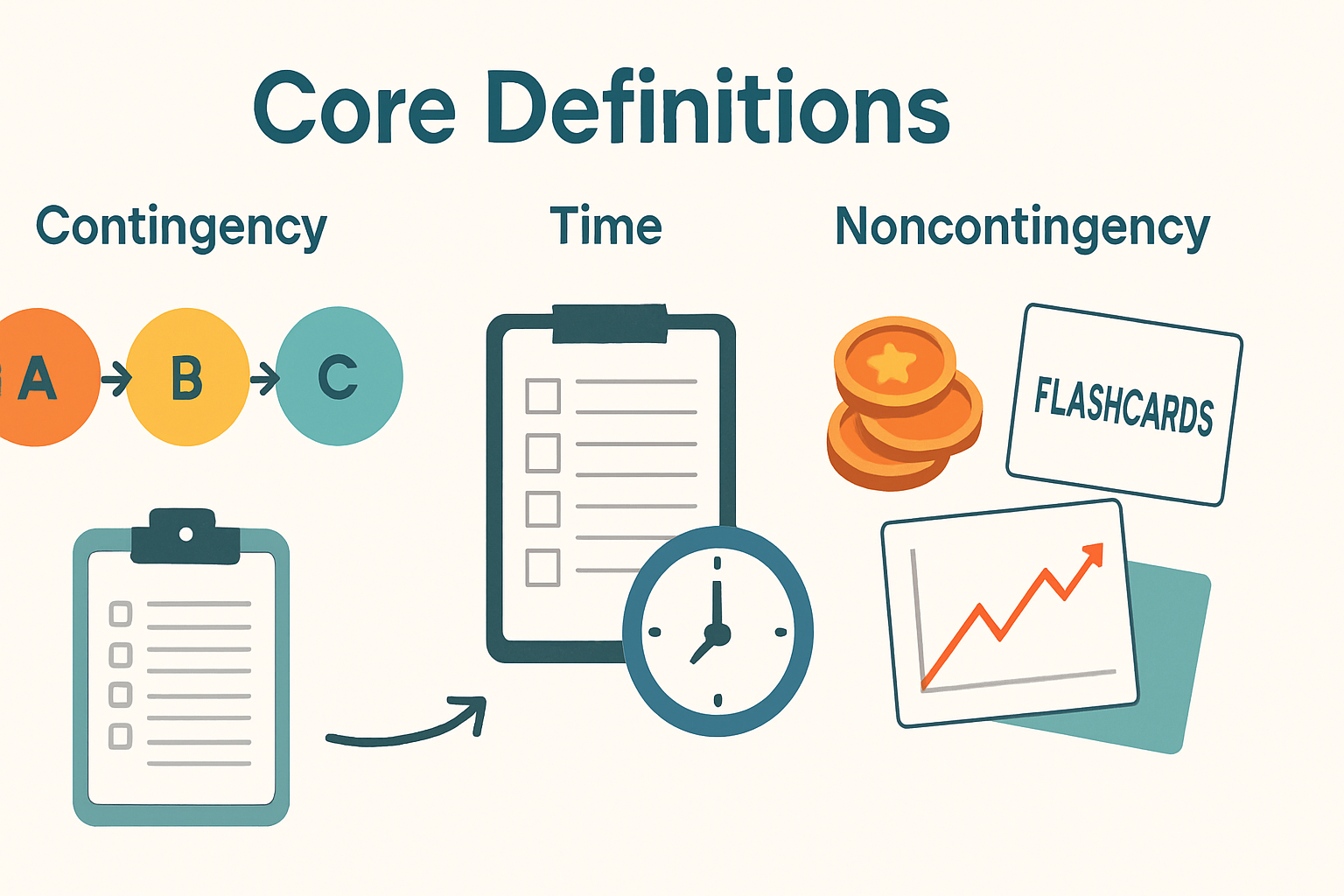
Understanding the fundamental distinction between time-based reinforcement schedules and Noncontingent Reinforcement (NCR) begins with grasping the concept of contingency. In applied behavior analysis, a contingency refers to the if-then relationship between behavior and consequence. This relationship is what separates these two important intervention strategies.
Time-based schedules maintain a contingent relationship where reinforcement depends on behavior occurring after specific time intervals. NCR, in contrast, breaks this contingency by delivering reinforcement independent of behavior. This foundational difference drives their distinct applications in clinical practice and their different effects on behavior.
What Defines a Time-Based Reinforcement Schedule?
Time-based reinforcement schedules involve interval schedules where reinforcement becomes available only after a specific time period has elapsed. The two primary types are Fixed-Interval (FI) and Variable-Interval (VI) schedules. In both cases, reinforcement is contingent upon the first target behavior that occurs after the time requirement has been met.
With Fixed-Interval schedules, the time requirement remains constant. For example, in an FI-5 minute schedule, reinforcement becomes available exactly five minutes after the previous reinforcement. Variable-Interval schedules use an average time interval that varies unpredictably. A VI-3 minute schedule might deliver reinforcement after 1 minute, then 5 minutes, then 3 minutes, averaging to 3 minutes.
The critical element is that reinforcement depends on both time passage and behavior occurrence. This creates the characteristic scalloped pattern of responding where behavior increases as the interval end approaches, then drops immediately after reinforcement. Understanding these patterns is essential for effective behavior programming.
What is Noncontingent Reinforcement (NCR)?
Noncontingent Reinforcement represents an antecedent intervention strategy where reinforcement is delivered on a time-based schedule regardless of the target behavior’s occurrence. The term noncontingent literally means ‘not contingent upon’ – reinforcement delivery is independent of any specific behavior.
NCR functions primarily by abolishing motivating operations for problem behavior. By providing free access to the reinforcer that maintains problem behavior, NCR reduces the establishing operation that makes that behavior valuable. This approach is particularly effective for behaviors maintained by automatic reinforcement or when immediate behavior reduction is critical for safety.
The delivery schedule in NCR typically starts with a rich schedule (frequent delivery) that is gradually thinned to a more practical maintenance schedule. Unlike time-based reinforcement schedules, NCR does not aim to strengthen alternative behaviors but rather to reduce the motivation for problem behavior by satiating the individual with the reinforcer.
Applied Distinction: Worked Examples from Assessment to Intervention
Moving beyond theoretical definitions, practical application reveals how these strategies function differently in real-world settings. Each example demonstrates how assessment data drives intervention selection and how implementation differs between contingent and noncontingent approaches.
Example 1: Escape-Maintained Behavior and NCR (Break Schedule)
Consider a student who engages in task refusal and property destruction during academic work sessions. Functional assessment reveals these behaviors are maintained by escape from demands. The BCBA implements NCR by providing noncontingent breaks on a fixed-time schedule.
Every 3 minutes, regardless of work completion or problem behavior, the student receives a 30-second break. This approach reduces the aversive properties of work by providing predictable escape opportunities. Importantly, breaks are not contingent on any behavior – they occur whether the student works appropriately or engages in problem behavior.
As problem behavior decreases, the BCBA might introduce a Differential Reinforcement component, teaching the student to request breaks appropriately. However, the initial NCR intervention focuses on reducing the establishing operation for escape rather than teaching new skills. This contrasts with time-based schedules where breaks would only follow appropriate work completion after specific intervals.
Example 2: Attention-Seeking and a VI Schedule for Praise
A child frequently interrupts adults with inappropriate comments during conversations. Assessment indicates this behavior is maintained by adult attention. The BCBA teaches the child to raise their hand quietly as an appropriate attention-seeking behavior.
The intervention uses a Variable-Interval 2-minute schedule for reinforcement. After teaching the hand-raising response, the adult provides attention contingent on hand-raising, but only after variable time intervals averaging 2 minutes. This creates a maintained contingency where reinforcement depends on both time passage and the appropriate behavior.
This approach differs fundamentally from NCR, where attention would be delivered noncontingently on a time schedule regardless of the child’s behavior. The VI schedule maintains the hand-raising behavior while reducing interruptions by making reinforcement unpredictable but contingent on appropriate behavior.
Example 3: The Critical Difference in a Classroom Setting
Imagine two classroom scenarios that highlight the operational distinction. In Classroom A, a student receives a token every 5 minutes regardless of work completion – this is NCR. The tokens are delivered noncontingently, independent of any specific behavior.
In Classroom B, a student receives a token for the first completed problem after 5 minutes have elapsed – this is FI-5 minute. Here, reinforcement is contingent on both time passage and work completion. The token delivery depends on the student engaging in the target behavior after the interval ends.
The likely effects differ significantly. NCR may reduce escape-motivated behaviors by providing predictable reinforcement, but it typically does not increase work completion. The FI schedule, however, creates the characteristic scalloped pattern where work completion increases as the 5-minute mark approaches. Understanding these differential effects is crucial for effective intervention planning.
BCBA Exam Relevance and Common Conceptual Traps
This distinction appears frequently on the BCBA exam, testing candidates’ ability to differentiate between contingent and noncontingent procedures. Mastery requires not just memorization but conceptual understanding of how these strategies function differently.
Mapping to the BCBA Task List
Several Task List items relate directly to this topic. Section G-14 (Use reinforcement) requires understanding different reinforcement schedules. Section D-5 (Use antecedent interventions) covers NCR as an antecedent strategy. Section G-7 (Define and provide examples of schedules of reinforcement) specifically addresses interval schedules.
Additionally, Section F-7 (Conduct functional assessments) connects to understanding when to select NCR versus other interventions based on function. The BACB’s official task list provides the complete framework for these competencies.
Top 3 Exam Traps to Avoid
First, candidates often confuse ‘time-based’ with ‘noncontingent.’ Remember: all NCR uses time-based delivery, but not all time-based delivery is NCR. The critical distinction is whether reinforcement is contingent on behavior.
Second, many mistakenly believe NCR strengthens behavior. Actually, NCR is designed to reduce problem behavior by abolishing motivating operations, not to increase alternative behaviors. Reinforcement strengthening requires contingency.
Third, misidentifying schedules in scenarios is common. A quick self-check: Ask ‘Does reinforcement depend on a specific behavior occurring after the time interval?’ If yes, it’s a time-based schedule; if no, it’s NCR. Practice distinguishing these through targeted practice questions.
Clinical Decision-Making: When to Choose Which Strategy
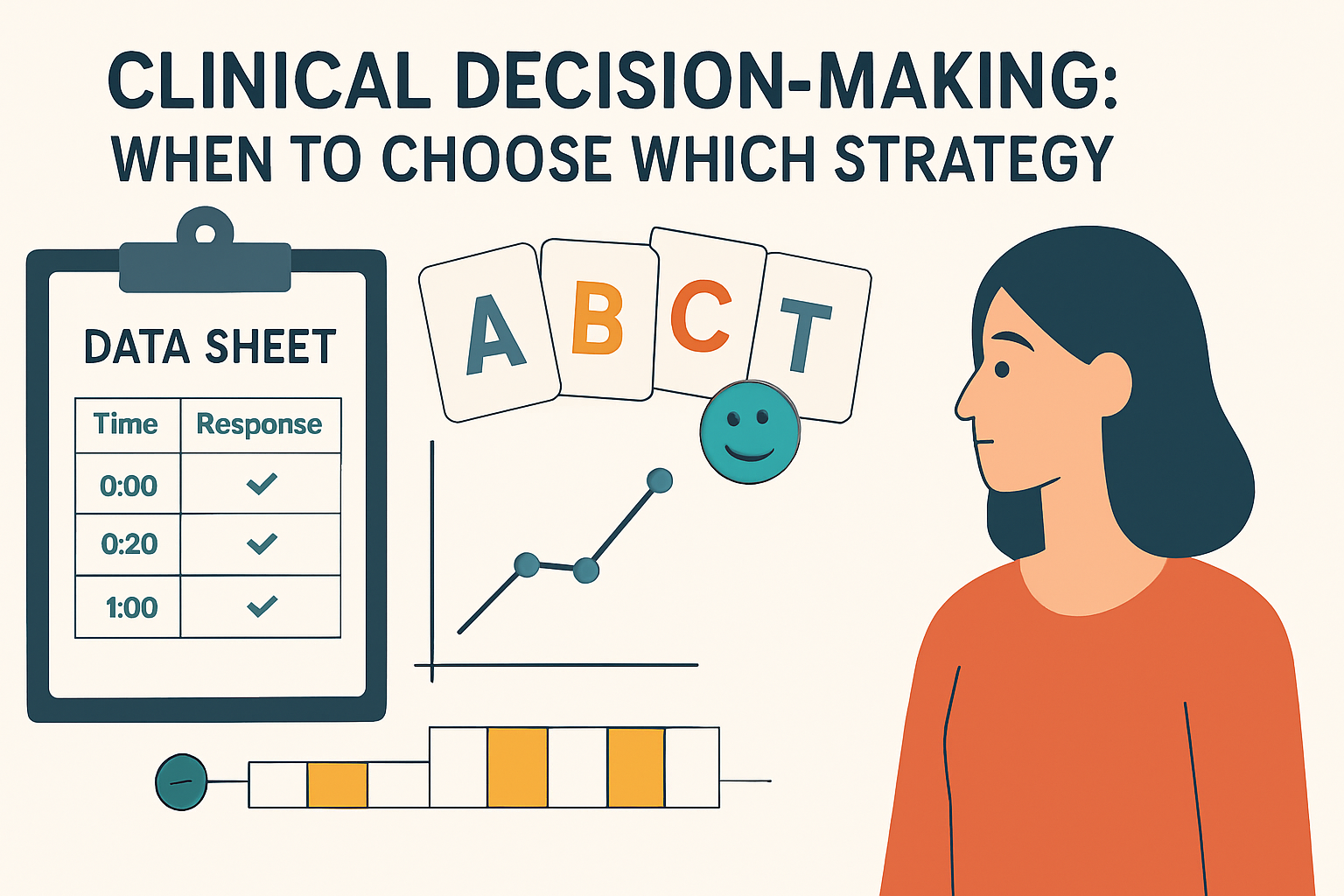
Selecting between time-based reinforcement schedules and NCR requires systematic decision-making based on assessment data, client characteristics, and intervention goals. The following framework guides this clinical decision process.
Begin with a functional behavior assessment to identify the maintaining variables. For behaviors maintained by automatic reinforcement or when immediate reduction is critical for safety, NCR may be the initial choice. The noncontingent delivery of the reinforcer reduces the establishing operation without requiring alternative behavior.
When the goal is to increase or maintain a specific behavior, time-based reinforcement schedules are appropriate. These schedules create predictable patterns of responding and can be used to build behavioral momentum. Consider client history with reinforcement and current skill level when selecting interval parameters.
For escape-maintained behaviors, NCR can provide immediate relief by delivering breaks noncontingently. However, this should typically be combined with or followed by teaching functional communication for breaks. The time-based schedule might then be used to maintain the communication response.
Attention-maintained behaviors present another decision point. NCR can reduce problem behavior by providing noncontingent attention, but this may not teach appropriate attention-seeking. A VI schedule for appropriate attention-seeking behaviors often provides a better long-term solution by maintaining the alternative behavior.
Consider schedule thinning requirements for both approaches. NCR schedules typically start rich and are thinned gradually as problem behavior decreases. Time-based schedules may also require thinning but maintain the contingent relationship throughout the process.
Finally, evaluate practical considerations including staff training, implementation fidelity, and environmental constraints. NCR often requires more frequent reinforcement delivery initially, while time-based schedules may produce characteristic response patterns that require monitoring and adjustment.
By systematically applying this decision framework, BCBAs can select the most appropriate strategy based on empirical evidence and client needs, ensuring effective intervention outcomes while preparing thoroughly for exam scenarios that test these critical distinctions.



