


What is Response Maintenance? The Core Definition for BCBAs
In applied behavior analysis, response maintenance refers to the continued performance of a learned behavior after the initial teaching procedures have been discontinued. This concept is crucial for BCBAs because it represents the ultimate goal of intervention: skills that persist over time without ongoing support. When we talk about response maintenance, we’re specifically addressing whether a behavior continues to occur after reinforcement schedules have been thinned or eliminated entirely.
It’s essential to distinguish maintenance from the acquisition phase of learning. During acquisition, behaviors are being taught using intensive prompting and reinforcement. Maintenance occurs after these teaching procedures have been systematically faded. The behavior analyst must carefully plan for maintenance by gradually reducing support while ensuring the behavior remains strong and functional.
Response Maintenance vs. Stimulus Generalization: Don’t Mix Them Up
Many BCBA exam candidates confuse response maintenance with stimulus generalization, but these are distinct concepts. Response maintenance focuses on behavior persisting over time after teaching stops. In contrast, stimulus generalization refers to behavior occurring in new settings, with different people, or in response to novel stimuli. A common exam trap involves questions that describe a skill being used in a new environment – this tests generalization, not maintenance.
To remember the difference: maintenance is about temporal persistence (time), while generalization is about stimulus variation (settings/people). Both are important outcomes, but they require different programming strategies. On the BCBA exam, carefully read whether the scenario emphasizes time passing after intervention or behavior occurring in novel situations.
Response Maintenance in Action: Worked ABA Examples
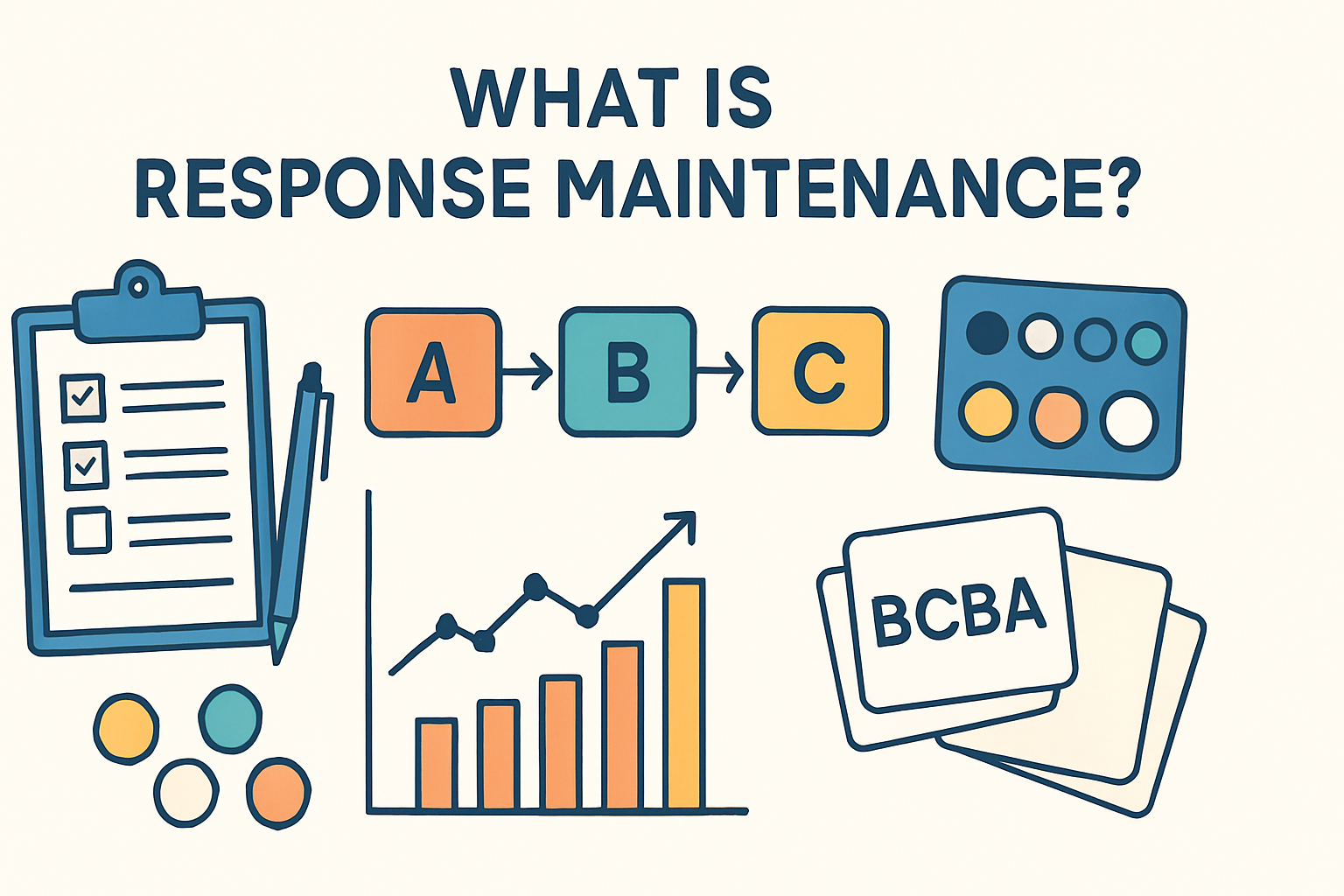
Understanding response maintenance requires seeing it in practice. These real-world examples demonstrate how maintenance is measured and why it might fail, using the ABC data format that BCBAs rely on for analysis. Each example highlights different factors that influence whether skills persist over time.
Example 1: Maintaining Manding Skills in a Preschool Setting
Consider a 4-year-old child who learned to mand for preferred items using a picture exchange system. During intensive teaching, the therapist provided immediate reinforcement (access to the requested item) for every correct mand. After 8 weeks of daily sessions, the teaching procedures were faded, and data collection continued for maintenance.
ABC data from week 12 shows: Antecedent – Child sees preferred toy on shelf; Behavior – Child picks up “toy” picture card and hands it to teacher; Consequence – Teacher says “Great asking!” and gives toy. The thin reinforcement schedule (intermittent praise plus access) maintains the skill. However, if maintenance data shows declining mands, we might hypothesize that the function (access to tangibles) isn’t sufficiently reinforced in the natural environment.
Example 2: Self-Management Skills for an Adult Client
An adult client with executive functioning challenges learned to use a self-monitoring checklist for on-task behavior at work. During intervention, a therapist prompted checklist use every 30 minutes and provided social reinforcement. After 6 weeks, prompts were faded to once daily, then eliminated entirely.
Maintenance data collected 3 months post-intervention reveals: Antecedent – Client begins a challenging work task; Behavior – Client independently completes checklist items; Consequence – Client experiences satisfaction and task completion. Potential competing contingencies (escape from difficult tasks) could undermine maintenance if the checklist becomes associated with aversive work demands rather than self-management success.
Response Maintenance on the BCBA® Exam: What to Expect
The BCBA exam frequently tests understanding of response maintenance through scenario-based questions. These questions typically present data showing behavior patterns over time and ask you to identify whether maintenance has occurred or what strategies would promote it. Being able to distinguish maintenance from other behavioral concepts is essential for exam success.
Exam questions often include graphs showing behavior trends across phases. You’ll need to interpret whether behavior remains stable after intervention withdrawal (maintenance) or declines (lack of maintenance). Some questions present multiple-choice options about programming strategies, requiring you to select the most appropriate approach for promoting long-term skill persistence.
Common Exam Traps and How to Avoid Them
Several predictable traps appear on BCBA exam questions about response maintenance. First, confusing maintenance with generalization – remember that maintenance involves time, while generalization involves novel stimuli. Second, selecting “continuous reinforcement” as a maintenance strategy – continuous reinforcement actually promotes acquisition, not maintenance.
Another common trap involves failing to identify a lack of maintenance in a scenario. The exam might present data showing skill decline after intervention ends, testing whether you recognize this as a maintenance failure rather than generalization or stimulus control issue. Always check whether the scenario emphasizes time passage versus environmental changes.
Programming for Maintenance: A Quick Clinical Checklist
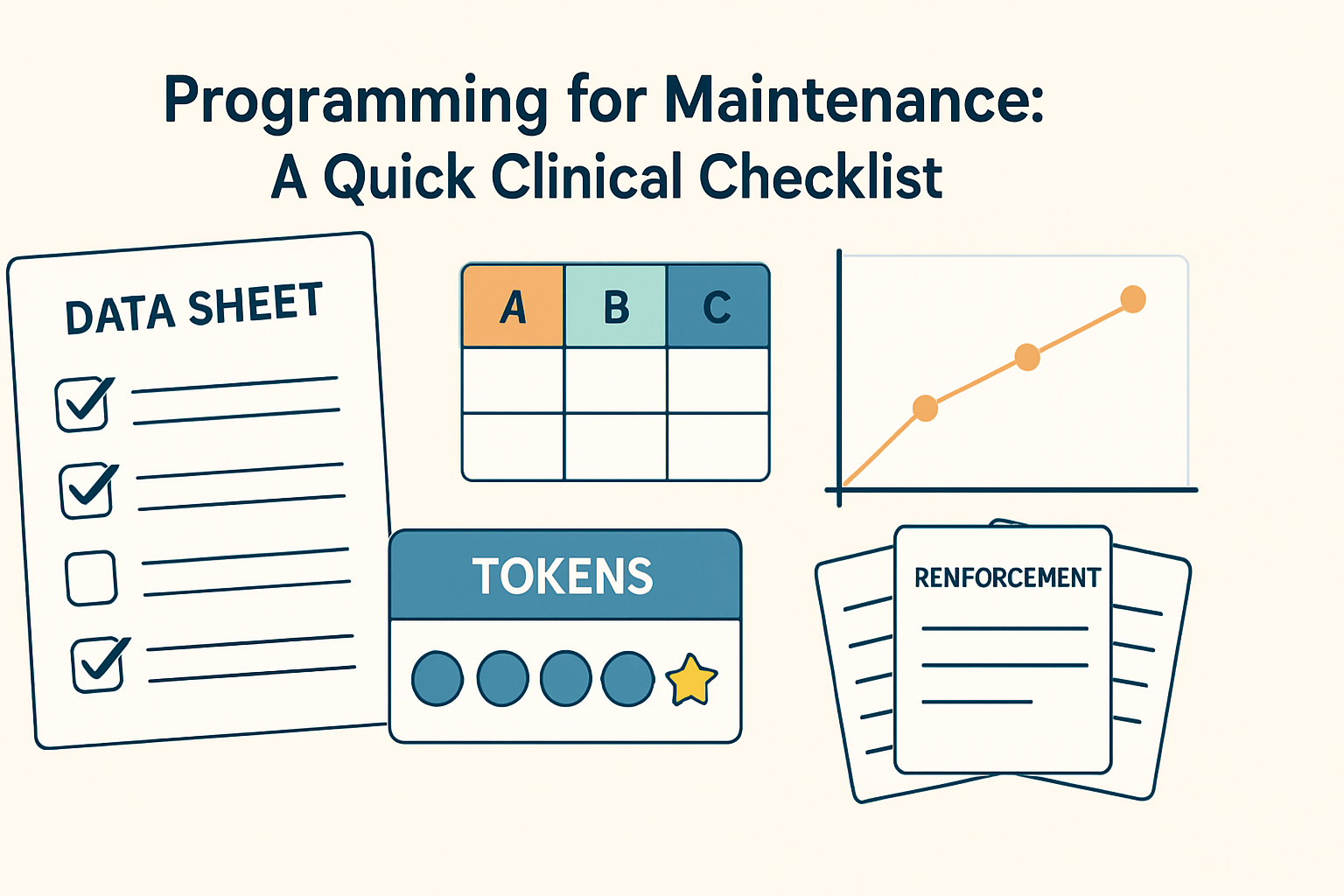
Effective response maintenance requires intentional programming from the beginning of intervention. Use this clinical checklist when planning any skill acquisition program to ensure skills will persist over time. These strategies are based on established behavioral principles and research evidence.
- Plan maintenance from the start – Don’t wait until skills are mastered to think about maintenance. Build maintenance strategies into your initial intervention plan.
- Use intermittent reinforcement schedules – Gradually thin reinforcement from continuous to variable schedules that mimic natural contingencies.
- Program common stimuli – Include elements from the natural environment during teaching to facilitate maintenance.
- Teach self-management skills – Equip clients with strategies to monitor and reinforce their own behavior.
- Involve natural change agents – Train parents, teachers, or peers to support and reinforce the behavior.
- Conduct maintenance probes – Schedule regular checks to assess whether skills persist without intervention.
- Address competing contingencies – Identify and modify environmental factors that might undermine maintenance.
For more detailed planning tools, see our guide on behavior intervention plans that incorporate maintenance strategies from the beginning.
Key Takeaways for Your Studies
Mastering response maintenance concepts is essential for both BCBA exam success and effective clinical practice. Remember these critical points when studying this topic:
- Response maintenance means behavior persistence over time after teaching stops – it’s about temporal durability, not environmental variation.
- Maintenance requires intentional programming – skills won’t automatically persist without planned reinforcement thinning and environmental support.
- Distinguish maintenance from generalization – exam questions often test this distinction, so practice identifying whether scenarios emphasize time or setting changes.
- Use data to evaluate maintenance – maintenance probes and ongoing data collection are essential for determining whether skills persist.
- Address competing contingencies – Environmental factors that reinforce alternative behaviors can undermine maintenance if not identified and modified.
For additional study resources on related concepts, explore our articles on stimulus generalization and reinforcement schedules. The BACB Task List also provides official guidance on maintenance-related competencies required for certification.
Response maintenance represents the ultimate test of effective intervention: skills that continue to benefit clients long after formal teaching ends. By understanding these principles and applying systematic maintenance programming, you’ll be prepared for both exam questions and real-world clinical challenges.


