
What Are Preference Assessments and Why Are They Critical?
Preference assessments are systematic procedures used in applied behavior analysis to identify stimuli that an individual is likely to select when given choices. These assessments help practitioners identify potential reinforcers that can be used to increase desired behaviors during intervention programs. The fundamental purpose is to determine what items, activities, or interactions an individual prefers, which provides valuable information for developing effective reinforcement systems.
In ABA practice, preference assessments are critical because they move beyond assumptions about what might be reinforcing. Without systematic assessment, practitioners risk using ineffective reinforcers that won’t maintain behavior change. For the BCBA exam, understanding preference assessments is essential as they represent a core competency in behavior assessment and intervention planning. The BACB Task List specifically includes items related to identifying potential reinforcers through preference assessments.
These assessments serve multiple functions: they help establish reinforcement hierarchies, inform individualized programming, and ensure ethical practice by using preferred items rather than imposing arbitrary consequences. When preparing for the BCBA exam, you’ll need to distinguish between different assessment types and understand when to apply each procedure based on client characteristics and assessment goals.
Core Types of Preference Assessments
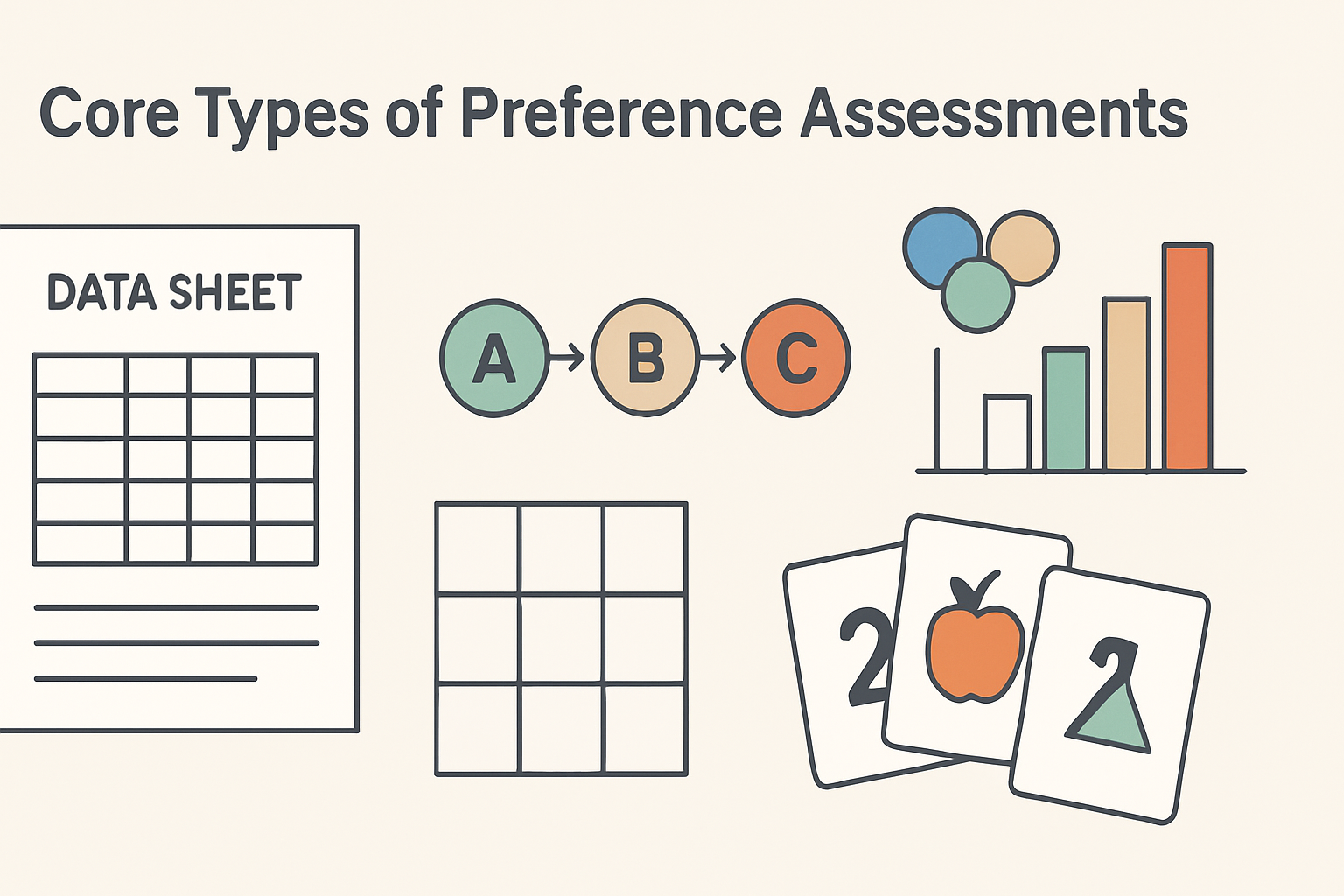
Preference assessments fall into two main categories: free operant observations and trial-based methods. Each approach has distinct procedures and applications that BCBA candidates must understand for both clinical practice and exam success. The selection of assessment type depends on factors like client skills, available time, and the specificity of data needed.
Free Operant Observations: Identifying Natural Choices
Free operant observations involve presenting multiple items simultaneously and recording which items the individual approaches and engages with. The key characteristic is that there is no response requirement – the individual can freely interact with any available items. Data is typically collected on duration of engagement or frequency of approaches to each stimulus.
This method is particularly useful as an initial assessment or with individuals who may have difficulty with more structured procedures. There are two main variations: naturalistic observations conducted in the individual’s typical environment, and contrived observations where items are systematically arranged. Free operant assessments provide valuable information about relative preferences without the demands of structured trials.
Trial-Based Methods: Structured Comparisons
Trial-based methods involve presenting items in structured formats and recording selections. The single-item assessment presents one item at a time and records engagement, while the paired-choice assessment (also called forced-choice) presents two items simultaneously and records which is selected. The multiple-stimulus assessment presents several items at once, with two main variations: MSWO (multiple stimulus without replacement) and MSW (multiple stimulus with replacement).
In MSWO procedures, selected items are removed from subsequent presentations, creating a clear preference hierarchy. In MSW procedures, all items remain available throughout the assessment. These methods provide more precise data about relative preference and are particularly useful when you need to establish a clear reinforcement hierarchy for intervention planning.
Applying Assessments: Worked Examples for BCBAs
Understanding preference assessment procedures is essential, but applying them to real scenarios is where true mastery occurs. These worked examples demonstrate how different assessments function in practice and how to interpret the resulting data for intervention planning.
Example 1: MSWO for Tangible Reinforcers
Consider a 7-year-old child named Alex who is learning communication skills. You conduct an MSWO assessment with five tangible items: bubbles, puzzle, ball, tablet, and stickers. You present all five items simultaneously and record Alex’s selection. He chooses the tablet first, so you remove it and present the remaining four items. He selects bubbles next, then ball, then puzzle, and finally stickers.
The resulting preference hierarchy shows tablet as most preferred, followed by bubbles, ball, puzzle, and stickers as least preferred. This data suggests that access to tangibles (particularly electronic items) may function as a powerful reinforcer for Alex. You could use this information to develop a reinforcement system where tablet time is earned for completing communication trials. For more on reinforcement systems, see our guide on effective reinforcement strategies.
Example 2: Paired-Choice for Social Interactions
For a teenager named Sam who is working on social skills, you conduct a paired-choice assessment to identify preferred social activities. You create pairs of potential social interactions: high-five vs. fist bump, conversation about movies vs. conversation about sports, playing a board game vs. playing cards. You present each pair multiple times in randomized order.
Data analysis reveals Sam consistently selects fist bumps over high-fives and prefers conversations about movies over sports. This information helps create a social reinforcement menu that incorporates Sam’s preferences. You can use preferred social interactions as natural reinforcers during social skills training, increasing the likelihood that Sam will engage in target behaviors.
Preference Assessments on the BCBA Exam: What to Know
The BCBA exam tests your ability to select appropriate assessment methods, interpret results, and apply findings to intervention planning. Understanding common exam traps and having a decision-making framework will significantly improve your performance on preference assessment questions.
Common Exam Traps and Misconceptions
Several misconceptions frequently lead to incorrect answers on the BCBA exam. First, many candidates confuse preference with reinforcer efficacy – just because someone prefers an item doesn’t guarantee it will function as a reinforcer. Second, misidentifying assessment types is common, particularly confusing MSW with MSWO procedures based on whether items are replaced.
Another common error is selecting an assessment that doesn’t match the client’s skill level or response capabilities. For example, recommending a complex paired-choice assessment for a client with limited attending skills. Finally, many candidates fail to consider assessment efficiency when time is limited in the scenario description. The exam often presents scenarios where you must balance thoroughness with practicality.
Quick-Selection Checklist for Practitioners
Use this decision-making framework to select appropriate preference assessments:
- Start with free operant observations for initial screening or with clients who have difficulty with structured demands
- Use single-item assessments when you need to determine if specific items are preferred individually
- Choose paired-choice assessments when you need precise comparison data between specific items
- Select MSWO procedures when you need to establish a clear preference hierarchy from multiple items
- Consider client characteristics including attention span, motor skills, and response capabilities
- Factor in time constraints and assessment efficiency requirements
This framework aligns with best practices outlined in the professional literature on preference assessment methodology.
Key Takeaways and Next Steps for Mastery
Mastering preference assessments requires understanding both the procedures and their practical applications. Key points to remember include: preference assessments identify potential reinforcers, not guaranteed ones; different assessment types serve different purposes; and selection should consider client characteristics and assessment goals.
For BCBA exam preparation, focus on being able to: identify assessment types from descriptions, select appropriate assessments based on scenario details, interpret assessment results, and apply findings to intervention planning. Practice with scenario-based questions that require you to make these clinical decisions.
To deepen your understanding, review the behavior assessment section of our study materials and practice applying different assessment methods to varied client profiles. Remember that preference assessments are dynamic – preferences can change over time, so regular reassessment is part of ethical, effective practice. By mastering these concepts, you’ll be well-prepared for both the BCBA exam and clinical application of these essential assessment procedures.



